RAPS is short for Regional Animal Protection Society, a registered charity and operator of a sanctuary which houses and cares for nearly 500 homeless or abandoned cats in Richmond, BC, Canada. The Neko Files is a celebration of the sanctuary and all those who live and work there.
Showing posts with label Zanda*. Show all posts

Thursday, August 5, 2021

Creston and Banff

From Kitty Comforter Pauline Chin:

Creston & Banff
This pair journeyed all the way from Alberta where they lived in a hoarder’s house with many other animals.  Being leukemia kitties, they had no place to go, so it’s off to the Sanctuary to join the FeLV+ cats and their playground.

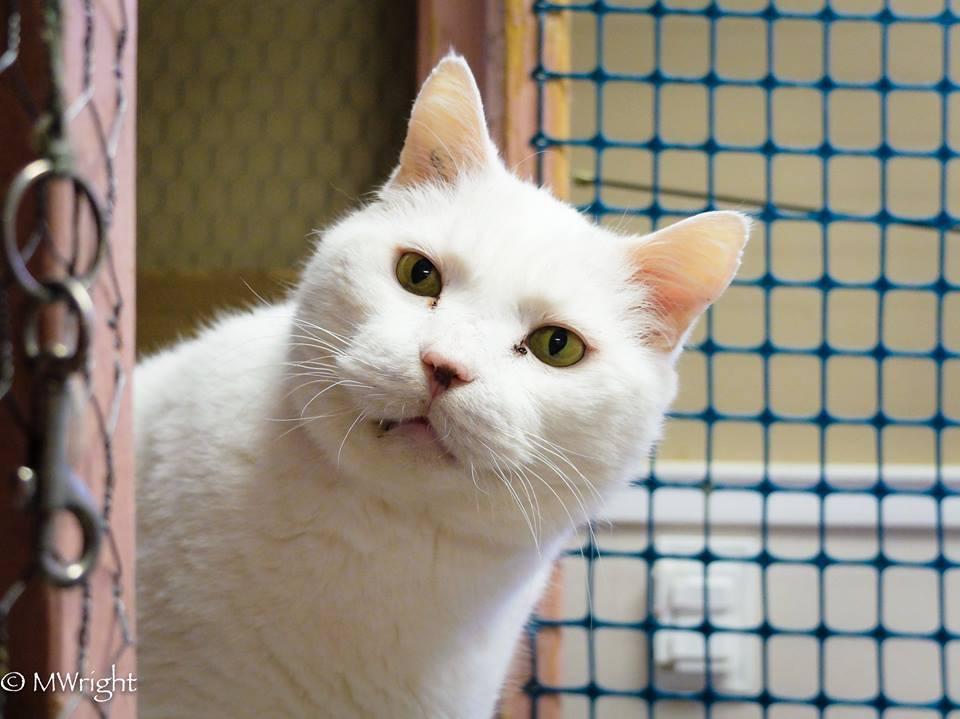
Creston
Cats from hoarder homes are mystery packages.  We don’t know what sort of handling, or socialization they’ve had, surprising triggers, or what their of opinion of humans is.  The least we can hope for is a clean bill of health or fast recovery.  Personality quirks are bonus discoveries.

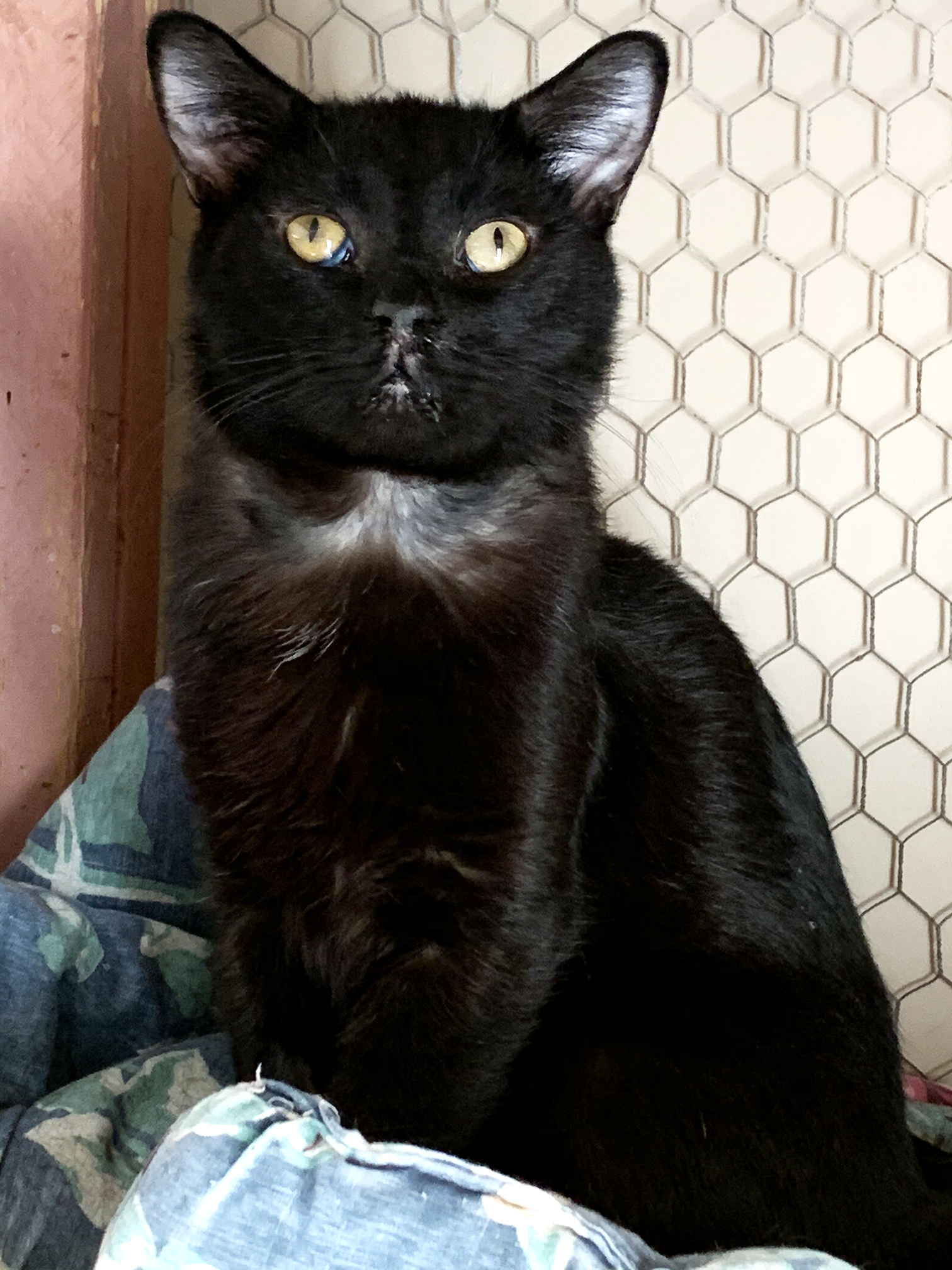
Zanda
Walleyed Creston looks a tad rough around the edges, like the late Zanda.  Despite that, this boy has an unusually cuddly personality.  During the first 2 weeks, he spent his time camping in his tent.  He could be seen randomly gobbling down wet food or treats.  Sometimes, he greeted humans with hisses.  He acts cautious initially because he doesn’t know if your hands are going to poke and prod him or pet him.  Once he’s sure of the latter, he’ll push his head into your hand and insist on head scratches.  


Creston’s quirk is to go roly-poly and nearly tumble off the shelf while being petted.  I can’t tell if he’s looking for the most comfortable spot or if he gets enjoyment out of rolling around, making funny poses.  When he purrs, his front half vibrates.  If he doesn’t want you touching his soft belly, he’ll politely nudge your hand away with his back feet.  No claws involved.

I spent a couple minutes removing a mat from his tail.  Not once did he protest, nor whip his head around like other cats and hiss, “what are you doing, human?!”  Of course, I let him sniff test the mat to see if he was familiar with it.

Every new item in Creston’s cage warrants a sniff, but there’s a lack of engagement in toys.  Perhaps he’s not familiar with playtime?  The other cats will gladly demonstrate the joy of toys for him once he’s out of the cage. 

Banff
Across the way is Banff.  He has a very clean and bright appearance.  Most orange cats have a white muzzle.  Banff’s muzzle is orange and he reminds me of Baby, late Queen of the Moore House.  He still retains his curious kitten looks. Whip out a new toy and watch his eyes grow into saucers.

Banff and his toys
You can often hear toy balls rattling and little feet bouncing around.  He’ll hurry to the front to check out toys and then shy away when your hand starts moving.  He’s touchable, but you have to be sneaky with the petting - using a wand in one hand and petting with the other.  The challenge now is to get him used to touch before his release day.  It would be a tragedy for a youngster like him to spend his time hiding in a corner of the playground.  Quite the opposite of Creston!

Daphne (now adopted)
I predict he’ll be another Daphne - shy in the first month and an attention hog thereafter.  He’s also fond of treats.  It wouldn't be surprising if he started asking for them regularly.  

Anything for me?
Banff has an odd habit of vocalizing when we’re interacting with other cats - they're a mixture of wind-up chirps, coos, meeps, and rolling meows.  Yet, when we turn towards him, he goes silent.  
Banff exploring
The med staff have decided that it's time to let these two face the wider world of the Leukemia kitties, and perhaps make some new friends. 
happy together
Those of us who devoted time to socializing this pint-sized panther and tiny tiger are eager to have them roam their new kingdom.  They’re far from feral and enjoy interactions.  Two quirky new kitties are more than welcome here.


Blog and all photos by Pauline Chin


Monday, December 30, 2019

Remembering Friends

Back Pens - everyone loved  Chatter - MW
At the end of each December, we wish each other a Happy New Year – but we also look back at the year just past and remember the triumphs we've won and the trials we’ve survived.  And especially at the Cat Sanctuary, we’ll remember the cats we’ve lost.
SW - Georgie & her Christmas Mouse - MW
We actually memorialize them in the summer at a pot-luck event held at the Sanctuary and attended by humans and cats alike (it can be a little hard to keep them off the tables!)  And part of the event always includes the reading of the names of the cats who have passed in the previous year – a moment that is named for raggedy Chance who got a second chance of life when he came to us. We are reminded of the legend of the Rainbow Bridge, and the cats who are waiting for us to cross as well – and there are always tears and fond memories.
Front - Gilbert, much loved - MW
But remembering Big Personalities who have passed is more common in the media at the turn of the year – so here are just a few of the beloved cats who have been in our care, and have gone on to the Rainbow Bridge.
Moore - Spicer, missed by her buddy Shaggy - MW
In the Moore House, established by and named for our beloved Marianne Moore, most of the cats are seniors (it’s affectionately known as “geriCATrics”), and though we grieve their passing, we know that these are cats who have had their final days with much love from us
Moore - PomPom (BC) & Fluffy (MW) -   both came to us
when they were already seniors
Moore - Jack went from being a cranky aggressive cat
to one who loved being petted - MW
Our FIV+ cats may not ever develop full-blown AIDS, but many of them have lived feral, rough lives before they came to us, and their bodies are more fragile than in the general population
NewAids - Mr Moochie - BC
NewAids - Achilles - MW
The FeLV (feline leukemia) cats’ fragile immune systems mean that we tend them with great care for cleanliness. Of the cats we’ve lost this year, two stand out for me:
OA - Zanda loved to come and cuddle - PH

OA - Cleo was disabled, but gutsy! - MW
Those of us who work in the SingleWide quickly develop our favourites
SW - Zoe was a member of the Dryer Gang - MW
SW - Tammy hated other cats - but loved Shelter Manager Lisa - MW
Some really significant cats in the front courtyard have passed
Brothers Tommy & Pogo were well-loved by everyone - MW
We lost Daniel in 2018; Cloverleaf has gone to be with his buddy - MW
Many of the Double-wide cats who have gone are either seniors (Binky, Deenie) or the cage-top shy ferals (Pixie, Peanut, Mary). The cat that I still subconciously look for is Sativa, whose Manx-Syndrome incontinence brought her to us, and whose human family faithfully visited her every Sunday.
DW - we all got used to cleaning up after Sativa - MW
So many big personalities in small furry bodies in the back courtyard have passed.
PawPaw happily made the transition from an outside pen
to live inside with his buddy Chimo - MW
B/w WobblyBob and his grey buddy Yogi went
within weeks of each other - VL
Terry never let his disability stop him! - PH
And I can’t pass up the chance to memorialize the two I adopted from the Moore house, and had in my care for all too short a time – much loved and not forgotten.
Mr Bojangles and Madame Hooch - MW
Many of these cats came in to us as ferals, and as ferals they would have had short, hard lives. In our care they were loved by staff, volunteers and visitors. Their passing was grieved – but it also left space to accept other homeless cats – ferals, strays, rejects – all of whom are now discovering that life can be good at the Cat Sanctuary.

Blog by Brigid Coult
Photos by Brigid Coult, Phaedra Hardman, Vicki Lo, Michele Wright


Friday, March 24, 2017

Loving the Leukemia Cats

You came to see me?  -  Dexter - MW
Many of our volunteers come arrive faithfully each week to do a shift – often in the same area each time. And in the course of those regular shifts, they get to know some cats really well.  A few of us enjoy the opportunity to dive into different areas off-schedule and get to know less familiar cats, or ones we’ve not seen for a while.
Happy - MW
Last week I covered a shift in the Old Aids area with the leukemia cats.  Old Aids is like coming home for me; I have fond memories of time there with Bella and Bubba, Panther and Jasper – cats who were dearly loved, and have now passed. I remember when the main room was pretty battered, the floor not in great condition, so that the cat-pee smells were impossible to eradicate totally. After one of Doug’s miracle refurbishing sessions, it became much easier to keep it clean, and you will often find volunteers cuddled up in the comfy armchair with a lapful of cats.
Where's dinner? - DW
When you visit an area on a regular basis, you get a different view of it than the one you perceive with less frequent visits.  I was given a very vocal greeting at the door, as usual, by Dexter – letting me know in no uncertain terms that dinner was overdue and he was starving!  The first surprise of the evening was Frodo, though – also anxiously waiting, but as soon as I sat down, he wanted up in my lap. Frodo has been one of the shadow cats for so long – usually hovering on a cage-top or out in the open area. More recently he’s been known to make quick escapes through the door and into the porch area, and he quite enjoys human company. But this is the first time I’ve known him demand cuddles in that way.
Frodo - PH
Much to Dexter’s annoyance, cuddle time came first. Happy was already in the chair, and shifted so I could sit with her. For so long she’s been a very wary little feral, but as she ages, contact with humans is less feared. Eva came up to join us, sitting behind me on the arm of the chair and offering kisses.  Her worried face belies a cat that has settled well with us; she’s not really keen on the other cats, but she tolerates them, and loves petting from volunteers.
Chair snuggles: Eva, Happy, Zanda & Merlin - BC
Zanda woke from his nap and bustled over to join us.  He’s always been a friendly boy and willing to snuggle with his pals; it’s a little worrying to see that he’s a bit more unsteady on his feet now. Merlin perched on the other chair arm and head-butted, wanting attention.
I'm so BOOORED waiting for dinner! - DW
The Dexter-demands were getting louder, so I warmed the cans, scooped the boxes and doled out food – with Dexter helping himself from every plate.  A quick visit next door to the Val Jones cats for the essentials, a few treats and a check that all was well, and then I returned to the main room for some more quality-time.  Shadow/Chateaux appeared for a quick feed, but he’s still very wary around people, though he has his feline cuddle-buddies. I checked the outside area to find Martini and Ooly in their usual hiding places;  Martini just looks down with disdain and rarely responds; Ooly was cosily established under the heat lamp, but later came into the main room for some food and company. She’s interested in humans, but doesn’t really want contact.
Martini hides in the shadows;
Ooly enjoys the warmth  - BC
More armchair time, more cuddles, and chicken tidbits on offer. Bibi is quick to emerge when there’s chicken; she can usually be found high up on a shelf or hiding behind the armchair, but treats take priority and she loses all wariness, ready to put her paws up on a knee to get the best bits.  Not a lap-cat yet, but who knows...
Bibsy - PH
It’s very easy, faced with the number of cats in other areas, to forget about some of these closed-off cats. They are kept separate partly for their own sakes – their immune systems are compromised, which is why it’s so important that we wash before entering their area – and partly for the other cats – feline leukemia is easily transmitted in saliva.  But they are a lovely group, and appreciate visitors who offer attention and cuddling – the favourite thing for so many cats.

Blog by Brigid Coult
Photos: Brigid Coult, Phaedra Hardman, Debbie Wolanski, Michele Wright


Saturday, October 29, 2016

It's always Black Cat Day!

This past 27 October marked Black Cat Day.
Sid having a cat-nap - MW
True cat lovers will tell you that every day is black cat day – but it is unfortunately true that for black cats in a shelter, adoption comes less easily. Sometimes that's in part because it's so hard to take a picture of a black cat - lighting and contrasts become more important than in a cat with other colours, Even a single white spot or streak helps to make the cat more defined, but even in the Sanctuary where we know and love our black cats over years, it's sometimes hard to tell who you're looking at, so you can understand how a shelter cat can become overlooked.

Colin - MW
Superstition may have something to do with it – but superstitions vary enormously from one culture to another, when it comes to black cats.  Going all the way back to ancient Egypt, the view of black cats being favorable creatures is attributed specifically to the Egyptian goddess Bast (or Bastet), the cat goddess. Egyptian households believed they could gain favor from Bastet by hosting black cats in their household.
Chrissie - MW
In some fishing communities, black cats are considered good luck, and fishermen’s wives keep their black cats safely at home, believing that their husbands will be kept safe as well.  We would really like to see all cats kept safe at home – cats allowed outside are more likely to be harmed by traffic, predators or poison.
Zanda - PH
Black cats have often been looked upon as a symbol of evil omens in much Western history, specifically being suspected of being the familiars of witches, and so many Europeans consider the black cat a symbol of bad luck, especially if one crosses paths with a person. But there are also conflicting superstitions:  in Germany, some believe that black cats crossing a person's path from right to left, is a bad omen. But from left to right, the cat is granting favorable times. In the UK it is commonly considered that a black cat crossing a person's path is a good omen.
Beetle - MW
Many shelters hold off on adopting black cats out around Halloween, for fear of people harming them in superstitious rituals.  It actually makes more sense not to be encouraging any adoptions at all until fireworks season is over – a cat in new surroundings is going to be easily spooked by lights and bangs.
Mirror cats - MW
At the Sanctuary, we’re happily crossing paths with black cats all the time. Volunteers know that many of our black cats are accomplished cuddlers with awesome purrsonalities. It does take time to get to know them and tell them apart, of course, but that’s time well spent!
Ninja lives up to his name - MW


Blog by Brigid Coult
Photos by Brigid Coult, Phaedra Hardman, Michele Wright

Monday, July 5, 2010

Zanda


Zanda came to RAPS back in 2002 when his mom, Sky, was brought in with her kittens. The other kittens were adopted, but nobody took the black one. When Leslie told me this as she introduced me to Zanda last month, she didn't sound too surprised. And she shouldn't be. Not because there's anything wrong with Zanda - he's lovely, by the way - but because black cats are classically the hardest to adopt out.


Just Google "black cats" + "adoptions" and you'll come up with a number of articles posted by various humane societies in North America talking about how the adoption rates for black cats are lower than those with other colours and markings. The old idea of black cats being bad luck is given as one reason, but superstition takes a back seat to the idea that they simply lack distinguishing features. People feel they don't easily stand out from other black cats, that's they're less unique than an animal with clearly identifiable markings, or even just that it's "harder to see expression in a dark face." [1]

Even among new volunteers at the sanctuary, the number of black cats wandering around the front courtyard alone can be a bit overwhelming when it comes to making friends. It's too easy to mentally apply of generic label of "black shorthair" to many of them and leave it at that.

But - spend a little time getting to know one of them, and the personality soon starts to shine through any notion of generic labelling. Take Zanda: still on the shy side even after being at shelter for the past 8 years (again, how many people target one of the multitude of black cats to be the object of affection and target of socialization?), he's quite comfortable around Leslie and will contentedly allow himself to be stroked by others... particularly while Leslie's nearby to keep his confidence up.