RAPS is short for Regional Animal Protection Society, a registered charity and operator of a sanctuary which houses and cares for nearly 500 homeless or abandoned cats in Richmond, BC, Canada. The Neko Files is a celebration of the sanctuary and all those who live and work there.
Showing posts with label Silky-A. Show all posts

Tuesday, June 2, 2020

....aaaand.... ACTION!

In every area of the Sanctuary, there are boxes or pots filled with cat-toys.
Tyson chomps on a commercial toy - KN
And I think most cat-owners are probably in the same space – we think “I’ve not been playing enough with Chonky; I’ll get him some new toys”, and he plays with them for a bit, and then they go under the couch or behind the fridge, or wherever, nevermore to be used.
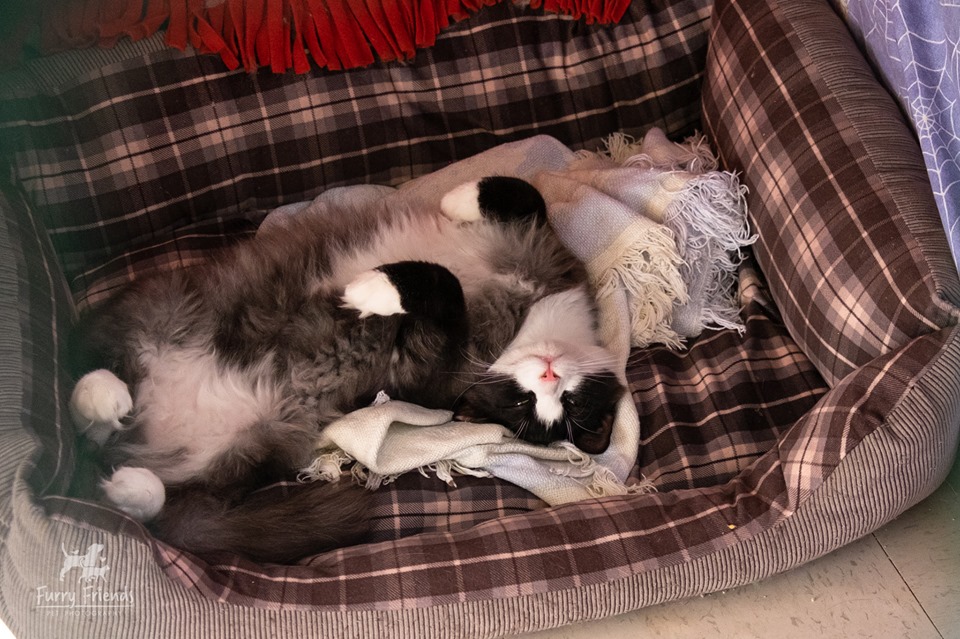
Silky - LBF
Ah, but summertime.... when the playing is easy....
Autumn - KN
It’s the season of LONG grass stalks, which are the perfect cat toy – they have exactly the right amount of spring to tempt a hunter, claws don’t get stuck in them, if they get broken, there are plenty more where they come from.
Kiwi - LBF
So big thanks to Lisa Brill-Friesen and to Karen Nicholson for some stretchy happy-cat pictures....

Leo - LBF
Used-to-be-feral Ranger reaching for his goals....
 KN

"Take that!" says Tigger, getting unusually energetic!
 LBF

Mozart (Poptart) is just a little quicker to grab than his brother Benny.
 LBF

Dodger doesn't do the streeeeetch very well, but the intent is all there
 LBF
Christina Aguilera, who is one of our polydactyls, thinks that it's really useful to have extra toes when you want to grab some grass.
 LBF

Aphrodite, floofy as she is, can stretch with the best of them!
LBF

Even Licorice, who is rather arthritic, and not much into action, wanted in on playing with grass stalks.
KN

There was a lot of action throughout the day - and there were a lot of tired cats at the end.
 KN


Blog (minimal) by Brigid Coult
Photos by Lisa Brill-Friesen & Karen Nicholson


Thursday, July 25, 2019

Room for Teens

One regular visiting-day question is “where are the kittens?”
Kittens always look SO cute!  - JS
Visitors are always disappointed to learn that any kittens in RAPS care are usually to be found at the City Shelter, waiting for adoption – and some of them go rushing off to visit there.
In fact, to get kittens to that point, there’s a great deal more RAPS care by the invisible (to the public) team of fosterers.  Any time a pregnant cat, or a mom and kittens arrives in our care, someone from the fostering team leaps into action.  Many of them reserve a room in their home just as a kitten-nursery; if that space is taken, stand-alone cages are erected on the dining-room table, and all formal entertaining is postponed.
Mama Carly Simon is now settled with us;
her kittens were all adopted from the City Shelter - MW/KD
Fosterers are used to the anxiety of waiting for a litter to be born, of tube- and syringe-feeding when necessary, of dodging a protective mom in order to clean a cage. They handle young kittens as soon as possible, to familiarize them with people – the weaning stage between four and eight weeks is usually seen as the best time – and when the kittens are old enough, they are taken to the City Shelter for adoption - while mama is spayed, to prevent another litter, and moved to Shelter or Sanctuary, depending on her temperament.
Four wary teenagers: Perry, Peony, Perkins & Della - MM
The problem comes when we receive older kittens, who are past that optimal window for easy handling. Socializing them when they are four months old or more can take a great deal of patience to overcome the feral instincts instilled by a feral mama. We will sometimes receive these ones at the Sanctuary. At the age of 4 months to a year, they are not yet fully adult – we would probably say that a 1-year old kitten is developmentally equivalent to a 15-year old human.  And though 15-year old humans can be delightful creatures, they are not as adult as they think they are! We don’t need any feline teen pregnancies, so all of them will be “speutered” (spayed/neutered) before they come to us.
Baby Beetle is all grown up now - but still shy  - MW
You may hear the Sanctuary’s Hill House sometimes referred to as “The Teens”, from its early function. These days we have fewer teens, and they usually go to a room off the quiet senior-focused Moore House.  At one stage it housed Sage and Silky, Cricket, Beetle and Frisky, it was a home for the young cow-cats, Mya and Kirstie, when they first came to us, for Perry, Perkins and Peony (all adopted) and now it’s the base for six youngsters.
Blond Leo relies on his braver friend Benny - BC
Leo and Benny came to us from a hoarding situation. They are less than a year old, and were initially very nervous about being handled. Benny rapidly settled; Leo was less ready to be touched. They were sited in the DoubleWide, and got a lot of attention, but large as our cages are, they really didn’t give this pair space to be as active as they would like. Kitty Comforters spent a lot of time and love on them, and it was obvious that it would just take a bit of time. The two of them are a younger echo of Lindor and Parker who came to us earlier this year – and with similar colouring and initial characteristics. Both Lindor and Benny are fuzzy and black, fairly outgoing and not afraid to engage; both Parker and Leo are slighter and blond, much more shy and in need of coaxing.
Mason loves having space to play - AM
In the cage facing them was a little black panther: young Mason; very hissy and swatty in his first weeks with us, but with the Kitty Comforters working with him, he became very keen on human company – going in to feed or clean his cage meant entertainment time!
It's a hard life, being a kitten, says Mozart - MW
In the meantime, there was another group of teens in one of the Single-Wide’s big cages, tended only by the med staff until we were sure that they were all healthy. This trio had come to us from the Interior, offspring of a feral mama, and about 8 months old. They were named Pistachio, Caleb and Mozart – Pistachio with a little moustache marking; Caleb with more black markings, and Mozart more grey.
Mozart & Caleb - KN
Now there’s been a general reshuffle and the two groups have been put together in the Moore House kitten room, where there’s more room for them to run and play, and for the Kitty Comforters to do the work of socializing them as much as possible.  We hope that they will eventually go to the City Shelter for adoption, but it may be that their feral beginnings are too ingrained to overcome, and they will end up staying with us like the other youngsters. Sadly for visitors, the Moore House is off-limits – they may be seen out on the deck if they choose; they can be admired but not handled.
Pistachio - MW
The Kitty Comforters, of course, are having a wonderful time – but they all know that how they play with these delightful fuzzballs will be vital in establishing patterns that will help Benny and Leo, Mason, Pistachio, Caleb & Mozart eventually to find new homes and grow to be confident cats.

Blog by Brigid Coult
Photos by Brigid Coult, Kati DeGraff, Anne Marchetti, the late Marianne Moore, 
Karen Nicholson, Jocelyn Schonekess, Michele Wright

Monday, July 15, 2019

Adopting a Feral

More than half of our Sanctuary cats have come in as ferals.
Smithy's first reaction always used to be a hiss;
 recently he's become more curious than aggressive - BC
Feral cats are those born wild, or living wild from a very early age. They run the range from the cats that take one look at you and turn to hide (or to hiss angrily at a human interloper) to the cats who have decided that there is no better life than sitting in a human’s lap. Ferals and strays are not the same thing; a stray knows what human contact is, and though scared, may more easily revert to tame behaviour.
Our beloved Dell came in as a terrifyingly aggressive cat;
we are sure he was a stray because of how quickly he settled with us.  - MD
For many years the Sanctuary has been a refuge for ferals, as well as for owner-surrenders and health-problem cats. When we’ve had a particularly friendly cat, we have sometimes transferred it to the Shelter at 5 Road, so that it can have its chance at finding a new home.  And because for many of those years, the Sanctuary was Richmond’s best-kept secret, that was very often the only way those cats might make a new start, if they weren’t adopted by one of our volunteers.
Sandy (L) and Pebble (R) are feral sisters;  Sandy still has the horrified
feral stare and is wary of humans; Pebble loves to be petted.  - KN
What we call the semi-ferals are those cats who have adapted well to life with humans at the Sanctuary; they are often among the welcoming committee at the gate, and come looking for petting and attention. But just because they seek attention doesn’t always mean that they are adoptable – experiences with cats like Esme and Jenny led to a general no-feral-adoptions rule. A cat that appears happy to be handled at the Sanctuary may freak out when taken out of its familiar turf and put into a new home.
Sweet Jenny is entirely at home in the Single-Wide - MW
Many of us, of course, have ferals or former ferals at home. My own little Kissa, who passed last year, would hide when anyone except me or her favourite cat-sitter entered the house.  It took her more than two years of living with me before she allowed herself to lap-sit.  I have friends who care for neighbourhood ferals, who have adopted them as their humans, and who come and go from their home with great comfort.
Watson was very scared when he came in to our care;
he now lives happily with one of our volunteers.  MW
But at RAPS we feel a strong responsibility to the cats who we allow to leave in someone’s care. A cat that escapes from a new home may never return if it’s on unfamiliar territory. When you adopt a cat from the RAPS City Shelter, you will complete a questionnaire intended to ensure that you will provide a safe home for your new friend. If you adopt from the Sanctuary, you can expect, in addition, to be grilled by our Manager and/or med staff. Will this be an only cat? What is the potential access to outdoors? Do you have a room that can be a sanctuary for its first days or weeks? What’s your experience with ferals?
Peony - now called Twinkles - was a half-grown feral kitten from a composting
centre when she came to us; she's another cat who has found a home with a volunteer.  MW
Some of our former ferals we will never adopt out – cats like Simone and Latte have lived with us for years, and we would not want to have a relocation make them unhappy. For them, the compromise is sponsorship – the knowledge that you are contributing to their welfare and to a continued happy life with us. But others have become contented outgoing members of the welcoming committee, and when the right person comes along an adoption may be possible. The impetus has to come from the cat; when a visitor appears weekly and the cat makes a bee-line for them every time, discussions can take place. Sadly, many of those bonds happen with people whose situation may not allow for an adoption, and they become among our most faithful visitors in order to have time with “their” cat.
Pretty Cher is mostly a one-man cat,
and her guy comes to visit with her every Sunday - MW
The majority of adoptions from the Sanctuary are actually owner-surrender cats who may have been too stressed at the Shelter to show well, but who blossom in our hands.  Tiger, Terra, Suki (now Cassie - first blogged here by her new owner), Mookie and several others are doing very well in new homes – but the Sanctuary was never really home for them. Cats like Cricket or Silky in the front courtyard, and Willow or Hillie in the back are all a very different affair – they are all cats who have known the wild life as youngsters, and they are all used to a life without boundaries (other than the Sanctuary walls). We would need to be very sure that they had bonded with a human they had chosen, and that the potential owner understood that giving a home to a feral may be a much longer process than with a tame cat. Cricket, in particular, is outgoing and sociable with visitors (as both Jenny and Esme were), but that is no guarantee that she would be a good candidate for adoption.
Cricket loves attention - but she loves her relative freedom still more - MW
We do have feral adoption success stories – especially from among our volunteers, who establish a relationship of trust with one cat or another. But even with a feral-savvy adopter, it can take much patience, waiting for the cat to decide that it can trust again after relocation - Watson's human tells me that it took more than three months for him to come out of hiding.
Many of our ferals, friendly and shy alike, will need to live out their lives in our care, confident that with us they are in a place of safety.


Blog by Brigid Coult
Photos by Brigid Coult, Melanie Draper, Karen Nicholson, Michele Wright

Friday, July 21, 2017

Tiny Cats

Silky - MD
Visitors to the Sanctuary often notice one of the small cats like Little Mama in the Single-wide trailer or Tricia in the Double-wide trailer and assume that they’re kittens.  It’s true that they do look like kittens but both of these cats are fully-grown and, in fact, quite mature.  There are a few other small ones around, like Sara Lee, Gizmo, and newly-arrived Bengal Jinx but none of them are kittens either.  So why are these adult cats still kitten-size?
Sara Lee - MM
In the case of the females, like Little Mama, Tricia, and Sara Lee, there’s a simple but somewhat sad explanation for their being so petite.  They all had litters of kittens when they weren’t much more than kittens themselves.  As any human female who’s been pregnant can testify, pregnancy takes a lot out of the body!  Humans are generally aware of the nutritional care required during pregnancy and are able to supplement those elements and calories that the growing baby takes from them.  Sadly, homeless female kittens don’t have that luxury. Cats can become pregnant when they’re as young as four to six months old.
Tricia - MM
At that age, their own bodies have certainly not fully developed and having a litter will most likely result in them never attaining full size.  For a young feral cat, their intake of nutritional food is erratic at best, and almost certainly insufficient to support a litter of growing kittens in utero.  They often have small litters of only two or three kittens, have difficulty giving birth, and may lose some or all of their tiny offspring shortly after birth.  Then they have to feed the voracious little babies, again at the expense of their own nutritional needs.
Little Mama - MM
Little Mama, Tricia and Sara Lee were all young and pregnant when trapped, which most likely explains their petite dimensions.  As a cat from a Bengal breeder, Jinx was unlikely to have been a teenage mom, but, despite being eleven years old, she still looks like a kitten.
Jinx - DW
There are, of course, other possible reasons besides early pregnancy for a cat being on the small side. Gizmo, known as “Gizmo the Grey”, is not nearly as large as the average adult cat but, since he’s a male, early pregnancy doesn’t explain his size.  He’s a feisty young ex-stray so probably didn’t get enough food to help his little body grow to a normal size.
Gizmo - MW
There are several other diminutive female cats at the Sanctuary, such as Jax (Jacky) in the Single-wide and Marilee in the front courtyard, but the reasons they’re small aren’t always known.
Tiny Merilee likes to snuggle with Little Orange
- who is not as small as his name implies!  - MM
Like humans, cats do just come in different sizes as a result of genetics and/or nutrition.   The “runt” of a litter or one who was ill or poorly nourished as a kitten has a decreased likelihood of reaching normal mature cat size.  Or, a small cat may simply be a member of a small breed or have parents of a small breed.  As they become elderly, cats who were normal sized or even large in their salad days lose muscle mass and begin to look as if they’re much younger.  Cheetah and Taboo in the front courtyard, and Booster in the Double-wide are all examples of cats who, as humans also do, have become smaller since they became "senior citizen cats".
Cheetah sunning his old bones - MW
So, when you visit the Sanctuary and see cats that are smaller than the others, it’s not because they’re kittens.  They’re fully grown but for some reason don’t look it.  But they do look especially cute!  

Blog by Marianne Moore
Pictures by Melanie Draper, Marianne Moore, Debbie Wolanski, Michele Wright