RAPS is short for Regional Animal Protection Society, a registered charity and operator of a sanctuary which houses and cares for nearly 500 homeless or abandoned cats in Richmond, BC, Canada. The Neko Files is a celebration of the sanctuary and all those who live and work there.
Showing posts with label Perkins*. Show all posts

Thursday, July 25, 2019

Room for Teens

One regular visiting-day question is “where are the kittens?”
Kittens always look SO cute!  - JS
Visitors are always disappointed to learn that any kittens in RAPS care are usually to be found at the City Shelter, waiting for adoption – and some of them go rushing off to visit there.
In fact, to get kittens to that point, there’s a great deal more RAPS care by the invisible (to the public) team of fosterers.  Any time a pregnant cat, or a mom and kittens arrives in our care, someone from the fostering team leaps into action.  Many of them reserve a room in their home just as a kitten-nursery; if that space is taken, stand-alone cages are erected on the dining-room table, and all formal entertaining is postponed.
Mama Carly Simon is now settled with us;
her kittens were all adopted from the City Shelter - MW/KD
Fosterers are used to the anxiety of waiting for a litter to be born, of tube- and syringe-feeding when necessary, of dodging a protective mom in order to clean a cage. They handle young kittens as soon as possible, to familiarize them with people – the weaning stage between four and eight weeks is usually seen as the best time – and when the kittens are old enough, they are taken to the City Shelter for adoption - while mama is spayed, to prevent another litter, and moved to Shelter or Sanctuary, depending on her temperament.
Four wary teenagers: Perry, Peony, Perkins & Della - MM
The problem comes when we receive older kittens, who are past that optimal window for easy handling. Socializing them when they are four months old or more can take a great deal of patience to overcome the feral instincts instilled by a feral mama. We will sometimes receive these ones at the Sanctuary. At the age of 4 months to a year, they are not yet fully adult – we would probably say that a 1-year old kitten is developmentally equivalent to a 15-year old human.  And though 15-year old humans can be delightful creatures, they are not as adult as they think they are! We don’t need any feline teen pregnancies, so all of them will be “speutered” (spayed/neutered) before they come to us.
Baby Beetle is all grown up now - but still shy  - MW
You may hear the Sanctuary’s Hill House sometimes referred to as “The Teens”, from its early function. These days we have fewer teens, and they usually go to a room off the quiet senior-focused Moore House.  At one stage it housed Sage and Silky, Cricket, Beetle and Frisky, it was a home for the young cow-cats, Mya and Kirstie, when they first came to us, for Perry, Perkins and Peony (all adopted) and now it’s the base for six youngsters.
Blond Leo relies on his braver friend Benny - BC
Leo and Benny came to us from a hoarding situation. They are less than a year old, and were initially very nervous about being handled. Benny rapidly settled; Leo was less ready to be touched. They were sited in the DoubleWide, and got a lot of attention, but large as our cages are, they really didn’t give this pair space to be as active as they would like. Kitty Comforters spent a lot of time and love on them, and it was obvious that it would just take a bit of time. The two of them are a younger echo of Lindor and Parker who came to us earlier this year – and with similar colouring and initial characteristics. Both Lindor and Benny are fuzzy and black, fairly outgoing and not afraid to engage; both Parker and Leo are slighter and blond, much more shy and in need of coaxing.
Mason loves having space to play - AM
In the cage facing them was a little black panther: young Mason; very hissy and swatty in his first weeks with us, but with the Kitty Comforters working with him, he became very keen on human company – going in to feed or clean his cage meant entertainment time!
It's a hard life, being a kitten, says Mozart - MW
In the meantime, there was another group of teens in one of the Single-Wide’s big cages, tended only by the med staff until we were sure that they were all healthy. This trio had come to us from the Interior, offspring of a feral mama, and about 8 months old. They were named Pistachio, Caleb and Mozart – Pistachio with a little moustache marking; Caleb with more black markings, and Mozart more grey.
Mozart & Caleb - KN
Now there’s been a general reshuffle and the two groups have been put together in the Moore House kitten room, where there’s more room for them to run and play, and for the Kitty Comforters to do the work of socializing them as much as possible.  We hope that they will eventually go to the City Shelter for adoption, but it may be that their feral beginnings are too ingrained to overcome, and they will end up staying with us like the other youngsters. Sadly for visitors, the Moore House is off-limits – they may be seen out on the deck if they choose; they can be admired but not handled.
Pistachio - MW
The Kitty Comforters, of course, are having a wonderful time – but they all know that how they play with these delightful fuzzballs will be vital in establishing patterns that will help Benny and Leo, Mason, Pistachio, Caleb & Mozart eventually to find new homes and grow to be confident cats.

Blog by Brigid Coult
Photos by Brigid Coult, Kati DeGraff, Anne Marchetti, the late Marianne Moore, 
Karen Nicholson, Jocelyn Schonekess, Michele Wright

Saturday, November 28, 2015

A Trio of Cow Cats

Feral cats come to us in a number of ways. Most frequently someone will report a cat or several cats hanging around, and one of our staff or volunteers will go out and set traps. Occasionally it turns out that the stray does indeed have a home, but often it is a cat that has lived wild for some time.
a part of the complex where a large colony of cats live
One colony of cats that is well-established (at least, to the cats’ satisfaction) is at a nearby composting plant. The staff there had noticed regular patterns of feline comings and goings, and were able to recognise some of the cats. Stephanie, one of our volunteers, has made it a personal mission to identify and trap as many cats there as she can, knowing that this is not the safest of sites for them – coyotes, hawks, eagles and other predators hang around.
Juvenile bald eagle looking for lunch - PH
Any fully adult feral cat may simply be spayed/neutered and returned to the area to take its chance, but when we know of female cats having litters of kittens, trapping them and trying to socialize them becomes a priority.
older cat, too wary to be trapped - PH
Stephanie has observed that many of the cats around the site are black and white, in a variety of patterns (sometimes called "cow cats" from their pattern similarities to Holstein cows), and she has identified the older males who have probably sired most of the kittens. Peony and Della were from a spring trapping at a nearby site, and in May Stephanie managed to trap three black and white girls.  Phaedra was with her when Mya was trapped, and chose the name; Teagan and Kirstie were names chosen by Stephanie for the other two. The three are likely siblings.
The newly trapped Mya  - PH
Phaedra says that Mya was the wildest kitten she'd ever encountered - she made the trap rock and bounce all over the place. For the first part of her stay she was angry and unapproachable, and Phaedra feared that she might never tame up - but then Leslie made breakthrough, much to Phaedra's delight. 
Kirsty kitten takes a dim view of being at the Sanctuary - PH
Kirsty was fostered for a while and then came to join her sisters.  There was a lot of initial hissing, but it proved to be mostly bluff.  Teagan bonded with another kitten, Yorkie, who was very handleable, and she took her cues from her buddy.
 
Teagan ready to run - PH
When we have really small kittens, they are fostered out for maximum handling, and then go straight to No 5 Road for adoption. But with half-grown kittens, there’s no way of knowing if they will tame, and the med staff at the Sanctuary have taken to a two-step pattern. In the Moore House, where most of the senior cats live, is a separate room with its own patio; we’ve been keeping the kittens there, apart from the general population, but where they can have some of the Kitty Comforters working with them.
For some time we would look into the Kitten Patio and find black-and-white bodies crammed into corners or having climbed up over the windows; being socialised was NOT in their agenda. But gentle determination and regular visits have worked their magic, and the no-longer-kittens were recently transferred to stage two: a transfer to the single-wide trailer.
Mya & Kirstie enjoying their new home - BC
There they are together in one of the large, walk-in cages, and are discovering that humans are to be welcomed; all three happily accept petting, and even belly-rubs (not welcomed by every cat!).
Mya now totally relaxed - MW
Teagan enjoying a stretch - MW
Like Perry and Perkins and Della and Peony, they will soon be released into the general population of the single-wide. They will probably not go to No 5 Rd for adoption; cats from such a feral background are likely not to be great adoption prospects, though if they develop a close relationship with a volunteer, sometimes exceptions are made.  In any case, any potential adopter would need to be very experienced in dealing with a semi-feral cat.
Kirstie wants MORE play - MW
Big thanks to Stephanie and her team for rescuing these sweeties (and many more!).  Quoting Phaedra: "These girls have been a joint effort of love by volunteers, kitty comforters and staff. I'm delighted at how happy they seem and proud to be a part of a team that can work magic like this."


Blog by Brigid Coult
Photos by Phaedra Hardman & Michele Wright

Sunday, May 24, 2015

Adoptable – or not? – part 5: Find me a home!

The four blogs earlier in the series have addressed some of the issues that come into play when deciding if a Sanctuary cat might possibly be a candidate for adoption.  Feral cats – no…  Health problem cats -  only with due care, and knowing that you’ll be taking on a financial commitment. Behaviour problems – occasionally, but usually only if that cat will be an “only”. Semi-ferals – usually not; no matter how “tame” they may appear, there’s a wild kitten hidden inside. However, it is sometimes difficult to differentiate between a semi-feral cat that has missed its socialization window, and a formerly tame cat that has strayed from home and lived wild, so that some of the feral instincts click in. This is where it becomes important to check in with med-staff Leslie, who knows all the cats, having been with the Sanctuary since its beginning.
 
May and Adam are most often found together,
and if adopted out, would do best as a pair.
Sometimes it’s just a case of where the population is... The No 5 Road Shelter has only so much room for cats, and towards the end of kitten season, when the adoptable kittens come in, sometimes some of the long-term adult cats need to be moved out. These are all cats that were candidates for adoption, and just didn’t “take” for whatever reason. What we call the No 5 Road Pen has several of these cats. Some former residents have already been moved back to the Shelter and been adopted out; others are still waiting for the kittens to go and someone who wants an adult cat to appear. In this pen are also Carreen, Chinook and Hudson...
Ninja would do well in a townhouse where he has room to move
Others are just long-term-residents of the Sanctuary. Ninja is one of many black cats – and yes, cats suffer from the same human reluctance to adopt a black as dogs do. He’s something of a loner; he doesn’t interact much with other cats. But he’s often delighted to be fussed over by a visitor, and to have his plushy soft fur admired.
 
Hannah loves people and attention – other cats, not so much… (CF)
Hannah came to us from what was something of a hoarding situation. Her former owner came to visit her regularly till she died. Hannah’s best known for her habit of jumping onto shoulders – preferably from behind. She’s a friendly girl who carries her tail straight up in the air.
Ashley - (PH)
Another category of adoptable cat is the older one – one in which the owner may have died or gone into care, but the cat is felt to be too old to be put into the No. 5 Road population.  Ashley came to us when his owner, a RAPS supporter, died suddenly. He’s still caged and settling, but is a friendly boy and a wonderful candidate for homing.
STOP PRESS: Ashley has a new home and is loving being an only-cat again!
Garfield (orange) and Diamond (Tabby) need each other’s company
Diamond and Garfield were also owner-surrenders. Mother and son, they are deeply bonded, and didn’t handle the No 5 Rd Shelter well. With us, they can share a large cage where we can try and control their food intake – what they need is a home where they can get lots of exercise.
 
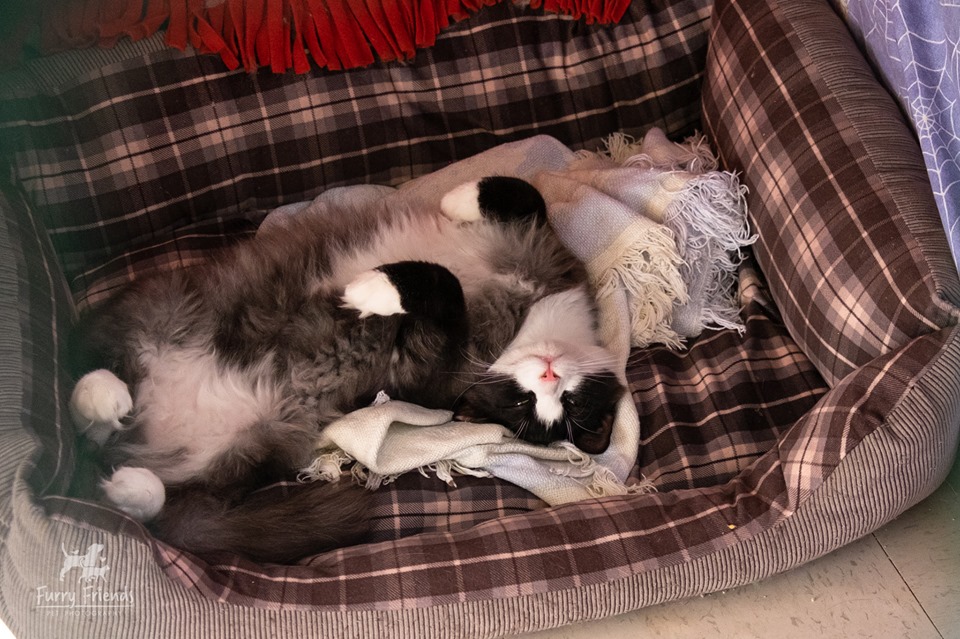
Perkins (tabby) & Perry (tabby/white)
We rarely have kittens on-site - most of them go for fostering and then straight to the No 5 Road Shelter for adoption - but occasionally they need more time for socializing than 5 Road can give them. There are currently four half-grown kittens getting steady attention from the Kitty Comforters; Perry and Perkins are shy but ready to be handled and played with; their sisters Della and Peony, not so much, yet.
 
The majority of adopters from the Sanctuary are actually our wonderful volunteers. They come in faithfully each week to tend their favourites until the point where they can’t bear to leave that favourite behind when they leave – at which point they negotiate with Leslie, and a cat goes back with them – perhaps for palliative or end-of-life care, perhaps to begin a new life.

Taking on a Sanctuary cat, then, is a two-part process – first, you go through the formal adoption approval paperwork at the No 5 Road Shelter. With Sanctuary cats there is always the concern that they are going to an indoors-only life - these are not cats that are safe with outside access.  Then, you talk with Leslie about the possible adoption candidates, and about what you can offer them. And perhaps, if all goes well, they will find their new Sanctuary with you.
 
Blog by Brigid Coult
Photos by Claire Fossey, Phaedra Hardman and Michele Wright