RAPS is short for Regional Animal Protection Society, a registered charity and operator of a sanctuary which houses and cares for nearly 500 homeless or abandoned cats in Richmond, BC, Canada. The Neko Files is a celebration of the sanctuary and all those who live and work there.
Showing posts with label Li'l Bit (Bitty). Show all posts

Wednesday, October 15, 2025

Colourful ferals

Sarah (KN)
Sometimes it feels like we have a flood of new cats that come in from different rescues, and it may take awhile for them to settle enough that we can really get to know them.  One such inundation happened in late 2023 when we took in the colony that had lived at Cranbrook College of the Rockies, until the College demanded their removal. The feral colony came into our care, and is now well settled in pens 2 and 3 in the back courtyard; most of them remain fearful and avoid contact with humans.

Raya - newly arrived  (BC)
At about the same time, a trio of little cats came to us from Broken Promises Rescue, on Vancouver Island,  and were placed in a DoubleWide cage opposite the College cats. Like the larger group, the trio was feral, and spent all their cage time huddled behind their privacy drape. Efforts to visit with them were met by fearful hissing; they definitely didn’t want people around them.  They were a colourful little family – a short-haired calico, a long-haired tortie, and a long-haired pale one with raccoon eyes. The two long-haired ones were found behind a Port Renfrew restaurant, on the west coast; the calico came from a First Nations reserve near Ladysmith. Broken Promises works largely with fostering, and these three were in care together for some time, before it was decided that they were too scared to tame, and would be better at the Sanctuary.

Sarah, in Pen 3  (KN)
Typically the Sanctuary cage-stay is 6-8 weeks, allowing us to administer necessary vaccines, do spay and neuter when needed, assess health issues and dental care, and with luck, enable the newcomers to encounter humans and learn that we mean no harm. Practically, most ferals don’t change that quickly – and because they’re sharing cages, their proximity both gives them comfort, and reinforces that they’d rather be with their own companions. When the med staff feel we’ve done as much as we can, the cage doors are opened, and the cats can decide what their next move will be. The majority of the College Cats made their way out – first to the DW Deck, and then out into the pens; only Tabitha (also known as Tubbitha) remained indoors – and her attitude to people didn’t change much, though she appreciated the food service!  In the opposite cage of Broken Promises cats, little Sarah, the calico, summoned up courage and headed for the great outdoors;  since then she has mostly located in pen 3, where she has made friends with other small ferals, and with the Calgary colony who live there. I most frequently see her in company with black-and-white Tofino, who is very cat-social.
Madeleine & Raya were always together  (BC)
The other two little girls were definitely bonded, and decided to base themselves in the cage and refuse to move; their drape was left up, and I think many of us almost forgot that they were there. Occasionally little Madeleine would be seen scooting from cage to the Deck door, like a little grey ghost; tortie Raya was not to be dislodged. They must have come out at night to share from the wet-food plate – but only the evening med-staff might occasionally spot them.

Madeleine in the great outdoors  (BC)
Then big changes:  the 25-year-old DoubleWide trailer badly needed refurbishing: pee-sodden wood had to be torn out, wiring and insulation replaced, shelving installed, all the cages rebuilt. Much to the dismay of the regular inhabitants, everyone was moved out and doors closed behind them.  Madeleine took herself right out of the building and to pens 2 and 3 – I don’t see her much in company with Sarah, but she can sometimes be found hanging around Yma, who is still very shy.

Raya, out on the deck with the other ferals  (BB)
Tortie Raya vanished completely, but has been discovered hanging out on the DW deck with the other semi-ferals; like Madonna, she hides out in the beds that line the shelf above the windows.  When the work on the main room is done, it will be interesting to see whether she returns to it, or whether she prefers to stay where there are new friends. And as the weather gets colder, who knows if Madeleine will manage to make her way back to the main building to be with Raya, or if she will let Sarah show her how to manage, out in the gardens.  

Madeleine, still hiding out (BC)
All three remain fearful of human contact – unlike the Cranbrook cats, who are getting increasingly brave at being around humans (Li’l Bit actually spent Sunday visiting time out in the open – not interacting, but not running away!).  Sarah’s had a winter outside, and knows how things go;  once the DoubleWide renovations are complete, the med-staff will make a decision on whether to net Madeleine and return her to keep company with Raya, or whether to leave her to do her own thing with Sarah and the other ferals in the back pens.

Blog by Brigid Coult
Photos by Braden Burgess, Brigid Coult, Karen Nicholson

Wednesday, February 28, 2024

KCs At Work

Raisin - a pen 4 feral girl   (KN)
Visitors who come to the Sanctuary at the weekend are often astonished and delighted by the number of cats who come to greet them.  What they will not see are the cats who are hidden away – either by their own choice as ferals, or because they are caged. Cages are not what the Sanctuary is about – but they are occasionally a tool to lead to something better for the cats. Most of our felines are here either because they are feral or because they have been surrendered. If they are immediately adoptable, then they will go to the Adoption Centre – but many of them are not ready for that when they come to us. 

When Creampuff came to us, she spent most
of her time hiding behind a drape   (BC)
Because a new cat needs to be assessed, and have all its vaccinations current before it is released into the general population, it will often spend 4-6 weeks in a cage. There is always a drape or a carrier or somewhere that they can hide.  Some cats are happy to be hidden away in a quiet dark place – but that doesn’t help them when they finally emerge. So there is a team of volunteers who will happily spend time sitting quietly in a cage, allowing the cats to learn that humans are not always scary.

Marianne & friends - by Selena Marchetti
The team of Kitty Comforters was the creation of the late Marianne Moore, a longtime Sanctuary volunteer, who passed in 2018. Six years before that, she established a group of “cat-whisperers”, volunteers who had proved themselves to be calm and patient and occasionally willing to be scratched or bitten by a scared cat. The team is still operating under the leadership of Anne Marchetti, and they appear faithfully each afternoon to spend time with cats who are receiving medical care, cats who are new to the Sanctuary, and some of our shyer inhabitants. 

Food bribery   (LBF)
Sometimes kitty-comforting time involves food bribery, or gentle grooming; sometimes it may be no more than a quiet voice. We learn which are the cats that are aggressive in their fear, and which are the ones who will only hide. Most of our time is spent with caged cats, but we also look for the shyer cats who live in the open pens, and connect with them as much as we can. Kitty Comforting is about much more than just having fun with your favourite cats; it’s about searching out the ones who need us, and establishing trust by whatever means we can.  Most of the KC’s have done their share of cleaning and feeding, and are known by Anne to be really patient and persistent in reaching out to scared cats.

Shy Tibby hid in her cage for weeks;
now she's out, and much more confident  (AA)
My recent KC session began with a visit to the Adoption Centre, where Benjamin and Olivia are still awaiting someone to offer them a home. Benjamin came out for a visit and some cuddling; Olivia has a bit of a cold, and stayed in her bed. From there, I paid a visit to the SingleWide offices, which are much quieter than usual, with a lot of the admin transferred to the Adoption Centre. Mojo and Licorice like the quiet, but they also need some stimulation and love. They have been joined recently by pretty Tibby, surrendered for inappropriate urination, and, like Oscar and Winston, on a diet to see if there is a physical basis to her problem. Licorice believes firmly that all visitors come to see him, and took exception to my paying attention to Tibby by backing up and peeing on my leg – sometimes a penalty of being around our cats!

Li'l Bit outside the DW deck   (KN)
A quick visit with Oscar and Winston and a check in to compare notes with fellow KC Catherine, on her own rounds, and then I moved to the back pens for a bit, checking in there with Lisa who is one of the “magic people” with ferals. She has been working with shy Raisin in Pen 4, who still hides away from everyone else.  We are watching for a gradual relocation of some of the Cranbrook College cats who base themselves on the high shelves on the DoubleWide deck, but who have also discovered the cat-door and the potential for visits to the back pens. We will occasionally see Li'l Bit and Foster exploring in Pen 3 – though their explorations tend to be around sunrise or sunset, when there are fewer humans around. 

Sweet Audi is beginning to be curious about us  (BC)
There are more caged cats in the DW because it’s closest to the med-staff. Some of the cages still bear “Staff Access Only” signs; in a few of those cases, Anne may let us know that the KCs do have access to start the familiarization process. Sometimes we’ll barely see the cats in question, who have places to hide and prefer to use them with strangers – sometimes the offer of a treat will be met with a well-placed claw, or with warning hisses. With these cats, little and often is the key; they need to discover that humans may feel scary, but don’t intend them any harm.

Sylar enjoying petting  (BC)
From visiting with shy Audi, I move next door to visit with an old friend. Sylar has been my sponsor cat for years. He’s a very wary feral who loves his chicken, and has progressed to occasionally accepting it from the hand, though he prefers to have it tossed to him. Currently he’s in for observation; he’s lost some weight and has become pretty matted, so I hope blood tests will show the problem. As always, there is fierce hissing as I enter his cage. Because I know that he knows me, I loop his drape back so that he has nowhere to hide; I offer his favourite chicken and he accepts it without biting my fingers. Very carefully I hold tidbits in my right hand and pet him with my left; he allows it without protest, and the bum comes up as I pet down his body. By the time I leave him, he’s allowing petting (but not grooming) without hissing. I suspect, though, that once he’s out, he’ll be back to not permitting touch!

Sometimes the best Kitty Comforter is another cat -
Denzel is being visited by his buddy Luke    (BC)
I visit with sweet Denzel, who’s had dental surgery and is caged so that he only eats wet catfood for a while, and with Mortimer, who’s just out of a cage; Mortimer came to us as an unneutered tomcat and was a little reactive while he waited for release. Now the hormones are under control and he has his freedom, he’s become one of the cuddle-bugs on the DW couch.

Espoir is listening, but doesn't want to interact  (BC)
One more scared cat to visit, and I return to the front courtyard to be with Espoir in the Hill House. She pretends I’m not there and hides behind her cat-tree; it’s too soon to push her for contact, so I just sit and talk with her for a bit. There’s a series of interested visitors at the door; many of the Hill House cats enjoy company, both human and feline, and Espoir will not be a total stranger to them by the time she’s finally allowed out.
Magnus (front) and Jim  (GA)
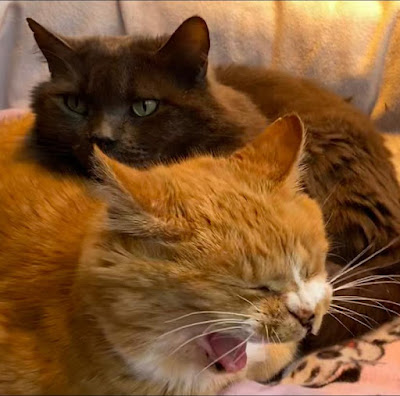
My shift is finally over as the evening feeders-and-scoopers start to appear – I stretch my time with a short visit to my buddies in the Val Jones pen. The porch chair is vacant, and as soon as I sit down, Magnus and Jim occupy my lap. These guys don’t need the work we put into the more scared cats, but they do need us to spend some time with them because the Val Jones is closed off as an FIV pen – they just need to know they’re not forgotten, and most of the regular volunteers will happily spend time with them as well.

Blog by Brigid Coult
Photos by Graham Akira, Alicia Almeida, Brigid Coult, Karen Nicholson

Tuesday, January 9, 2024

Welcoming the Cranbrook College Cats

S'mores & girlfriend Twiglet  (LBF)
When the former Richmond Homeless Cats became Richmond Animal Protection Society, and then the Regional Animal Protection Society, we moved from being a very locally-focused organization to one that has links with rescues all over the place. Our work is particularly valuable to small rescues dealing with multiple feral cats; if the cats that come into their care cannot be tamed, very few of these places are able to offer long-term safe housing to the animals – they just don’t have the facilities. With the financial support of cat-lovers all over the place, we have been able to offer sanctuary to cats from the length of Vancouver Island, from Kamloops and Prince George and the Okanagan, and most recently, from the Kootenays.

Li'l Bit, high on her shelf on the deck (BC)
Sadly, there are still too many people who are careless with their cats, who allow them to wander, and who don’t ensure that they are spayed and neutered. And the result is colonies of cats who are born in the wild and who fear human contact. Ideally, TNR (Trap/Neuter/Return) can turn a growing colony into one that is stable and eventually disappears by natural attrition. But it takes patience, and it also takes local education so that the colony isn’t continually enlarged by dumped cats.  For more than ten years there has been a managed colony of feral cats living on the campus of the College of the Rockies in Cranbrook. Their volunteer caretaker took all the responsibility for their feeding, vaccinations, spay/neuter, and the College had agreed to provide access to some space for their housing.

Smudge is hiding in the same high-up corner
where Ringo, and then Hamlet, used to hide  (BC)


This past spring, the College authorities announced that the colony housing would be dismantled and the colony dispersed – though there was no understanding of what might happen to the cats. There was some local outcry; petitions flew around, the media got involved; eventually everyone was satisfied with the decision to relocate the colony into RAPS’ care. That’s not as simple as it sounds; we were talking about taking on up to 14 cats with consequent bills for food and medical care, but generous donors stepped up, donations arrived, and the cats came to us in two separate groups.

Spunky, Toffee (top), Smudge, Li'l Bit (bottom)
with Bernadette behind in the adjacent cage  (BC)
As with all newcomers, they were initially caged so that they could have all their medical checks and become used to some aspects of Sanctuary life. Because they were used to each others’ company, we put the first five cats in adjacent cages in the Double-Wide, and cut a hole in the mesh between them, so that they could move between the cages. They could choose whether to be up on a shelf or on the floor, hiding behind a drape or in the open. It rapidly became clear that though they had had contact with humans, they were very fearful and preferred to hide, huddling together for comfort. There was much hissing, which is less about aggression and more a fear reaction, and contact with them initially tended to be in the hands of the med-staff and the most experienced of the Kitty Comforters.

We think Foster, on the left, is the mother of Li'l Bit   (LBF)
They're glad to be back together again!
The first group of cats had their cage-stay and were released, choosing quickly to relocate to the adjacent DW Deck. This is an area well-suited to ferals, with lots of high shelving around the perimeter, and many places to hide. Ringo, Hamlet and many others have had their shy-time on the deck and moved on to other territory, or to comfortable interaction with humans. The College cats are still in the wary stage, preferring to stay right out of reach, but tolerating the regular advances of Lisa, who usually has tidbits for them. Li’l Bit (or Bitty) is not so little, but once you get past the hissing, she is a tidbit fan; Smudge, on the other hand, resolutely hides in the corner nobody can reach. Toffee made his way out via the cat-door in the corner, but must have had underlying health issues, because sadly, his body was found unexpectedly in the back pens.

S'mores, Twiglet & Purrl  (LBF)
The second batch of cats remained caged a little longer, but by their own choice. It turned out that Buddy was FIV+, and he is now living in New Aids. S’mores and Twiglet are most often found sharing a bed, and have proved amenable to a little petting; both seemed to enjoy scritches and they’re relaxed enough to accept food from the hand. Currently their cage is open, but they feel safest there, and are still allowing visitors to come in gently and offer pets; when they’re ready, they’ll probably make the move to the DW Deck with their fellow-Collegiates. Foster (who we think is Li’l Bit’s mother, has moved out to join her daughter; Purrl and Tabitha, both short-haired tabbies, prefer to remain in the now-familiar cage, with a drape behind which they can hide. Currently there are vacant cages, so we don’t need to evict them too quickly, and they still have access from one cage to another and can visit happily.

Spunky & Smudge  (LBF)

We’ll look forward to following the Cranbrook cats,  and watching as they take their time assimilating into the Sanctuary way of life. 


Blog by Brigid Coult
Photos by Lisa Brill-Friesen & Brigid Coult