RAPS is short for Regional Animal Protection Society, a registered charity and operator of a sanctuary which houses and cares for nearly 500 homeless or abandoned cats in Richmond, BC, Canada. The Neko Files is a celebration of the sanctuary and all those who live and work there.
Showing posts with label Benny. Show all posts

Tuesday, July 9, 2024

Sanctuary Salon

Lindor's shave-down helps him sleep cooler  (KN)
Cats are often characterized as being very clean – constantly attending to their own grooming, and occasionally sharing grooming with others. That being so, you’d think there wouldn’t be much for humans to do, to maintain that cleanliness. Let me tell you, it ain’t necessarily so!

Persimmon is a big girl - with or without floof!  (KN)
To start with, probably a third of the Sanctuary cats are long-haired. And as cat-owners will know, long-haired cats frequently need help with grooming. Those gorgeous floofy coats may look good, but run a hand over them, and you will find lumps and bumps of matted fur. Even the best-natured cats dislike having mats combed out, and when the cat in question is a feral who fears human attention, being brushed is not an option.  SweetPea (now adopted) loved petting, but her sister Curious still dislikes human contact, and when she got matted, a shave was the only possibility.

Curious still doesn't like humans  (BC)
Mats may be caused by a number of factors. The shed undercoat may become caught in the top coat. Dirt or natural oils may cause the hairs to mat. Urine or feces may create back-leg lumps. And all these factors may affect short-haired as well as long-haired ones.  Most dogs may be taken to a groomer, where they will stand while expert hands remove excess hair. This is not an option with the majority of cats, who take a dim view of being made to do anything!  So, what to do with all our matted moggies?

Jobie HATES being groomed and gets a lion cut each summer (MW)
As much as possible, prevention is a factor; most of the staff and the Kitty Comforters keep a comb or a deshedding tool tucked in a pocket, and grooming is one of the things that the KCs will offer to comfort a cat. But when there’s matting to deal with, it’s not comforting!  Scissors are not recommended; sometimes the matting goes right to the skin, and there is the risk of cutting the cat, and not just the fur. Occasionally the top part of a mat can be cut off and then the rest of it can be broken down – but that takes time and patience and a cooperative cat.

Higgins is a stray tomcat who came to us with
a number of injuries that needed shaving for treatment  (BC)
Occasionally a cat with mats is also scheduled for a dental procedure, or something that requires full sedation, and then the hospital staff can do an expert shave-job, producing a classic lion-cut.  But it’s not good practice when not essential, and the majority of the matted cats wait for a day when a couple of the Sanctuary med-staff can work together, and the cats in question are given an oral sedative that calms them somewhat without putting them out. Under these circumstances, the cut may not be totally elegant or complete – but at least the mats are out, and the cat is cool and comfortable.  

Perhaps Lindor's a little embarrassed
- but he's much cooler!   (BC)
Some of the trims are partial – most commonly the “sanitary” trims that leave the back legs free of  fur. This is especially necessary for some of the chonky cats who can’t always reach back there to clean.

Benny got a sanitary cut - no more dirty bloomers! (SL)
Other trims are minimal – Alfred is a short-haired boy, but had a couple of nasty mats on his rump just where he couldn’t reach them. For a while he was walking around with a bald patch, but the fur is growing in again.

Just one little matted patch needed a shave for Alfred  (BC)
There are a few cats that resist any attempt to make them feel comfortable. Feral Smithy has matted fur that becomes dreadlocks on a regular basis. He has been shaved before and was acutely embarrassed; mostly we leave him to cope unless we feel he’s suffering, and we’ll occasionally find what we call “Smithy’s beardy bits” in the back courtyard – as long as they’re not too tight to the skin, they will often work their way loose.
Smithy is not cooperative about grooming - or anything else  (KN)

When you find something like this lying around,
you know Smithy's shed a beardy bit!   (BC)
Now that summer weather has hit us, the staff are keeping a keen eye open for the ferals who are carrying extra fur weight around.  The Cranbrook College cats are now on the radar, but they are still not comfortable around humans, and the experience of being captured, dosed and shaved is not a pleasant one for them. Still, it’s better than carrying around lumps of fur that pull on their skin.

With a coat like this, Foster really needed a shave! (KN)

And she got it!  (KN)
The haircuts also have the added advantage of helping us identify previously identical-appearing cats. The Kamloops cats usually wander around together like a shoal of tubby goldfish – it’s really interesting to notice that some of them, like Kumquat, are really slim under all the fur that is now gone.

Kumquat is feeling much less lumpy  (KN)
Work with brushes and combs and deshedders will continue – but the shavers will continue to make summer life more bearable for the floofier cats.
An evening's cat-fluff!  (KN)


Blog by Brigid Coult
Photos by Brigid Coult, Stacey Lambert, Karen Nicholson, Michele Wright

Thursday, October 14, 2021

Teens All Grown Up

Mozart, Caleb, Benny (LBF)
Real kittens – the tiny cute kind – almost never come to us at the Sanctuary.  There are two main reasons – their immune systems are not yet fully developed and they are susceptible to any number of infections they can catch from adult cats, and they need a LOT of handling to get them used to being with people.  The common wisdom is that up to 10-12 weeks old they can be socialized fairly easily. After that, it’s a much more individual thing – some tame easily, and other maintain their feral instincts.

Two happy adopted girls:
Aphrodite (MD) & Leona (ACA)
I have written before about our aging population, but we do also have a fair number of younger cats – most of whom have come in at around 6-months-plus as young ferals.  We will usually try to keep them apart from the general population and have our Kitty Comforters spend concentrated time with them, helping to learn that humans can be trusted. With some of them, the magic happens, a bond is created, and a cat finds a home - tortie Aphrodite and blonde Leona had early established themselves as the ones most receptive to human attention in the McLeod pen 6 and are now spoiled house-cats; the rest of their family prefer to remain out of reach and are part of the feral population in pen 1. 

Mr Megafloof - Mozart  (KN)
In a similar way, we had a group of “teens” in a separate area of the old Moore House.  Much time and patience was spent working with Benny, Leo, Caleb, Pistachio, Mozart and Mason, and for the most part they resisted all efforts.  We finally conceded defeat and moved them to the front courtyard.

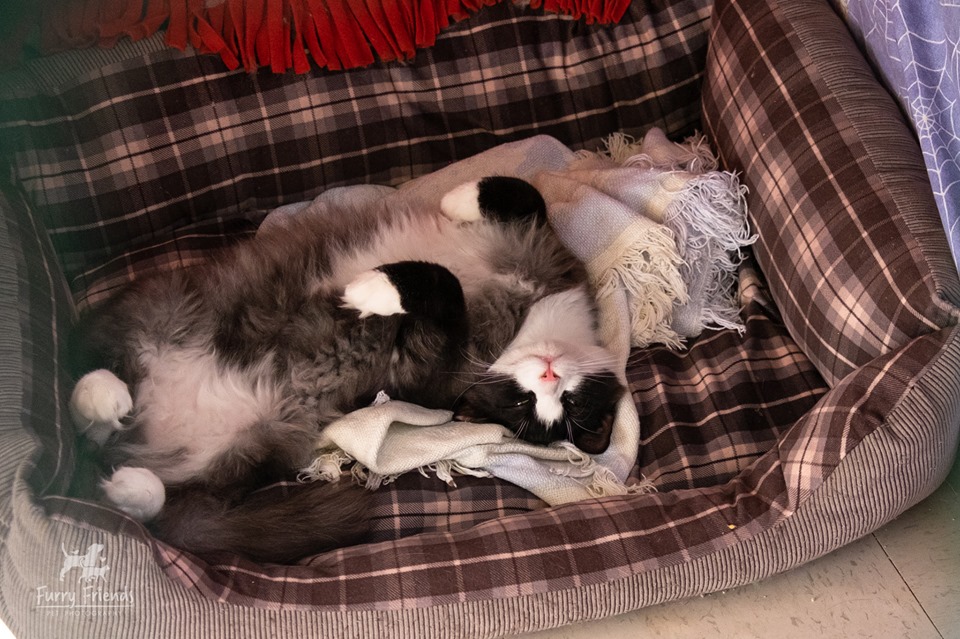
Benny's another guy with cattitude  (KN)
Eighteen months later, and they are for the most part relaxed and happy. Pistachio and Mason really tamed up, and were adopted within a few months.  The others have made themselves totally at home in the front courtyard population.   Benny, the long-haired black boy, can be told by his characteristic curled plume of a tail.  He is now actually a little warier of human contact than his formerly shy buddy, blond Leo, who is more comfortable around people these days – especially if chicken is offered.  Leo is now one of those cats who will roll over and accept tummy-rubs from starry-eyed visitors.

Leo is one of our prettiest front-courtyard cats (KN)
Handsome Caleb has become a social butterfly with a number of other cats, but he is obviously most relaxed and at ease with his brothers, and can often be found snuggling or playing with them. The leader of the group is usually Mr Floof – Mozart (also known as Poptart).

"Handsome" is definitely the word for our Caleb (MW)

The incomparable Mozart  (KN)
There is no way this boy can be confused with anyone else – in both appearance and personality, he shines! Visitors often ask for him, and he’s usually happy to be fussed over for a while – until he decides he’s had enough, and disappears into the feral area, which is out of bounds to visitors.  He is happiest when the other cats are around him. We have often been asked about his adoptability, and the sad fact is that Mozart is a pee-er, and would probably not make a good house-cat.  But along with his brothers, he makes a wonderful Sanctuary cat! 

Blog by Brigid Coult
Photos by Ana Carolina Albuquerque, Lisa Brill-Friesen,
Melanie Draper, Karen Nicholson, Michele Wright


Wednesday, February 5, 2020

Relocating the Teens

Some of our younger cats have come to us at an age which misses the optimal window for socialization, and they hover in the cusp between feral and approachable.
Mozart (also known as "Poptart") - KN
Young kittens, living and playing together, learn to socialize with each other and with the humans caring for them; it becomes relatively easy to get them comfortable with handling, and thus ready for adoption at the City Shelter. But kittens who come to us at 6 months old or more may have missed that opportunity, and many remain fearful and not so easily handled.
Caleb exploring - KN
Sometimes, some determined play/handling therapy can turn the corner; we’ve had a number of kittens who have eventually been adopted, once they’ve learned that humans aren’t so bad. But we also have several who, though friendly enough now, remain feral at heart – easily scared, and not good adoption prospects unless they truly bond with a human. Silky and Sage, Cricket and Beetle are now all cats like that – handleable in a space where they are comfortable and relaxed, but we would be very wary about ever adopting them out.
Leo & Benny as  newcomers - LL
Leo & Benny still together - KN
We recently had a batch of these “teens” in semi-isolation in the room on the east end of the Moore House.  Regular visits from staff and Kitty Comforters got them a little more comfortable with handling, but it was obvious they they were not yet ready to be relaxed with visitors, and not likely to enjoy a move to the City Shelter. As with the other “teens” above (now full adults), it was decided to relocate them to the front courtyard.
Mason - KN
After an initial stay in the large Hill House cages, the doors were opened. It was interesting to see the different reactions.  Blond Leo was not happy – he has always been the shyest of the bunch, and he decided to hunker down in the cage and not come out for a while. That’s OK – he has time to adjust, and the Kitty Comforter visits will continue.  His buddy Benny was always braver, and was quick to emerge and explore; he likes to be around staff and volunteers, “helping” with chores. Leo now explores a bit, but prefers it when Benny is there to give him confidence.
All-black Mason was also quick to explore, and discovered a whole bunch of other little black cats – which makes it a bit difficult to pick him out!  For the greater part, he seems to have relocated himself to the feral cat area - but he does emerge occasionally to interact with his buddies.
Pistachio showing off - CP
"We pause to show paws, but the clause are no claws!'
The other three have settled in well. Pistachio was always the most social of the family; she is enjoying her explorations, and making friends. Caleb was initially cautious, but has expanded his range right across the courtyard and has joined the formal-wear crowd – between Miller, Vesper, Puck, Sylvester and Marvel – and that’s not counting the easily distinguished ones like ZeeZee, Spirit, and Mabel – it’s getting almost as hard to distinguish between the tuxes as between the many little blacks!
Mozart - CP
Nobody can mistake Mozart for another cat, though. His gorgeous floofy coat is the most intriguing mixture of grey and black. Initially very timid about relocation, he has begun to relax and to explore more readily. He joins the others in games of “get the red dot”; he’s beginning to seek out humans for interaction, and is often among the greeters at the gate.
Mozart in the snow - KN
We would love to see these six adopted, but we feel a move to the City Shelter would be too stressful for them, and we would want to be very sure that they had bonded with an adopter – whether they go singly or in pairs. In addition, they are all still very dependent on each other – Leo and Benny in particular.  For more information about any of them, we hope you will contact Shelter Manager Lisa Parker – lisap@rapsbc.com
Fur, as it should be worn - KN


Blog by Brigid Coult
Photos by Leslie Landa, Karen Nicholson, Carol Porteous


Thursday, July 25, 2019

Room for Teens

One regular visiting-day question is “where are the kittens?”
Kittens always look SO cute!  - JS
Visitors are always disappointed to learn that any kittens in RAPS care are usually to be found at the City Shelter, waiting for adoption – and some of them go rushing off to visit there.
In fact, to get kittens to that point, there’s a great deal more RAPS care by the invisible (to the public) team of fosterers.  Any time a pregnant cat, or a mom and kittens arrives in our care, someone from the fostering team leaps into action.  Many of them reserve a room in their home just as a kitten-nursery; if that space is taken, stand-alone cages are erected on the dining-room table, and all formal entertaining is postponed.
Mama Carly Simon is now settled with us;
her kittens were all adopted from the City Shelter - MW/KD
Fosterers are used to the anxiety of waiting for a litter to be born, of tube- and syringe-feeding when necessary, of dodging a protective mom in order to clean a cage. They handle young kittens as soon as possible, to familiarize them with people – the weaning stage between four and eight weeks is usually seen as the best time – and when the kittens are old enough, they are taken to the City Shelter for adoption - while mama is spayed, to prevent another litter, and moved to Shelter or Sanctuary, depending on her temperament.
Four wary teenagers: Perry, Peony, Perkins & Della - MM
The problem comes when we receive older kittens, who are past that optimal window for easy handling. Socializing them when they are four months old or more can take a great deal of patience to overcome the feral instincts instilled by a feral mama. We will sometimes receive these ones at the Sanctuary. At the age of 4 months to a year, they are not yet fully adult – we would probably say that a 1-year old kitten is developmentally equivalent to a 15-year old human.  And though 15-year old humans can be delightful creatures, they are not as adult as they think they are! We don’t need any feline teen pregnancies, so all of them will be “speutered” (spayed/neutered) before they come to us.
Baby Beetle is all grown up now - but still shy  - MW
You may hear the Sanctuary’s Hill House sometimes referred to as “The Teens”, from its early function. These days we have fewer teens, and they usually go to a room off the quiet senior-focused Moore House.  At one stage it housed Sage and Silky, Cricket, Beetle and Frisky, it was a home for the young cow-cats, Mya and Kirstie, when they first came to us, for Perry, Perkins and Peony (all adopted) and now it’s the base for six youngsters.
Blond Leo relies on his braver friend Benny - BC
Leo and Benny came to us from a hoarding situation. They are less than a year old, and were initially very nervous about being handled. Benny rapidly settled; Leo was less ready to be touched. They were sited in the DoubleWide, and got a lot of attention, but large as our cages are, they really didn’t give this pair space to be as active as they would like. Kitty Comforters spent a lot of time and love on them, and it was obvious that it would just take a bit of time. The two of them are a younger echo of Lindor and Parker who came to us earlier this year – and with similar colouring and initial characteristics. Both Lindor and Benny are fuzzy and black, fairly outgoing and not afraid to engage; both Parker and Leo are slighter and blond, much more shy and in need of coaxing.
Mason loves having space to play - AM
In the cage facing them was a little black panther: young Mason; very hissy and swatty in his first weeks with us, but with the Kitty Comforters working with him, he became very keen on human company – going in to feed or clean his cage meant entertainment time!
It's a hard life, being a kitten, says Mozart - MW
In the meantime, there was another group of teens in one of the Single-Wide’s big cages, tended only by the med staff until we were sure that they were all healthy. This trio had come to us from the Interior, offspring of a feral mama, and about 8 months old. They were named Pistachio, Caleb and Mozart – Pistachio with a little moustache marking; Caleb with more black markings, and Mozart more grey.
Mozart & Caleb - KN
Now there’s been a general reshuffle and the two groups have been put together in the Moore House kitten room, where there’s more room for them to run and play, and for the Kitty Comforters to do the work of socializing them as much as possible.  We hope that they will eventually go to the City Shelter for adoption, but it may be that their feral beginnings are too ingrained to overcome, and they will end up staying with us like the other youngsters. Sadly for visitors, the Moore House is off-limits – they may be seen out on the deck if they choose; they can be admired but not handled.
Pistachio - MW
The Kitty Comforters, of course, are having a wonderful time – but they all know that how they play with these delightful fuzzballs will be vital in establishing patterns that will help Benny and Leo, Mason, Pistachio, Caleb & Mozart eventually to find new homes and grow to be confident cats.

Blog by Brigid Coult
Photos by Brigid Coult, Kati DeGraff, Anne Marchetti, the late Marianne Moore, 
Karen Nicholson, Jocelyn Schonekess, Michele Wright