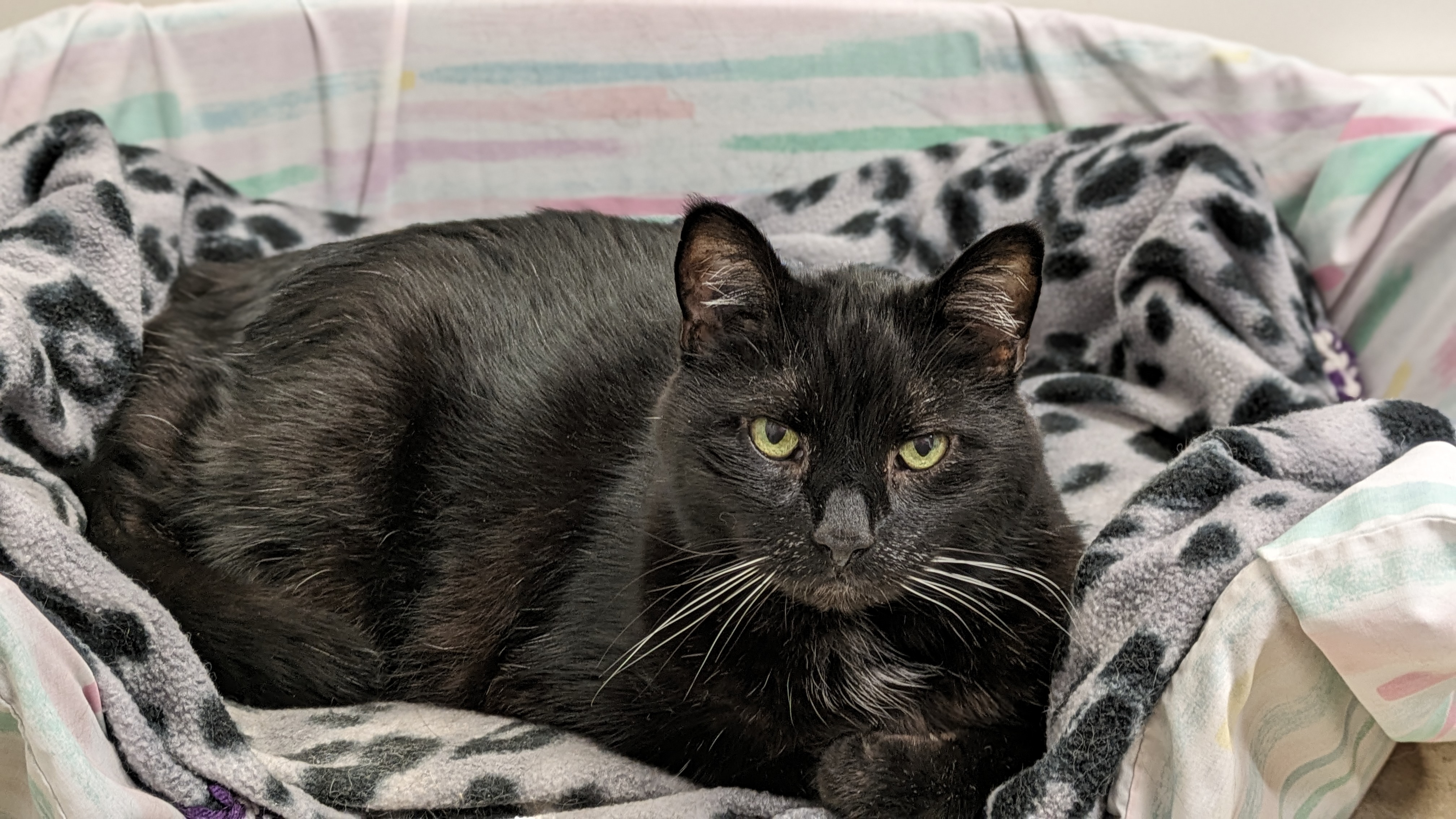
RAPS is short for Regional Animal Protection Society, a registered charity and operator of a sanctuary which houses and cares for nearly 500 homeless or abandoned cats in Richmond, BC, Canada. The Neko Files is a celebration of the sanctuary and all those who live and work there.
Showing posts with label Careen. Show all posts

Wednesday, April 17, 2024

BFFs Living Apart

Careen  (MW)
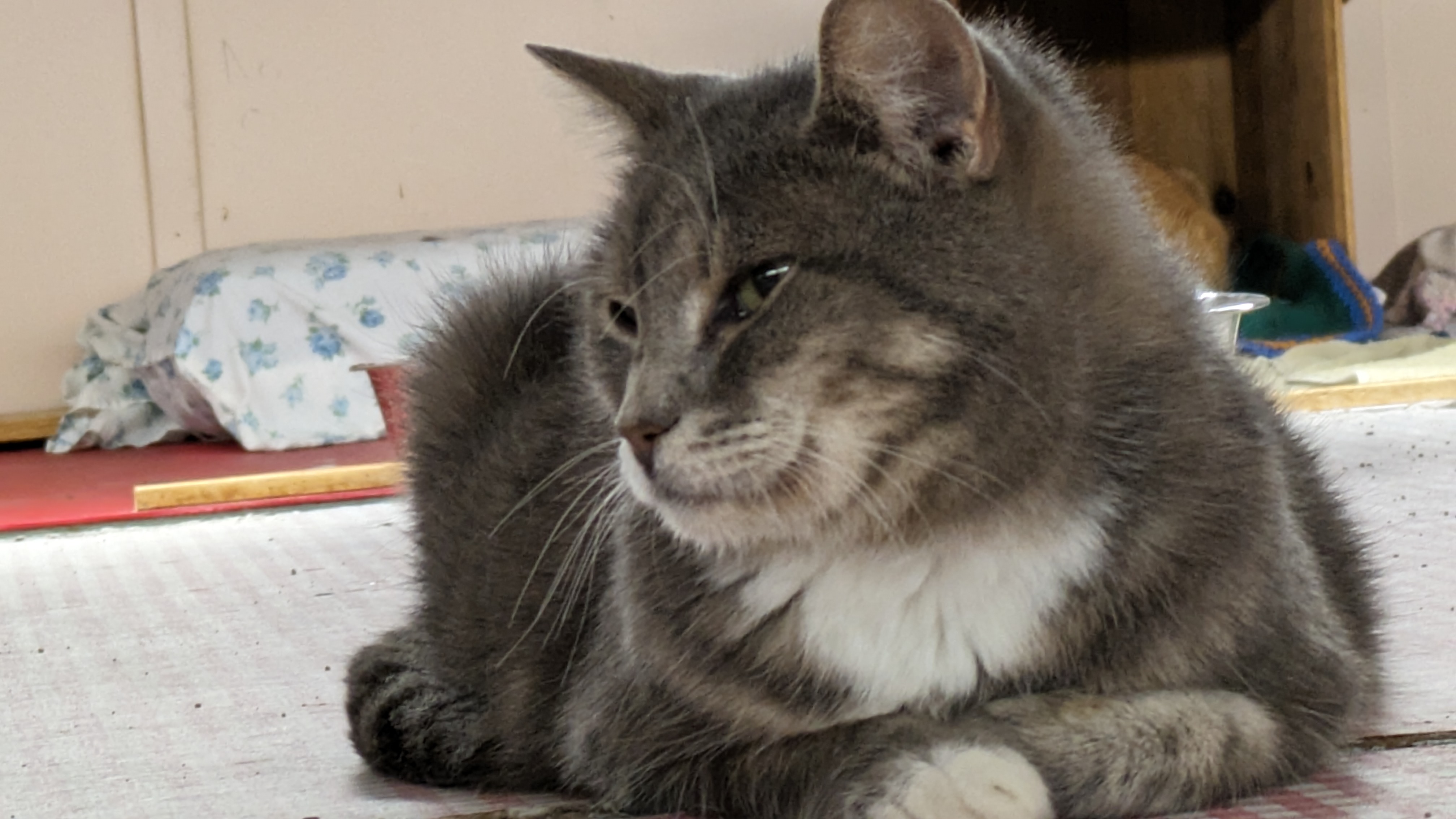
 For years, Pen 5 was the home of the bonded cats – pretty Salish and black Rudolph, siblings Adam and May, the menage a trois of Walker, Capilano and Chinook, and best girlfriends Careen and Willow. Only Adam and May remain – five others have passed over the last couple of years, and the two grey girls have gone their different ways.

Willow & Careen on Pen 5 porch    (KN)
Willow and Careen loved each other’s company. They came from different places, but each recognized a kindred spirit in the other.  For a while Willow was caged with an ear infection that affected her balance (vestibular disease) and when she recovered, she could often be found cuddling on the deck of the Pen 5 hut with Careen. She still carries her head slightly tilted - a long-term result of that condition.

The perfect way to spend and afternoon   (LBF)
But Willow has always been more of a wanderer than her buddy; Pen 5 was not her only home, and she could often be found bunking in Waldi’s hut – I suspect she liked that it was warmer.  Careen stayed around Pen 5, and enjoyed interacting with visitors at the weekend; she’s a gentle girl who likes attention and was always popular.

Willow, cosied up in Waldi's hut   (JN)
However, we began to notice that all was not well:  her fur became patchy and harsh, she put on weight, but not in a good way. Finally she was brought into the DoubleWide and caged for medical care.  Tests focused on hormonal changes, but in the end it was established that she was diabetic, and needed to join the cats who are checked regularly, and given twice-daily insulin. Because she was largely an outdoor cat, there was some discussion about transferring her to the SingleWide, to be with the other diabetic cats who live there – but in the end, it was decided that the med staff would see how well she could be managed for medication in surroundings she knew.

Careen enjoying the cage-tops   (BC)
In fact, it turned out to be unwarranted concern – having been caged in the DW, and had her initial treatments there, Careen decided that this was the place that she was most comfortable, and established herself as a regular DW cat. Occasionally the med staff have to coax her down from the cage-top to have her insulin shot, but when the latter is usually accompanied by a dish of tasty food, it didn’t take long for Careen to adapt to the new routine.

Waiting for her meds - and the tasty treats that come with them  (BC)
Sadly, it’s meant that she’s opted to remain an indoor cat, and has lost contact with Willow. And since all the tasty stuff is found there, Careen’s not got much incentive to explore outside her immediate surroundings.  Willow continues to migrate from Pen 5 to Waldi’s Hut, and enjoys interacting with volunteers and visitors in the main courtyard; she’ll often join us at coffee time for a little petting and a few tidbits, but she doesn’t venture into the DW.  As it gets warmer, the outer door is occasionally propped open, so there’s less of a barrier – I can’t help hoping that one of the pair ventures outside her immediate comfort zone and encounters her friend again, renewing a long friendship currently on hiatus.

Blog by Brigid Coult
Photos by Lisa Brill-Friesen, Brigid Coult,
Joanne Nicholson, Karen Nicholson, Michele Wright

Wednesday, November 22, 2023

Our Sweet Diabetics

Careen (MW)
November is Diabetes Awareness Month – but not everyone may be aware that cats, too, can suffer from diabetes.

Nikki and his Shadow  (KN)
There are two types of diabetes in cats. In Type I there is a decrease in insulin production, and therefore blood glucose concentrations are high. In Type II diabetes, glucose levels are high because cells in the body do not respond appropriately to insulin. In both types, the body cannot access the sugars needed, even though there is plenty of sugar in the blood, because insulin can’t transport the sugar from the bloodstream into the cells that need it.  Type II is the more common variety, and though it cannot be cured, it can be controlled with injections of insulin, and in some cases, with dietary management. 

Mojo is one of our larger cats  (BC)
Currently we have five cats with diabetes at the Sanctuary: Luke and Careen in the DoubleWide, and Nikki, Blaze and Meepos in the SingleWide. Two other cats are watched: big Mojo lives in the offices, where we can control his diet; his diabetes is currently in remission, and as long as we don’t let him overeat, we can probably keep it that way.  And newcomer McGregor (in next week's blog) came into our care with possible diabetes, but also seems to have it in remission – we watch him carefully for signs of recurrence. In his case, elevated blood sugars may have been a sign of stress.

Nikki holding court - look at those big
polydactyl feet!   (KN)
Nikki Sixx-Toes was diagnosed diabetic when he came into our care. He was a semiferal cat, wary about being handled, and the pen where he was living did not allow the med-staff to treat him without additional stress to his system. Reluctantly, we brought him inside and caged him – and unlike most feral cats, he grew to love it, and the attention it brought him. He got lots of fussing in his enclosure near the staff office, and received visitors with regal enjoyment.  Four years later, his throne has moved to be the papasan chair on the deck, where he is attended and guarded by his girlfriend Shadow.

Shy Meepos (KN)
Also on the deck, but usually hidden away, is fellow-diabetic Meepos, whose condition is of more recent diagnosis. Meepos has been with us for more than eleven years; he was trapped as a feral on Mitchell Island in the company of his buddy Bossanova, and the two of them were initially pretty shy, and took great comfort in each other. Meepos was initially the friendlier of the two, but never became as sociable as Bossanova – he will emerge and accept gentle attention if it’s quiet, but he prefers to stay out of the way. His is late-onset diabetes – most of his time with us, he’s been fine, but he’s not an active boy, and between his inaction and aging, his system quit processing blood-sugars properly.

Blaze (MW)
Sweet Blaze is the sister of fellow-tortie Toes, who lives in the front courtyard. The two were separated when Blaze developed skin problems and was brought inside where she could be treated more easily. She can usually be found on the shelves backing on to the big cage, and loves to have attention so long as she can remain in her own space. Like the other diabetics, she’s something of a chonk – it’s hard to balance the need to give them extra food at the same time as they get their insulin injection, with not overfeeding them. Their extra is mostly protein, with a few treats, but with so many cats around, there’s no way of stopping them eating more of the crunchies that are out for the cats who prefer to graze. With food and insulin every 12 hours, they have no reason to be hungry, though, or to raid the crunchie-bowl.

Luke (BC)
In the DoubleWide, Luke is the younger of the two diabetics. He is part of the Tuxedo Club that hangs out on the deck, and he has also suffered from dental problems, which have necessitated occasional caging while he heals. He’s an active and social cat, both with humans and with other cats, and just loves attention – which makes it much easier to give him his doses.  The other diabetic in the building is Careen. Careen was an outside cat for some time, and shared cuddle space with sweet Willow in Pen 5. When we recently noticed her changed habits in terms of eating and peeing, she was brought in for testing, and remained caged for a bit longer. As an outdoor cat, there was some discussion about her release – she’s friendly and handleable, but trying to find a grey cat on a dark night to give her insulin could well be a problem. However, Careen decided that having been moved into the DoubleWide, she might as well stay in warmth and comfort. She can usually be found peering down from the cage-tops, and her one bad habit is that when it’s meds time, she moves herself to the most inaccessible spot, and takes some coaxing to come and enjoy her special plate of goodies (and the minimal needle prick that goes with it).

Careen on the DW cagetops (BC)
Diabetes in a cat is a long way from being a death sentence, and doesn’t need a vet to do the injections; the insulin needle is very fine, and the dose is very small – the only disadvantage is that the cat-parent needs to schedule their activities in order that the dose is regular. And getting special plates of food – they must feel as if they are being treated as the royalty they consider themselves to be.

Blog by Brigid Coult
Photos by Brigid Coult, Karen Nicholson, Michele Wright

Thursday, April 14, 2022

Revisiting Pen 5

May & Adam  (KN)
The Sanctuary has been sited here since 1999, and many cats have come under our care in those intervening years. The majority of them have been ferals, and a lot of ferals don’t live long lives – longer with us than if they were truly out in the fields, but an early lack of care can affect them in later life.  We have had two significant generations of cats in Pen 5. The first group came to us as Steveston was being developed in the early years of this century, and we called them the Packers cats. BC Packers was known as one of the largest salmon canning industries, but by the ‘80s, the fishing industry was in decline, and the last processing took place in 1997.  As buildings were demolished and sites prepared for new construction, many cats were trapped by Carol and her Richmond Homeless Cats friends, and they were early tenants of the new Sanctuary.

Nevada - one of the Packers cats   (CF)
When I first volunteered twelve years ago, the Packers cats were getting very frail, and their numbers were diminishing. But there was no lack of new cats being brought in to the Shelter, and transferred to us when needed, and one such group joined the Packers cats in Pen 5. Initially it was kept as a closed pen, hoping that some of the inhabitants might return to the shelter for adoption – Katie, Moe & Theo all found homes. But when there are kittens, that’s what many people adopt, and the remaining adults stayed on, establishing the now open pen as their home.

Salish & Rudolph  (MW)
For some time it was also the pen of the bonded cats. Adam and May, Rudolph and Salish, Willow and Careen, the menage a trois of Chinook, Capilano and Walker – all devoted to each other, and rarely seen separately. In the last few years we’ve lost Chinook and Capilano, and sadly, Rudolph as well (to dental anaesthetic). 

Salish  (KN)
That last death was worrying because of Salish, who was devoted to her black buddy, but she seems to have adjusted well – she stays close to Adam and May, and though she’s still skittish about touch, she’s ready to emerge when treats are offered.

Walker  (MW)
Blond Walker lost both his loves: Capilano and Chinook had no great fondness for each other, but both turned to Walker as a calming influence, and he cuddled impartially with either of them.  He continues to sleep in Pen 5, but is to be found anywhere around the back courtyard, often in company with Pumpkin. The two of them are determined chickaholics, with a keen instinct for when tidbits are being handed out!

Careen  (MW)
Willow and Careen, who were always found together, appear to have separated. Careen still bases herself in the Pen 5 cabin but will often come out into the courtyard to visit if humans are sitting on the benches.

Willow  (KN)
Willow has become much more migratory, no longer confining herself to Pen 5 – in fact, she can most often be found in Waldi’s Hut at the south end of the courtyard, where she can get some space to herself – but she too joined in the courtyard cat-party last weekend!

Kramer  (MW)
Kramer joined the colony about four years ago, and remains the odd guy out – he doesn’t interact much with the other cats, but he has clearly made the Pen 5 cabin his home, and rarely ventures further afield. He is very happy to have human attention, but on his terms. Sadly, one of the attentions he doesn’t enjoy is a long-haired cat’s consequence to solitary living – he doesn’t appreciate having to be de-matted (though he’s not yet been in a bad enough state to need a lion-cut!)

a pleasant afternoon on the Pen 5 porch   (MW)

Many other cats wander in and out of the pen – it’s a favourite bathroom for the DoubleWide cats who prefer not to use a litter-box. And it’s one of many areas that will need a good work-party to make it look clean and inviting before we welcome visitors back to the Sanctuary at the end of the month.

Blog by Brigid Coult
Photos by Brigid Coult, Claire Fossey, 
Karen Nicholson & Michele Wright

Thursday, August 1, 2019

Careen & Willow

Pen 5 is largely inhabited by big cats.
Big floofy cats....
Adam & May - DW
Solid muscular cats...
Rudolph - MW
Cats who definitely could do with losing some weight.
Capilano - MD
And then there are Careen and Willow.
These two sweet grey girls are of the small-but-solid variety.  They came from very different situations, several years ago. Careen comes from the same site as many of the No 8 Pen cats – the Lafarge cement plant in Richmond – but unlike most of them, she was ready to be friendly with humans.  Unfortunately, by the time she came to us, the main shelter was in full swing of kitten season, and there was no room for Careen.
Careen - MW
Because we wanted to keep track of her, she was put in Pen 5, which was closed at that stage, and she quickly settled with her new cat family, though she became much shyer, once away from constant human contact.
Pet me now! - MW
She enjoys wandering the extent of Pen 5, and is much happier now about coming out to meet visitors, and indulging in human attention.
Careen naps - MW
She became the buddy of another little grey girl also from east Richmond.  Willow was a former farm-cat who came in as a typical scared feral who didn’t want human attention.  Her sister is Amelia Earheart, who hides out in Pen 4 with the ferals.
Young touch-me-not Willow in 2013 - PH
However, Willow was one of the cats who developed vestibular disease – a condition of the inner ear which leaves the cat off-balance and nauseous – and the necessary course of cage-care to help her recover had the added advantage of proving to her that humans were less scary than she had thought.
Willow - JK
Like many of the cats with this condition, Willow has been left with a slight head-tilt, which doesn’t seem to affect her movement, but certainly leaves her looking cute!  (Fellow felines Babylon, Tara and Tibet all have a similar head-tilt – though Babylon can turn his head round more like an owl!)
Willow - PH
Both Willow and Careen enjoy gentle attention from visitors. As former ferals, we would be very wary about allowing adoption unless they were to bond with someone – and they might well not adapt well to becoming indoor cats after enjoying the freedom and safety of pen life.
Willow was Miss June in our calendar two years ago! - MW
Their favourite place is to be found on the front step of the cabin, where they happily share a chair and mutual cuddles.
Willow & Careen - KN
The idiom “it’s a dog’s life” is usually taken to mean that life is unpleasant or boring. There is no feline equivalent idiom, but a cat’s life, for Careen and Willow, feels pretty good!

Blog by Brigid Coult
Photos by Melanie Draper, Phaedra Hardman, Jennine Kariya, 
Karen Nicholson, Debbie Wolanski, Michele Wright

Saturday, April 15, 2017

Ears!

A few months ago I blogged about the variety we find in cats’ eyes, and I’ve been looking round the Sanctuary at the similar variety found in feline ears.

The primary differential is whether the basic shape is rounded or more pointed. There are a lot of rounded ears to be seen, and the proportion of ear to skull shape can make that more or less obvious.
Careen - MW
Other ears are more pointed, and in many cases, the point is emphasized by a little tuft of hair at the apex – a lynx-tip.  Sometimes the tuft is the same colour as the cat, which enhances the point;
Chatter & Colin (MW)
in others, the lynx-tip provides colour-contrast.
Emery (MW) & Faline (BC)
Ears are a part of body-language; we all recognize the flattened airplane-ears of a fearful or angry cat
Ringo  (BC) and Janine (MW) in hiding
Presley  (AL)
though in some cases flattened ears are just the way that cat is made
Emo Pickles relaxed & happy (PH)
When doing TNR (Trap-Neuter-Release) it is common to notch or snip the ear of a neutered cat so that it is clear that it doesn’t need to be trapped again when the colony is checked.  Most of our cats have unmarked ears because they come to us from having been spayed/neutered.  Little Marilee is one of the exceptions; when she was first TNR’d she was returned to her colony with the common clipped ear; it was only when her tail became injured and had to be amputated that it was decided that she needed to remain with us rather than return to her colony.
Marilee (MW)
Haematoma ear is seen in a number of cats. An infection or a bruise can cause painful swelling between the skin and cartilage of the ear. Untreated, it fills with blood and then easily bursts, causing the ear to crumple. If it can be caught early enough, it is possible to minimize the damage.
Little Orange (MW)
Little Orange’s ear swelling was discovered early enough that just the top of the ear flap was affected. He was not the most cooperative of patients!
Bossanova (MW)
Bossanova came to us as a feral with his ear already well crumpled. Left to itself the haematoma will heal, but unevenly, leaving the feline equivalent of a “cauliflower ear”
Cara (CF)
Long-time volunteers will remember double-haematoma cat Cara, who had both ears affected – it never seemed to bother her!

Especially among the formerly unneutered male cats (many of them inhabitants of the New Aids pen) we see evidence of a life that involved fighting for their lives – and battered ears are definitely a common casualty.
Sweet battered Zimmer  (MW)
It is interesting that ear-hair, something that is SO aesthetically displeasing in humans, can be so pretty in cats.
Here are some of our feather-iest ears!
OJ  (MW)

Holland (MW)
Princess Diva (MW)

Blog by Brigid Coult
Photos by Brigid Coult, Claire Fossey, Phaedra Hardman, 
Ari Lioznyansky, Michele Wright

Saturday, March 26, 2016

Sanctuary Pen Five

Pen no. 5 is a little quieter these days – our sweet trio of Arlington, Kirara and Spaz have gone into foster-care – mostly with an eye to keeping alert to Spaz’s diet, and helping him lose some weight with a combination of fewer calories and more exercise. The three of them are greatly missed, but we’re very happy for them – they were surrendered to our care from a home, and it’s good to see them going into a home together.
They were a trio that was very demanding of attention from visitors, and it’s good that the other cats get a bit more of a look-in now.  I will hope, in upcoming blogs, to put more focus on individuals, but here’s an overview.
You’ll likely be greeted at the gate by big ROOKIE. He came to us as an unneutered stray, found by volunteers Barb & Waldi, who always make a point of visiting him.
Rookie - MW
HUDSON is very chatty and friendly from outside the pen – especially if treats are being handed out – but a little more wary about being touched by visitors; he will often take himself up to the top of the cat tree nearest the door.
Hudson - PH
Blond WALKER is the most vocal of the cats, and again, likes humans on the other side of the fence, but is none too sure about the ones inside. He’d rather hang around with his buddy CAPILANO, who is not friendly to humans, though calmer than he used to be. Capilano is another big boy, though his weight took a dive when he needed some serious dental work. 
Walker & Capilano - MW

Walker also seems to get on with a number of the other inhabitants of the pen, which includes two small grey cats. WILLOW is currently caged for vestibular disease – a condition that affects the inner ear, and therefore the balance of the cat.  CAREEN is shy but very sweet.
Careen & Walker - PH
ADAM & MAY have been introduced before; they are practically always together. Both enjoy being petted, but are not too sure about taking human attention much further yet.
May (top) & Adam - BC
There are a few lap-cats, though. CHINOOK was wary about people when he came in, and is now very find of attention, and loves to climb onto a lap. He’s a little sensitive around his lower back, but if you keep your petting around his head, he loves it.
Walker & Chinook - MW (Calendar cats!)


SALISH looks like another big animal, until you take a look at the head, and realise that it’s quite a small body under all that fur!  She’s another very shy, but beautiful cat.
Salish - MW
Handsome black RUDOLPH is either in hiding, or being the total flirt – he has the most beautiful fur, rather like Ninja.
Rudolph - MW
Just a reminder for visitors: we ask that people don’t go into this pen to visit them without an experienced volunteer or one of the staff present.
Blog by Brigid Coult
Photos by Brigid Coult, Phaedra Hardman, Michele Wright