RAPS is short for Regional Animal Protection Society, a registered charity and operator of a sanctuary which houses and cares for nearly 500 homeless or abandoned cats in Richmond, BC, Canada. The Neko Files is a celebration of the sanctuary and all those who live and work there.
Showing posts with label JackieO. Show all posts

Wednesday, September 21, 2022

Feeeeet!

Freya's feet   (MW)
 If you are reading this blog, you are probably one of the many people who uses social media to indulge in your feline addiction.
We post pictures of our own cats, our friends’ cats, cat-memes, famous cats like Cole & Marmalade or Maru.  If we are lucky enough to be associated with a shelter or a cat sanctuary, our cell-phones are loaded with images. Kittens and seniors, feel-good stories and sad tales of abandonment, all touch our emotions. 
And one of the never-fail images is of FEET.

Bentley paw over nose  (KN)
Paws, to be exact.  Poofy paws, usually, with claws discreetly hidden.  Poofy on the top, and with a variety of patterned toe-beans below.

Claws are useful for Plum to grab a treat  (KN)
Human feet are definitely not so interesting. Nobody wants to look at pictures of cattle or horses’ feet – impressive though they may be. Dogs – well, perhaps some of them.  But cats’ feet almost always get an “Awww” response.

Jasper demonstrates the pile of paws pose  (KN)
Cats are DIGITIGRADE – meaning they walk on their toes. This is why it is so cruel to declaw a cat – you’re taking away the top joint of the toe, and everything is more uncomfortable without it.  Many declawed cats will end up in a shelter or a sanctuary because they hate to use a litter-box – it hurts their feet. And many will lose muscle tone because they don’t like to move around so much, and are unable to give their muscles a real workout without digging their claws into something.

Akiva has no claws - but he still needs to clean between his toes  (KN)

On a hot day, they can often be found with pads exposed – when you have a fur coat, paws may be the only place you can cool off by sweating.

Lindor cooling off, with all paws exposed  (MW)

Cats use their paws for much more than just walking. They climb (sometimes having to return backwards down a tree); they dig (with luck, mostly in the litter-box), they leave scent markings for other cats to decode, they fight other cats (especially Jasper and Gizmo), they swat unwary humans, they wash up with velvet paws, and then extend their toes so they can clean between them.

Mr Binx clean-up time  (KN)
Our Sanctuary cats give us a wonderful collection of feet to admire

Alexandria is one of our very active cats, and her flexible paws are often used for climbing.

Alexandria offers the Vulcan salute  (KN)

Jackie-O is also a climber, possibly made easier by an extra “thumb” on her front paws
Jackie O's paw  (KN)

Extra thumbs help to hang on   (MW)

We have several polydactyl cats at the Sanctuary. Raymond in Val Jones, Christina Aguilera in the Front Courtyard, and NikkiSixxToes in the Single-Wide all have more than their share of toes.
NikkiSixxToes could also be called Bigfoot   (KN)

A glass table-top in Pen 3 is an irresistible tool for getting feet pictures from another angle

The models on top  (LBF)

paws from below  (LBF)

This dark tortie girl was named for her blond toes!
Toes  (EW)

Sometimes we call them “murder mittens” – but often when you see them like this, the cat is usually asking for attention
Kiefer's velvet paws reaching through from the Single-Wide (KN)

Winston says "Reach out and touch me!" (KN)

And of course, there is nothing we like better than to have a purring pile of fur in the lap, and the sensation of being kneaded gently as the paws show how much we are loved!
Roe loves a lap!  (JS)

Blog by Brigid Coult
Photos by Lisa Brill Friesen, Brigid Coult, 
Karen Nicholson, Justin Saint, Erica Warren, Michele Wright


Thursday, January 6, 2022

Winter Kitties


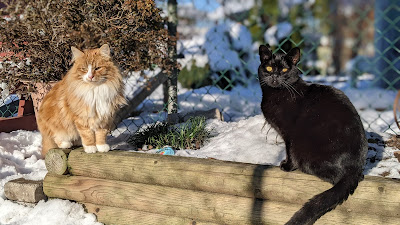
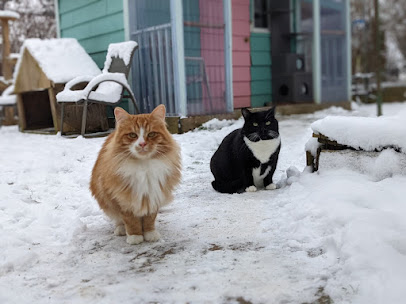
Cornelius & Gemini enjoying snow and sunshine (LBF)
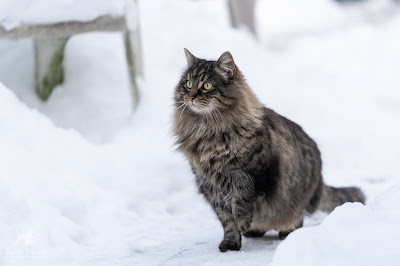
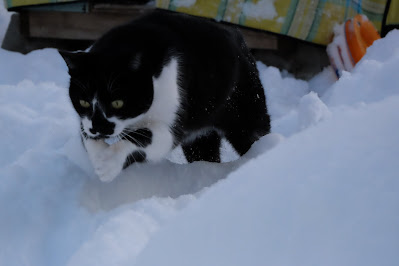
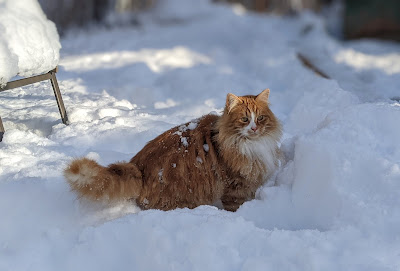
Ten days of snow in the Lower Mainland is pretty unusual; most of us need to head to the mountains to get the white stuff. So when it happens, everyone is taken by surprise - cats included!

Leo seems to love being outside  (KN)
Most humans and cats tend to fall into one of two categories; we turn our backs on what's going on outside and cosy up for the duration, or we get outside and enjoy winter sports.

The Pen 6 cats would rather stay in a warm floofy pile  (LBF)
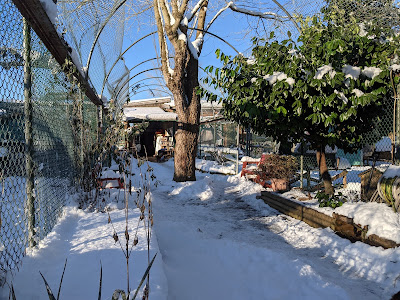
This happened during the holiday, when we had volunteers missing, and covering the extra shifts was complicated by the need to dig out paths to access the various buildings.

Sunshine on (piles of) snow.  (BC)
The majority of cats seem to prefer their comfort, and stayed safely in their buildings. There was, after all, no point in putting plates of food in their usual places outside; frozen catfood is not appealing to anyone. 

Chai is much more an indoor kitty than she used to be;
she stays carefully in the shoveled areas (KN)
In the front courtyard there was some serious hibernation, with only occasional visits outside to investigate the conditions. 

Autumn loves the snow, and her thick coat keeps her cosy  (MW)
But there are always a few intrepid explorers.

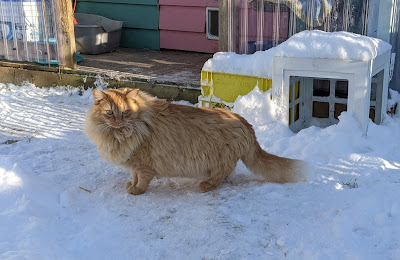
Kenji is another floof with no fear of the cold   (LBF)

Something under the snow attracts Figaro's attention  (KN)

The pen 3 cats are from Alberta.  They probably have no actual experience of an Alberta winter, having come from a hoarding situation, but they have been eager to get out and investigate.

Cornelius leads the way (LBF)

but encourages the others to join him!  (KN)

The pen 6 cats are from Kamloops and have undoubtedly survived winter cold. Their thick fur is good protection, and though they'd rather cuddle up and stay warm, some of them are willing to brave the cold to get a bit of fresh air.

Cheeto  (LBF)
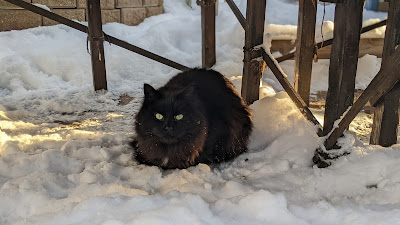
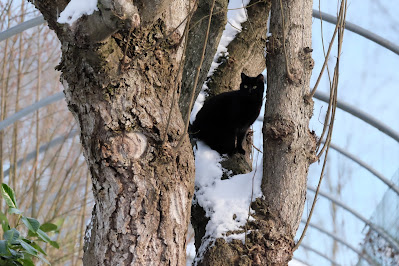
For some reason, the tree is especially attractive in this weather, and there have been several little black climbers surveying the Sanctuary from above.

Jackie O is the chilly queen of all she surveys  (KN)
Not everyone is happy, though.

Jasper's paws are cold!  (KN)
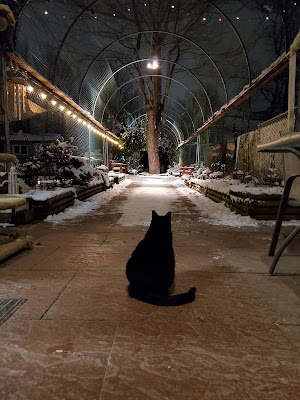
In the evening, they all return to their cabins, and leave it to the volunteers to tramp through the snow to deliver dinner.

Sanctuary at night (JS)
It's beautiful - but it never lasts long.  And nobody - cats or humans - enjoys the rain that inevitably washes it all away. 


Blog by Brigid Coult
Photos by Lisa Brill-Friesen, Brigid Coult, 
Karen Nicholson, Justin Saint, Michele Wright


Thursday, December 16, 2021

Visiting the Shut-Ins

Plum - caged for bath-time   (MW)
One of the things that so many of our visitors adore is the freedom that the Sanctuary cats have to roam. There are limits, of course – leukemia and FIV cats have separate areas, the Single-Wide cats never go out of their building, and some of the back pens are kept closed to give the cats inside a better sense of their own territory.  But people often come, expecting cages, and are surprised to find that they are the exception rather than the rule.

Rico, when he first came to us; now he roams the back pens freely   (BC)
So why do we have cages at all? Well, any new cat needs an acclimatization period, during which they become aware of other cats around, with whom they don’t yet have to interact.  They may have vaccinations due, or be recovering from spay/neuter surgery. And they need to get to know the people who will be working with them.  Perhaps they’re a cat that someone has identified as “off colour” and they are caged so that the med staff can assess if they’re eating/drinking enough, if they’re using the litter-box – perhaps a visit from the vet or a trip to the hospital is in the cards.  We’ve recently had a group of cats from one pen, with upset stomachs – they’ve been on a special diet, and it’s taken having the whole colony of that pen on dietary restriction to get it under control (they’re all back together now, and very happy about it).  

Poor Taylor has dental problems, and many teeth pulled;
hence the tongue-tip showing   (KN)
Perhaps a cat has been diagnosed with a condition like diabetes or hyperthyroidism, and they need to have cage time to get used to being medicated – and to allow the staff to assess how that medication will be most effectively administered. Or perhaps (and this is very common) they’ve had dental surgery, and are on a no-kibble restriction (which means extra wet-food treats!)

Winston getting cage-time snuggles  (MRJ)
A cat who is caged may only see the med staff when being medicated, or a volunteer when food is being offered or the cage cleaned.  The work of the Kitty Comforters is very important with these cats, encouraging contact with the shy ones, and making sure that the social ones don’t feel abandoned.  Many of the volunteers will spend extra time with the caged cats once a shift is “finished” – because for many of us, it’s not finished until we’ve shared cuddle time with our charges.

Quinn is not happy about being caged  (BC)
My Saturday evening place is with the Double-Wide cats, and last week, having fed everyone and checked on water and kibble, I went back to spend more quality time than just simply putting a plate down.  Two of our shyest cats were tucked away in different corners:  all I got from black Michonne (pen 4) was an unfriendly hiss, but handsome tabby Quinn, though hiding in a corner, gave me his best owlish stare.  Quinn is a buddy of my sponsor cat, grey Sylar, and is usually very keen on the prospect of chicken tidbits; he rarely allows himself to be touched and I was not about to force it on him, but with this visit he was not much in a mood for eating, either.   He will be watched carefully, and force-fed if necessary.

Oscar has to be tempted to eat a little of his special food   (BC)
Our Haida Gwaii teddy-bear-cat, Oscar, liked the cage he first came to so much that he has refused to vacate it. Right now he is confined so we can see just why he’s a bit off-colour, and just what he’s eating.  The med-staff are finding little tasty plates for him, and he will sometimes eat while there is someone there to admire, and talk with him. Sadly, he is not fond of the company of other cats, so a closed cage suits him well. 

Hillie enjoying visiting time  (BC)
Cow-cat Hillie has been caged for a while with a cold;  when a cat gets congested, not only is the breathing impaired but sometimes so is the appetite, because they may not be able to smell the food. Hillie seems to be doing well, but she’s less active than usual. She was very pleased to have a visitor, and emerged from behind her drape to sniff me over and accept attention. 

KeKe is not happy about necessary medical attention  (BC)
A temporary resident in the cage opposite is cranky KeKe. She is one of our diabetic cats, and more importantly, she’s one whose blood sugar fluctuates a lot, so she needs regular glucose checks. She is not happy about this – not because it’s particularly painful (the prick of a glucometer or of an insulin needle is negligible) but because she resents being handled on someone else’s agenda. She makes her feelings known very vocally, and by changing her mind frequently about what she will eat. The med-staff offer her a regular buffet of gourmet cat-food, and she will often make it quite clear that none of it is good enough.  It can become a real battle of wills to get her to eat before she gets her insulin and is released from the cage for the rest of the evening.

Rodan is happy to be caged and fussed; the more visitors, the better!  (BC)
In the cage backing on to hers there are two cats from the same pen – sometimes the presence of another cat that is known can be a comfort to a stressed animal.  In this case, grey Odie couldn’t care less; he has established himself at floor level and does not want to be bothered, letting me know by his hissing that he does not appreciate the visit. Rodan, on the other hand, is delighted by the presence of a friend. This sweet one-eyed boy is the only cat in pen 7 who is really comfortable with humans – a good thing, because he gets recurring colds and ear infections, and is a regular user of med-staff attention. He ignores Odie, and rolls happily at shelf level, begging for petting and treats.

Luke would rather mooch for treats than eat what's on his plate  (BC)
His next-door neighbour perks up and also begs at the mesh for chicken bits. Luke, normally a back deck member of the Tuxedo Club, is our newest diabetic, and is caged to accustom him to treatment and help us get a base-line on his glucose levels. He’s not likely to be a problem to medicate – most of the diabetics are pretty easy-going about the whole process. The biggest problem is convincing them that because they demanded tuna yesterday, it’ll be equally tasty today – it seems like the moment diabetes is diagnosed, they become pickier about what they will eat than Jamie Oliver!

JackieO hasn't let the loss of her tail affect her climbing skills;
she REALLY wants to be back out again  (KN)
The last cage belongs to a sweet girl – but a visit requires a towel. JackieO came to us in 2020 as a cat made incontinent by a tail-pull injury; we had her tail amputated (it was effectively paralysed) which meant that it was easier to keep her clean. The amputation has not slowed her down one bit – she climbs and jumps and plays as much as ever, and her polydactyl paws are always busy. She’s got a messy gut problem right now, and visiting requires the visitor to be well protected; we check and change all her bedding on a regular basis, and hope her medication will sort her out quickly so she can go back out to play – at the moment it’s rather like telling a child that they have to stay in their bedroom.

Nobody likes to think of the cats being caged; at least, in the DoubleWide, they’re big cages, so human visitors can sit fairly comfortably, and let the patients know that they’re not forgotten, and that the big wide world awaits them if they’ll just hurry up and get better!

Blog by Brigid Coult
Photos by Brigid Coult, Marla Rae Jenkins, Karen Nicholson, Michele Wright


Thursday, April 15, 2021

JackieO

 Just another little black cat – NOT!

JackieO - KN

JackieO is a little girl full of purrrsonality. She came to us last year as an owner-surrender – the owner having been told by the vet that her incontinence problems had no solution, and euthanasia was the only way.  Luckily, the owner disagreed, and JackieO came into our care.

Won't you play?  -  LBF

Apparently, she had originally come from Calgary – we don’t know the circumstances – but at some early age she sustained what’s called a tail pull injury, which causes neurological damage. It doesn’t necessarily mean that someone pulled her tail – it’s an injury that can happen under various conditions, such as a traffic accident – but it essentially involves the dislocation of vertebrae and the adjacent nerves that control anal and bladder function.

Waiting for the toy - KN

Euthanasia has its place for a cat who is suffering and has no quality of life. But JackieO doesn’t know anything is wrong; life for her is good, with people to interact with her, toys for play, other cats for company – she’s just discovered the great outdoors, with worms and bugs for excitement...

Keeping company with Charlotte - LBF

She’s still kitten-like – we think she’s about two years old, like her buddy Charlotte, who lived in the cage next to her. Now that both are out and about, they’ve gone in different directions, and JackieO entertains herself very happily.  Not only is she a pretty girl who attracts attention, but she is also a polydactyl – and those “thumbs” help when she’s grabbing onto a toy.

Showing her "thumb" - KN

We have our share of incontinent cats – most of whom have Manx syndrome. JackieO’s injury has a similar result – mostly she’s just not aware of when she needs to “go”; she can occasionally use a litter box, but we don’t count on it. She gets checked by the med staff at least twice a day, and bathed when it’s necessary. She still has her tail, though it has no sensation in it; in some ways it adds to the incontinence problem, because it hides what’s going on at her back end.  It’s likely that the vets will do an amputation at some point, which will help with keeping her as clean as possible.

Flies, ants, worms - JackieO is the Sanctuary's prime exterminator - BC

Tail or no tail, JackieO enjoys life; she runs and plays with a total lack of awareness of her handicap. A little extra laundry?  All in a day’s work at the Cat Sanctuary!


Blog by Brigid Coult
Photos by Lisa Brill-Friesen, Brigid Coult and Karen Nicholson


Thursday, February 4, 2021

Kitties from Haida Gwaii

 We are enjoying the company of two cats who have come to us from far in the north-west of BC. 

Oscar (L) & Charlotte (R) - LBF
All around the province there are rescues that do wonderful work, but the long-term future of cats in their care is limited because their space and resources are also limited.  If the cat is very feral, sometimes the only thing to be done is to spay/neuter it and return it to its source. Feral cats tend not to live long lives, but you have to balance a life lived in safety but also in fear, and one lived in the surroundings it knows.

I'd rather stay here, thank you....   KN
Sometimes the cat is obviously a stray and not a feral, and the issue then is finding it a home. If that is not possible in the community, it may be possible in another one.  And just occasionally it’s a feral cat, but the rescue thinks there’s hope, with time – and RAPS has time and space for that work. The rescues are often able to partner with a local airline, and we pick the newcomer up at the airport.

Any closer, and I'll smack you! - KN
Oscar was found at a dump in Haida Gwaii.  He is a big blond former tom-cat, who began by trying to convince us that he truly was a grouch, but isn’t quite up to keeping up with the act. His game is given away by his teddy-bear companion; staff and volunteers have to be careful to leave Ted where Oscar can see him.  As we do with most ferals, we have left Oscar’s carrier in his cage, and he prefers to hide in it for the greater part of the day, emerging occasionally to observe the world from a different angle. When you enter his cage, he retreats, but he is much less hissy than on arrival, and with the people of whom he approves, he will allow a little touching - and loves to play.

Smiling for string-toy play - PC
He reminds me very much of OJ in pen 4 – and he may yet end up in that feral pen – but we’re going to make every effort to reach the pussycat hidden behind those hisses. He’s not very fond of the other cats that pass his cage.  In many ways he reminds us more of Ranger, both physically and in attitude.  Ranger (who also came from the NorthWest) is still in pen 4, but by his own choice now; he will come out occasionally, but it’s now “his” space. It will be interesting to see if Oscar acclimates in the same way. The Kitty Comforters are spending a lot of quality time with him!

Wide-eyed scared kitten when she first came - KN
Oscar’s travelling mate is very unlike him. Charlotte is a tiny girl with a lot of fluff. She’s still quite young – less than two years old, we think – but she’s had a litter of kittens. She was put in one of the quieter cages, and with some reason at the beginning – she appeared to be terrified. But scared and hissy as she is, she’s actually made more progress than Oscar in terms of getting out of her carrier, and in interacting with humans.

Playing with her buddy Jackie O  -  LBF
Her age is a bonus; she’s young enough to want to play, and that offers bonding right away. Kitty Comforters with patience (and a pocketful of treats) are coaxing her into trust, and her cage door is now open, though she prefers to remain in its safety.  She is less stand-offish with other cats than Oscar is; she has bonded with the cat who was in the next-door cage, Jackie O, and the two of them have been found cuddling together.  She’s even been seen to roll over and expose her tummy to a visitor – an indicator of trust, though not an invitation for belly-rubs (yet).

Looking more adult...   LBF
Ferals progress at very different rates. Star and Leona, who came in together, are light-years apart – Star wants nothing to do with us, but Leona, with patience, may be adoptable.  The same with these two – it’s way too early to determine that Charlotte will be adopted out, but the potential is there, and we will give her every chance to find her own home and her own person.
Pretty kitten - LBF


Blog by Brigid Coult
Photos by Lisa Brill-Friesen, Pauline Chin & Karen Nicholson