RAPS is short for Regional Animal Protection Society, a registered charity and operator of a sanctuary which houses and cares for nearly 500 homeless or abandoned cats in Richmond, BC, Canada. The Neko Files is a celebration of the sanctuary and all those who live and work there.
Showing posts with label Marilee*. Show all posts

Thursday, December 30, 2021

Marty

Recent time spent in the Single-Wide has reminded me that there’s one little cat who has somehow missed having a blog to himself.

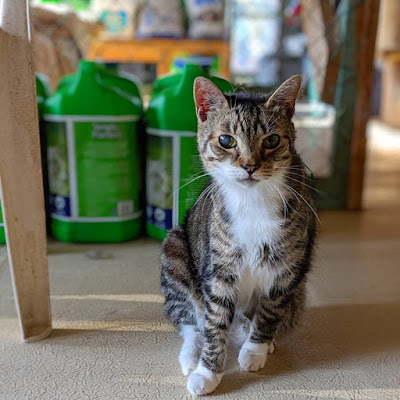
Marty, in his younger days   (MW)
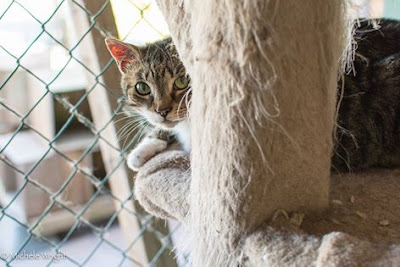
Marty is one of a group of cats that came to us from a farm in south Richmond in the days when we were still managing colonies of cats around the city, until they were forced out by development or changed ownership. Volunteer Mary He visited and fed them regularly, and when she saw a family of kittens there, she was able to trap them and bring them in.  Some of the adults later made it to the Sanctuary – Belinda, Marilee, Alec (who was adopted and loved by long-time volunteer Stephanie), Maureen, and others. But Mitchell, Mary, Mischa and Marty all came to the SingleWide, and never left; sadly, they were all too nervous to tame up well, and we were very wary about adopting semi-ferals out.  

Wary feral Marty  (MW)
They came to us in 2008; we lost Mitchell in the fall of 2011 and Mary a few years later; Mischa and Marty hovered in the background, reluctant to accept much attention until the past few years. Mischa likes to be around people but not necessarily within reach; Marty has recently become more and more a people-cat.  

Marty  (KN)
With me, he started by sneaking up from the back of the couch while I had lap-time with Belinda and Bossanova.  I became aware of this presence behind me, wanting in on the chicken treats, but not really wanting attention – so chicken bits would make their way over my shoulder where they would magically disappear. Gradually the couch back gave way to the arm, and then to a just-within-reach spot near me.

Chicken, please?   (BC)
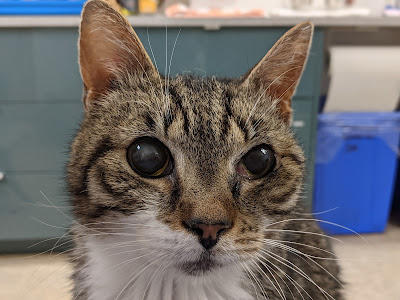
Marty has been having eye problems of late; one eye is quite cloudy and we don’t know how much sight he has in it; the other seems to get a recurring infection which responds to drops, and then flares up again. He’s had quite a lot of cage-time for treatment, and has become used to being handled and petted – with the result that he is now one of the most enthusiastic lap-cats in the room.  Both he and Mischa are obviously aging – at around 14 years they qualify as seniors, and as with people, some cats seem to age earlier (whereas others, like Sara Lee, go on like an Energizer Kitty).

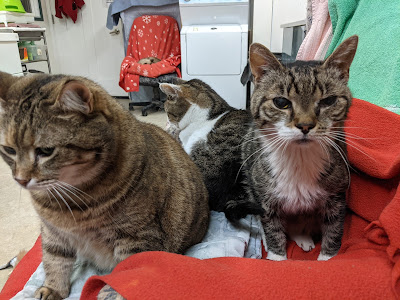
Sharing a chair with Dodger & Mr Pink  (BC)
When the weather’s not so cold, the couch on the deck is a good place to have a feline love-in. Boxing Day cuddles this year had to be a how-many-cats-can-you-hold affair in the main room, with Marty front and centre (and active) in my lap with Mr Pink, Bossanova over my shoulder, Dodger, Paylan and Presley all hovering hopefully.  Marty, you’ve come a long way from the scared feral kitten you were!

Blog by Brigid Coult
Photos by Brigid Coult, Karen Nicholson, Michele Wright


.

Thursday, May 10, 2018

Sunday Sanctuary Changes

Friendly Jake is always one of the first greeters - MW
Richmond Homeless Cats was founded in 1989 by Carol Reichert to address the needs of Richmond’s feral cat population. The Sanctuary came into existence when it became obvious that there were many cats who were never going to find a home – whether because they were feral, they had behaviour problems, or health issues. For years we were Richmond’s best kept secret – but gradually the word got out, and cat-lovers all over wanted to see what we were about.
The barn cats in pen 7 are shy semi-ferals  - MW
As a private organization we were able to set parameters around visiting, and Sunday afternoons became the favoured time – after the busy-ness of the morning cleaning was done, and before the evening feeding/scooping routines began. More and more people discovered us, and the number of visitors grew to a point at which we had concerns both for cats and for humans – the cats, because many of them were not used to unfamiliar people around them, and many of them would go into hiding to avoid attention – and the people, because inevitably there were scratches from cats who chose not to cooperate with handling, and it became very hard for the few volunteers on duty to monitor all the areas.
The back gardens - with no humans! - PH
We are, to some extent, the victim of our own success. The trouble is that many visitors have limited experience with ferals and semi-ferals, and look on the Sanctuary visit experience as if it were a petting zoo. The experience of  having more than a hundred visitors through on a not particularly nice day in early spring led us to consider what the situation was likely to be by the summer – and reluctantly, but for the safety of cats and humans alike, we’ve had to put some restrictions in place.
Puffin is tolerant only so far....     MW
The first concern was for very young children, and the decision was made to deny entry to those under 6 years old. Between 6 and 13 they are welcome, but must be attended by an adult at all times. Regular visitors know that cats like Puffin, Sophie, Lumi and Jobie are unpredictable, and we really don’t want an incident with any of them. Many of our young volunteers have first met the cats through Sunday visiting, but they cannot volunteer until they are 16 years old (unless they are working with an adult).
Hillie likes to wander - but she's not really comfortable round people -  DW
The second concern was for our shyer penned cats, and for those with health issues. It was decided to restrict access to all these areas – and to restrict it even to volunteers on Sunday afternoons, since it’s confusing for visitors to see someone in an area they’ve been told is out of bounds. Volunteers and Kitty Comforters can come and visit at the Sanctuary at any time, and will continue to do so, but Sunday afternoon focus is now on visitors, and volunteers who are present are there in the role of guides and ambassadors.
Shy Marilee hides behind her buddy Gilbert - MD
I have commented before that we have an ageing feline population, and an aging infrastructure too – timber that was in good condition when things were first constructed is now disintegrating under the influence of weather and enthusiastic claws. Many of our cat-cabins should really be replaced, pavers are buckling, pushed up by roots below, flooring needs to be re-laid, and the Single-Wide is only half-renovated. Generous donors made it possible to gut and renovate the Hill House, Connor and Old Aids in previous years, but there’s a long list of other projects awaiting attention.  So reluctantly, we have to be more pointed about asking for donations – financial or in kind.
Lumi scouting out her next victim - DW
It’s hard to make changes like this, and particularly hard on people who’ve made a routine of weekly visits, and look forward to visiting with favourite cats. We hope that some of those folks will commit themselves to being volunteers, giving them access not only during their shift but at other times.  Our primary concern has to be for the cats – not just for their physical well-being, but for making them feel that they are truly in a place that is a sanctuary for them.

Blog by Brigid Coult
Photos by Melanie Draper, Phaedra Hardman, Debbie Wolanski, Michele Wright

Thursday, April 26, 2018

Debbie-cat

Visitors to the Sanctuary know that one of the favourite places for front courtyard cats, especially in the winter months, is the area just at the top of the steps to the Single-Wide trailer.  At ground-level is a former paddling pool re-purposed as the Sanctuary’s largest litter-box; above it is a semi-closed area that holds a number of cat-beds surrounding a large papasan chair under a heat lamp.
Debbie, Gilbert, Spencer, Petunia and Lancelot
sharing the papasan
For ferals and former ferals who prefer not to be indoors, this is an area in much demand.  Cats in the papasan pile on top of each other to keep warm and cosy on otherwise chilly days. Boxes and beds underneath it offer a range of comfy places to hang out.
Little Debbie is a regular inhabitant of this area. Her distinctive nose-spot makes her easy to identify among the other tabbies, and she is one of the most reluctant to accept human contact. Many of her buddies are not exactly easy with people, but when treats are offered, cats like Petunia are quick to gather round, even though they don’t want to be petted. Unfortunately, Debbie doesn’t even want people to look at her, let alone to get within arm’s reach. Thank goodness for Michele's expert handling of lenses, which allow her to take pictures without looking as if she's looking!
This wariness can lead to problems for a long-haired cat. Debbie is one of those that has fine fur that mats from time to time, and she then has to go through the stressful process of being netted so that one of the med-staff can deal with her coiffure. It’s not surprising that she’s wary of us.
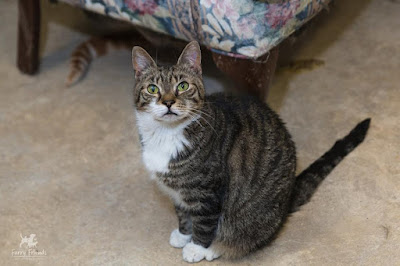
Debbie’s a long-term Sanctuary resident; she pre-dates human Debbie, but unlike her human namesake, she is not friendly and sociable. Some ferals gradually come to accept us, even to allow gentle petting. Marilee is a prime example of a feral who is starting to feel comfortable enough to be touched – when cuddling with Little Orange or Gilbert she is quite prepared for contact, and is now allowing select humans (sometimes even visitors) to pet her when she’s sitting alone.  
Marilee snuggling with Gilbert - MD
Debbie is hardwired for “cats good; humans bad”, and even a glance in her direction can sometime have her scurrying for shelter. This is where the RAPS Sanctuary comes into its own; under other jurisdictions a cat like Debbie wouldn’t have much chance as an untamable cat; with us, she is just one of many ferals that has a safe home here as long as she needs it.

Blog by Brigid Coult
Photos by Melanie Draper (last one) and Michele Wright (all the rest)

Friday, July 21, 2017

Tiny Cats

Silky - MD
Visitors to the Sanctuary often notice one of the small cats like Little Mama in the Single-wide trailer or Tricia in the Double-wide trailer and assume that they’re kittens.  It’s true that they do look like kittens but both of these cats are fully-grown and, in fact, quite mature.  There are a few other small ones around, like Sara Lee, Gizmo, and newly-arrived Bengal Jinx but none of them are kittens either.  So why are these adult cats still kitten-size?
Sara Lee - MM
In the case of the females, like Little Mama, Tricia, and Sara Lee, there’s a simple but somewhat sad explanation for their being so petite.  They all had litters of kittens when they weren’t much more than kittens themselves.  As any human female who’s been pregnant can testify, pregnancy takes a lot out of the body!  Humans are generally aware of the nutritional care required during pregnancy and are able to supplement those elements and calories that the growing baby takes from them.  Sadly, homeless female kittens don’t have that luxury. Cats can become pregnant when they’re as young as four to six months old.
Tricia - MM
At that age, their own bodies have certainly not fully developed and having a litter will most likely result in them never attaining full size.  For a young feral cat, their intake of nutritional food is erratic at best, and almost certainly insufficient to support a litter of growing kittens in utero.  They often have small litters of only two or three kittens, have difficulty giving birth, and may lose some or all of their tiny offspring shortly after birth.  Then they have to feed the voracious little babies, again at the expense of their own nutritional needs.
Little Mama - MM
Little Mama, Tricia and Sara Lee were all young and pregnant when trapped, which most likely explains their petite dimensions.  As a cat from a Bengal breeder, Jinx was unlikely to have been a teenage mom, but, despite being eleven years old, she still looks like a kitten.
Jinx - DW
There are, of course, other possible reasons besides early pregnancy for a cat being on the small side. Gizmo, known as “Gizmo the Grey”, is not nearly as large as the average adult cat but, since he’s a male, early pregnancy doesn’t explain his size.  He’s a feisty young ex-stray so probably didn’t get enough food to help his little body grow to a normal size.
Gizmo - MW
There are several other diminutive female cats at the Sanctuary, such as Jax (Jacky) in the Single-wide and Marilee in the front courtyard, but the reasons they’re small aren’t always known.
Tiny Merilee likes to snuggle with Little Orange
- who is not as small as his name implies!  - MM
Like humans, cats do just come in different sizes as a result of genetics and/or nutrition.   The “runt” of a litter or one who was ill or poorly nourished as a kitten has a decreased likelihood of reaching normal mature cat size.  Or, a small cat may simply be a member of a small breed or have parents of a small breed.  As they become elderly, cats who were normal sized or even large in their salad days lose muscle mass and begin to look as if they’re much younger.  Cheetah and Taboo in the front courtyard, and Booster in the Double-wide are all examples of cats who, as humans also do, have become smaller since they became "senior citizen cats".
Cheetah sunning his old bones - MW
So, when you visit the Sanctuary and see cats that are smaller than the others, it’s not because they’re kittens.  They’re fully grown but for some reason don’t look it.  But they do look especially cute!  

Blog by Marianne Moore
Pictures by Melanie Draper, Marianne Moore, Debbie Wolanski, Michele Wright

Saturday, April 15, 2017

Ears!

A few months ago I blogged about the variety we find in cats’ eyes, and I’ve been looking round the Sanctuary at the similar variety found in feline ears.

The primary differential is whether the basic shape is rounded or more pointed. There are a lot of rounded ears to be seen, and the proportion of ear to skull shape can make that more or less obvious.
Careen - MW
Other ears are more pointed, and in many cases, the point is emphasized by a little tuft of hair at the apex – a lynx-tip.  Sometimes the tuft is the same colour as the cat, which enhances the point;
Chatter & Colin (MW)
in others, the lynx-tip provides colour-contrast.
Emery (MW) & Faline (BC)
Ears are a part of body-language; we all recognize the flattened airplane-ears of a fearful or angry cat
Ringo  (BC) and Janine (MW) in hiding
Presley  (AL)
though in some cases flattened ears are just the way that cat is made
Emo Pickles relaxed & happy (PH)
When doing TNR (Trap-Neuter-Release) it is common to notch or snip the ear of a neutered cat so that it is clear that it doesn’t need to be trapped again when the colony is checked.  Most of our cats have unmarked ears because they come to us from having been spayed/neutered.  Little Marilee is one of the exceptions; when she was first TNR’d she was returned to her colony with the common clipped ear; it was only when her tail became injured and had to be amputated that it was decided that she needed to remain with us rather than return to her colony.
Marilee (MW)
Haematoma ear is seen in a number of cats. An infection or a bruise can cause painful swelling between the skin and cartilage of the ear. Untreated, it fills with blood and then easily bursts, causing the ear to crumple. If it can be caught early enough, it is possible to minimize the damage.
Little Orange (MW)
Little Orange’s ear swelling was discovered early enough that just the top of the ear flap was affected. He was not the most cooperative of patients!
Bossanova (MW)
Bossanova came to us as a feral with his ear already well crumpled. Left to itself the haematoma will heal, but unevenly, leaving the feline equivalent of a “cauliflower ear”
Cara (CF)
Long-time volunteers will remember double-haematoma cat Cara, who had both ears affected – it never seemed to bother her!

Especially among the formerly unneutered male cats (many of them inhabitants of the New Aids pen) we see evidence of a life that involved fighting for their lives – and battered ears are definitely a common casualty.
Sweet battered Zimmer  (MW)
It is interesting that ear-hair, something that is SO aesthetically displeasing in humans, can be so pretty in cats.
Here are some of our feather-iest ears!
OJ  (MW)

Holland (MW)
Princess Diva (MW)

Blog by Brigid Coult
Photos by Brigid Coult, Claire Fossey, Phaedra Hardman, 
Ari Lioznyansky, Michele Wright

Saturday, October 1, 2016

A Tale of Several Tails

The Sanctuary plays home to more than 400 cats of a variety of types – and has been home to probably a thousand more in the course of our 16 years in Richmond. They come in all sizes and shapes, purebreed and moggies – if you want to find a cat of any description, it’s probably passed through our gates at some time. The purebreeds – cats like our Persians and Bengals – are usually here because of their bathroom habits, but those are habits that keep a number of cats from being adopted, unfortunately.

A variety of cats come with a variety of tails – everything from the long and elegant tail of Bengal Lucky, usually carried low, or the similarly slim tail of tabby Hannah, usually erect...
Lucky - MW

Hannah - PH
to the magnificent bushy fluff of Puffin or Owl

Puffin - MW
We have our share of tail-less felines, usually known as Manx cats. These vary from the totally tail-less cats like Sweet-Pea, Kilmer and Emery, (known as “rumpies”) to the cats who actually have a tail, but one which is shorter than normal, and has the last few vertebrae fused together. With the latter it’s not always possible to tell without an X-ray whether the tail deformity is genetic or the result of an accident.  Depending on the length of the tail, these are known as a “rumpy riser” (Huey), a “stumpy” (Blue, in pen 6) or a “stubby” (Abby)
Abby - MW
Sweet-Pea is at the end of the Manx spectrum, suffering as she does from what is known as extreme Manx syndrome, in which the shortness of the spine creates a form of spina bifida, making it impossible for the cat to control its bladder and bowels. Those of us who love our little trilling calico mop up after her, and cuddle her in a thick towel from time to time; she gets a daily bath, as does Kilmer, who has a similar problem – though not quite to her degree.
Sweet-Pea - PH
Sometimes we know that the shortness of the tail is not genetic. Little Marilee was one of a family of cats who were trapped, neutered and released back to the farm where they lived. Unfortunately, Marilee managed to get her tail trapped in a bit of farm machinery. The tail had to be amputated, and it was decided that the Sanctuary was the safest place for Marilee. The picture of a wary Marilee from her early days with us is in contrast to the relaxed girl she is starting to become.
Marilee - PH
Do you recognize any of these tails?


One thing you can usually be sure of – a raised tail signals a happy cat – and what can be happier than meal-time!

Dinner-time! - TS


Blog by Brigid Coult
Photos by Brigid Coult, Phaedra Hardman, Tim Stocker & Michele Wright