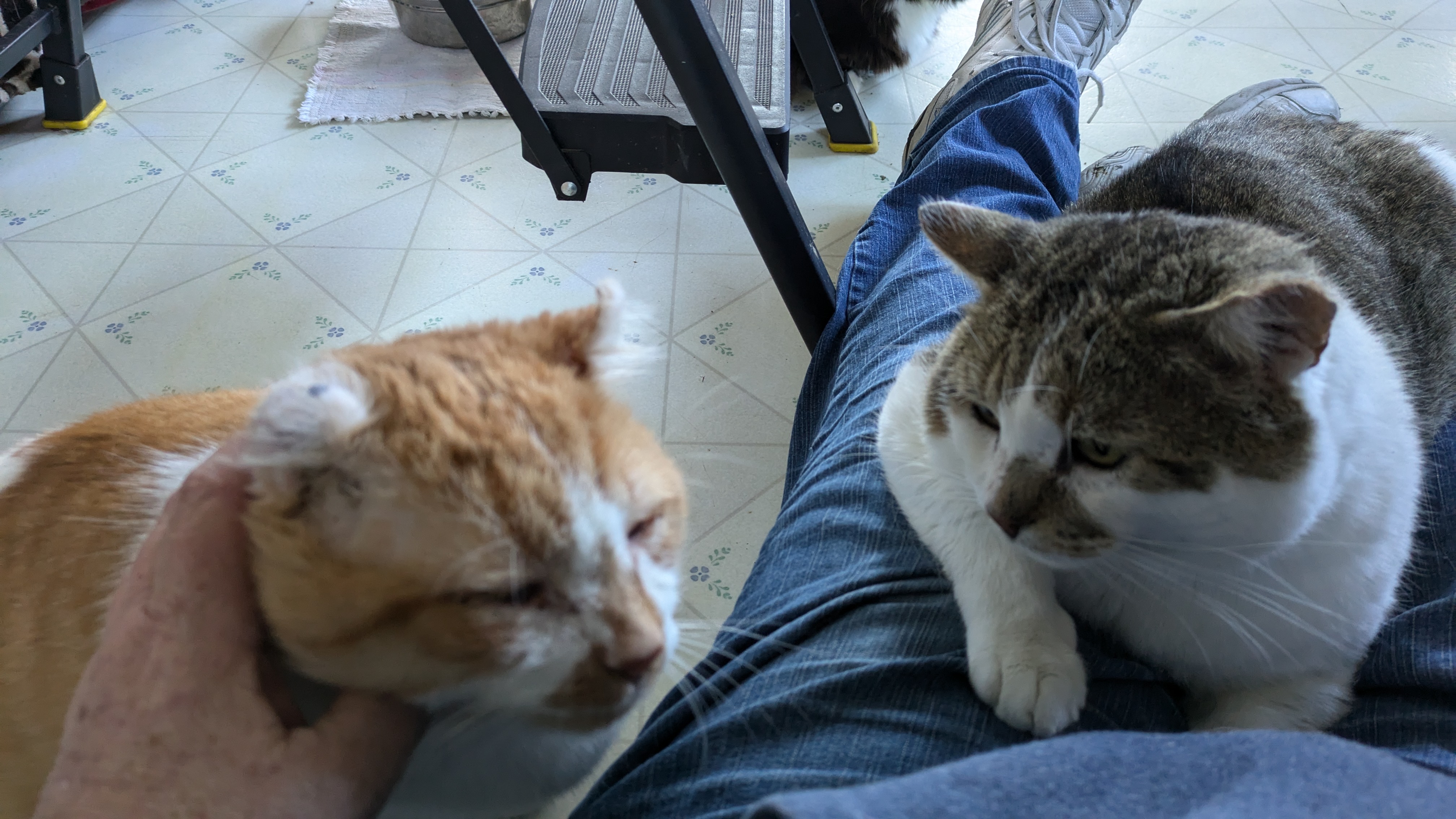
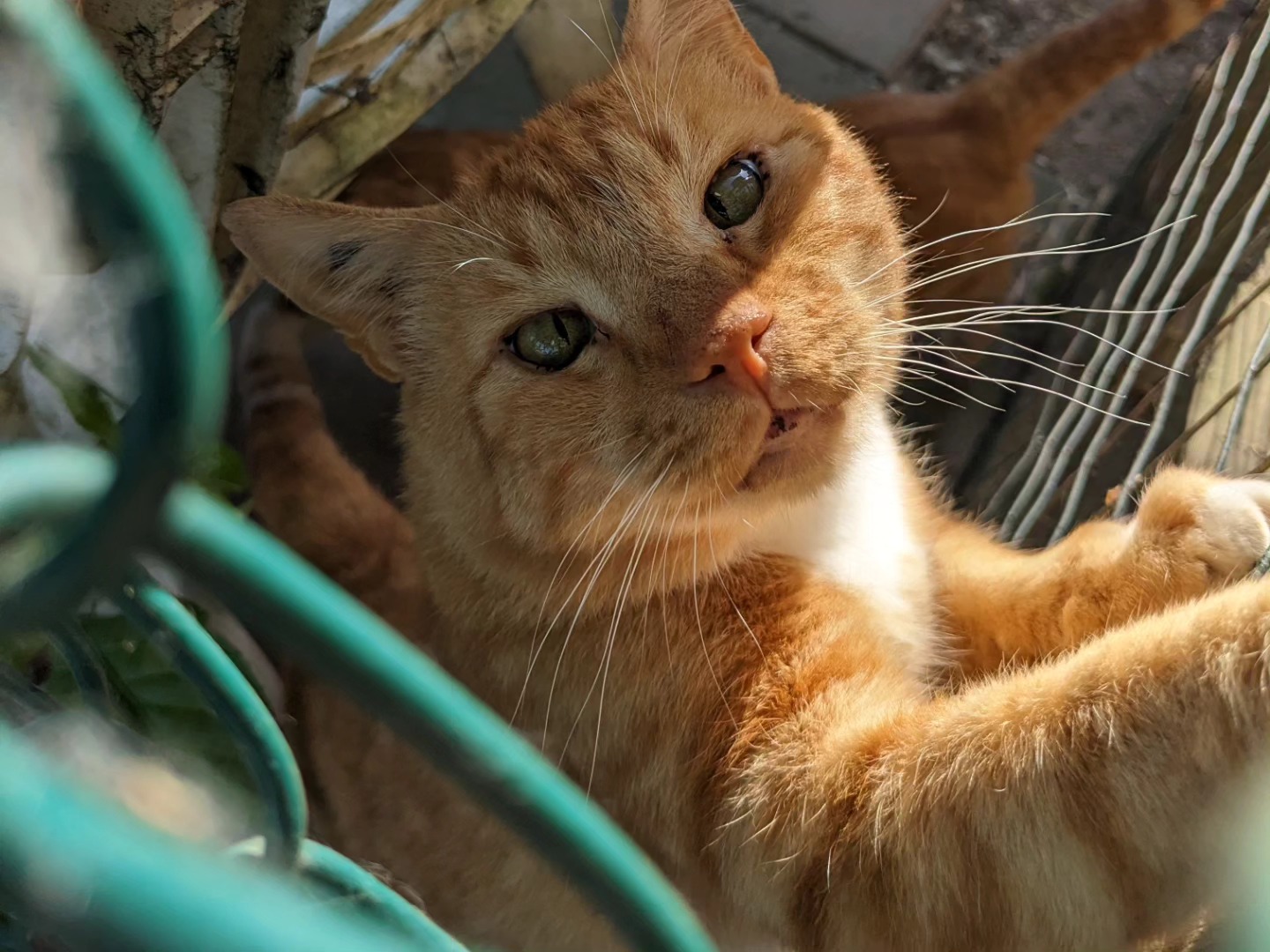
RAPS is short for Regional Animal Protection Society, a registered charity and operator of a sanctuary which houses and cares for nearly 500 homeless or abandoned cats in Richmond, BC, Canada. The Neko Files is a celebration of the sanctuary and all those who live and work there.
Showing posts with label Simon (II)-A. Show all posts

Wednesday, November 13, 2024

Another FIV Sweetheart

Chance (KN)
In the last few months we’ve had the addition of some very special cats to our FIV colony. I introduced Trooper in August, and Hank and Goose last month. As we’ve got to know them, we’ve also had another special boy in the background – and he is starting to blossom.  His name is Chance - a name he shares with one of the first cats I met at the Sanctuary, and who Claire Fossey described as "a furry disaster"

The battered boy - a picture from his Victoria foster
This second Chance came to us last July from Broken Promises rescue on Vancouver Island – we think he’s about 5 years old.  Even more than Hank, he’s a poster boy for an FIV stray – a big blocky cat with the musculature and large jowls of a late-neutered feline. He has the crumpled “cauliflower” ears of a long-time boxer; in his case, fighting may not be so much the cause as ear-mites leading to haematomas that never received any care. He reminds me of our beloved Bossanova – the ears are part of that, but the sad eyes and the hissy fearfulness that gradually gave way to trust complete the picture. When he was trapped there were obvious signs of fighting wounds, and he had care from a loving foster before he was transferred to RAPS.

Still wary, but hopeful  (BC)
He spent the first six weeks in a cage – initially with a drape in place, and some aggressive hissing coming from behind it. Many newer volunteers, in this situation, quietly pull the litter box out for scooping and place food and water for him without disturbing him.  The Kitty Comforters push the boundaries a bit, and several of us would climb into his cage with him, even if only to talk.  We discovered that a back-scratcher was a useful tool to allow him to experience touch at a remove, and found that he adored scritches round his head and ears – what he didn’t enjoy was having his drape moved, but once it was out of the way, he became quicker to settle down to enjoying caresses and melted into the petting hand.

Under the chair  (BC)
In the usual way, once the med staff decided it was time, Chance’s cage was opened, and having lived for a few days pretending the barrier was in place, he ventured out and went to ground under the adjacent chair. This presented a little more challenge – entry to the cabin usually meant discovering a Kitty Comforter lying on the ground, and coaxing Chance to emerge – all the while gently dissuading the other FIV cats who felt that humans lay on the ground for their benefit, and gathered around for attention.  Occasionally Chance would take some human-free time to climb the cat-tree and find a place in the cage-top beds, but he really preferred being at floor-level, and where he could retreat to a hidden place.

Chance thinks Henrie is a great cuddler
It’s wonderful that we have so many friendly cats in this pen – cats that are just longing to have someone with whom they can cuddle. Trooper, Biggie, Simon, Hank, Boomer, Angus – they all want attention, and the first four at least would do really well in their own homes (Goose went to his new family last week!) - but the fact that they all want attention means that Chance is very wary about emerging from hiding. 

Cuddles with Marty - and Trooper wants in...   (VE)
Our regular NewAids volunteers have proved to be most successful – they may not be labelled Kitty Comforters, but they sure have the gift!  Once the dinner plates are out and the cats otherwise occupied, Chance is more willing to risk himself and climb up for a cuddle – and the worried face relaxes to the point where you can see the smile emerging.

Look at that smile!  (KC)
Chance’s life has probably been a series of battles with other tomcats, and at the moment he’s actually happier with humans than he is with the other felines.  But he’s come so far from the fearful boy of the past summer; once he becomes fully comfortable with the largely non-aggressive encounters with a testosterone-free community of cats, we hope his growing confidence will make him an active member of our FIV family.

Hey Hank - can I share the lap?   (BC)

Blog by Brigid Coult
Photos by Katy Cobb, Brigid Coult, Vince Edwards,
Henrie Morgan, Karen Nicholson

Tuesday, June 11, 2024

Feline Daddies

Biggie is happy to snooze his days away  (KN)
We have our share of Mom-cats who arrived into our care with kittens on board or already born, and who have remained in the Sanctuary because they’re too feral or too shy, while their kittens go on to being socialized and finding their own homes.  It’s harder to ID the Dad-cats when fatherhood for most cats is a moment’s urge and not accompanied by any real bonding with the female in question – in fact, a fertile female cat can be impregnated by more than one tomcat, and her litter of kittens may have multiple sires.  So celebrating Father's Day at the Sanctuary is not as easy as celebrating Mother's Day! Having said that, there are a few instances where we’re pretty sure about both parents – and the certainty comes down to genetics.

Domino still has a tom-cat attitude;
he's probably sired his share of kittens! (BH)
Most of the cats in both New AIDS and the Val Jones are male, and most of them have come to us as unneutered tomcats – that, of course, being the reason they carry the FIV virus, which is conveyed in blood from bites. These boys lived their pre-Sanctuary lives fending for themselves, struggling to establish their territory, their food sources, and their potential mates – and, still ramped up with testosterone as they were, that inevitably involved fighting. It’s likely that many of them have sired litters of kittens before they came to us, but typically, cats are deadbeat dads, and have no concern for their offspring. The first thing that happens when they come into our care is that crucial vet appointment when they’re neutered – which means no more kittens, as well as reducing their urge to fight with each other. 

Simon & Biggie having a private son-and-father moment  (JS)
We’re pretty sure that Biggie, in the New AIDS pen, is the father of Simon and Smalls. The three of them, with female Marble, came to us last year from the Island. We think Marble is the mother of Simon and Smalls;  Biggie is older than the two boys, and likely sired them, but it’s possible that he may be both Marble’s son and her baby-daddy – cat colonies being what they are, there is often a lot of in-breeding. The orange colouring is a strong genetic marker, and Smalls’ black colouring is the most common alternative to a dominant orange gene.

Zeus (MD) and Pax (LBF)
both now adopted.
When in 2019 we brought in a large colony of cats created by someone who was feeding ferals, it was obviously a multi-generational affair – pregnant moms, kittens, teenagers, and a couple of older males who had clearly sired most of the younger ones.  These two males proved to be FIV+, but both were friendly and handleable; probably strays rather than ferals;  Pax and Zeus settled in easily to the Val Jones area, and both ended up being adopted to their forever homes.  

So like their dads! - Nyx & Juno (LBF)
Their genes can clearly be seen in some of the cats still living in Pen 1 – Nyx, Juno, Atlas and Mercury have a real resemblance to their sires, though all four, having grown up feral, have remained wary with people. And it’s quite likely that both Kenji and Allan, in the front courtyard, have the same genetics - though not gathered up at the same time, they came from close by.

Tamale enjoying the heat lamp (AM)
More recently, our trappers were involved in rescuing a colony from Shell Road. Most of these cats were tuxedos or blacks – and not from the same genetic pool as the earlier group, whose more pointed faces are a clear contrast to the broader heads and bodies of the newcomers. One of them proved to be FIV+ and is now living in New AIDS – he was introduced in an earlier blog as Boston. Two other males are in the front courtyard; Tamale is clearly related to Boston – father? brother? son? - and Chicharron (Cheech) has the same stocky build, though he’s tailless and all black. Staff and fosters were able to socialize many of the younger cats trapped at that site, and they were adopted, so we have no clear families to identify.

Percival Snugglebutt - also known as Daddy (JS)
Percival Snugglebutt is the other cat that we know for sure has fathered kittens. He was one of the colony of cats who came from the Kootenays in 2022, and the two little lynxpoint girls, Curious and SweetPea, both arrived pregnant. Rather than coming directly to us, they went into fosterage, where their kittens were born. Both litters had some tail-less kittens, a clear genetic link to Percival.  All the kittens were adopted out, and SweetPea also found a home; Curious is still with us because she’s not as friendly as her sister. 

Majestic (and shy) Basil  (KN)
The rest of the colony has a much more Himalayan look, though in a variety of colours; it’s likely that either shy Basil or friendly Owen (now adopted) was responsible for the younger cats. Percival is sometimes known as Big Daddy, though he has largely detached himself from the rest of the colony, and has moved on to socialize with the floofy Kamloops cats, and especially his buddy Thorne.

Percival with his best friend, Thorne  (JS)
The sentiment that powers the concepts of Mother's Day and Father's Day celebrations falters when it comes to felines.  For the majority of male cats, “love ‘em and leave ‘em!” is the primary urge – not necessarily something we want to celebrate! Whatever their paternal shortcomings, though, we love having them at the Sanctuary.

Blog by Brigid Coult
Photos by Lisa Brill-Friesen, Melanie Draper, Brielle Hutchinson,
Anne Marchetti, Karen Nicholson. Justin Saint

Thursday, March 14, 2024

Adopted - adoptable...

Smithy is the quintessential non-adoptable cat!  KN
For many years, visitors to the Cat Sanctuary have had the cats introduced as “unadoptable” – and for many of them, that’s just what they are:  scared ferals, cats with bad habits like aggression or litter-box avoidance, and cats with a variety of medical problems. When I first came to volunteer, we did minimal adoptions – perhaps ten in a year – and most of those went to volunteers who had bonded with the cats in question.

Both Twinks (formerly Peony) and Scooter (formerly Larkin)
came from the Sanctuary  (BJ)
But we’ve always had a number of what I would call stage-two ferals – cats who had come in wild and unsociable, and who had gradually eased into loving relationship with staff and volunteers. A great deal of the wariness about adopting out these semi-ferals came out of experiences where cats (Esme & Jenny, for instance) were adopted out, and then totally freaked out in their new homes, cramming themselves into inaccessible corners, and reverting to their former feral behaviour. In those situations, staff from RAPS went out to re-rescue the fearful cats, who were returned to the Sanctuary, to remain there for the rest of their lives.

The formerly feral Horatio became Louise's lap-cat (MW)
Looking back, it is easy to see that a number of steps were missed – there was not enough time given for the cats in question to bond with the adopter, there was no education about the adoption process, and there was no remedial action other than retrieving the cats. The mindset was on rescue and not on other possibilities.  Thanks to the work that has been done by cat behaviorists in the last decade, and experts like Jackson Galaxy and Pam Johnson-Bennett, we know much more about the processes that will work, from both ends of the adoption process.

75% of feral kittens don't survive to 6 months;
these babies will live, thanks to Lisa & Ken    (LBW)
The Adoption Centre deals primarily with the outcome of our rescue work; any time the team brings in a colony, there are practically always pregnant moms and kittens. We are lucky to have several wonderful fosterers who will watch over births, help new moms, and teach kittens that humans are to be trusted. When the kittens are old enough for adoption, they are brought to the Adoption Centre, where they can be visited; their adoption fees cover the cost of all their vaccinations and spay/neutering, for which their families bring them back to the RAPS Hospital.

Ernie, missing his Bert   (KN)
But though kittens are the biggest draw for visitors, they’re not the only inhabitants. We also take in surrendered cats, coming to us for a variety of reasons – usually humans who are no longer able to care for them. A senior pair, called Bert and Ernie, came in to us recently – very loveable and very unhappy about the change in their situation. They were checked over – there were some concerns about Ernie’s health – and caged together, with a request to the Kitty Comforters that they should be visited. Sadly, it was Bert whose health suddenly failed, and poor Ernie was left alone. Thankfully, someone stepped up, and Ernie has happily gone to a foster home where he will be well-loved for the rest of his life.

Benjamin & Olivia - gone to their new home  (BC)
While saying goodbye to Ernie, I heard that Benjamin and Olivia had also been adopted, which is wonderful news after all they’ve been through. The next cat in the Adoption Centre that we’ll all be rooting for is Greyson, discovered to have an infected eye probably caused in a fight; Greyson’s now one-eyed, but once recovered, will be someone’s beloved feline – he’s very chatty and friendly.

Greyson is loving the chance to explore, as he recovers  (ML)
Busy as the Adoption Centre is, some of the adoptable Sanctuary cats remain in the Sanctuary itself.  We are still hoping for homes for Whiskers and his brother Jinx, though the presence of other cats is starting to lead to some "stress pee-ing". But weekend visitors from the end of March will also encounter a variety of cats wearing “adoption bandanas”. These are not cats that we want anyone to point at, and say “I want that one!”, but they are cats that we hope visitors will sit down with, and get to know – preferably with repeated visits to give the cat a chance to bond with the human.  Sometimes we can ID the perfect cat for you – I still smile to think about how Strike “claimed” his new person last year, and how happy Elvis is with his family.

We miss our handsome Strike - but we know
he's happy in his new home   (KN)
Some of the potentially adoptable cats are still new to us, and finding their way – Truffle, Malibu and their crowd; some are part of the FIV cat community, and are not seen by all the visitors, but just love attention – Biggie, Simon, Billy Ray...  Even a couple of the FIV cats are adoptable by someone who can give them the special care they need.

Biggie loves nothing better than a good cuddle (BH)
What they all have in common is that any potential adoption needs a great deal of patience and time; most of them will not go home with you and settle in as if nothing has happened. The 3-3-3 rule is a really good one to bear in mind:
    • In the first three days: mostly in a quiet small space, with litterbox, bed and toys; let them approach you
    • In the first three weeks: allowing exploration at the cat’s pace, establishing a routine, finding a vet
    • by three months: comfortable with their space and their people, starting training

Some cats will adjust faster, but the failures usually happen when they are expected to do so more quickly, as with sweet Holly last year – her family returned her without giving her time to acclimate to a new environment – they wanted the relationship to be “right now”, and she was still scared. 

Holly's happier back with her cat-family  (KN)
The volunteers remain in prime position to bond with adoptable cats. I’ve not had a chance to blog about sweet Mortimer (mostly because he’s a black cat, and they’re notoriously difficult to get good photographs of!), but he came to us recently as a pretty reactive and sassy tom-cat, has had his neuter, and blossomed into a lap-cat (and an under-the-feet cat); he’s being adopted by a volunteer who fell in love with him while working in the DoubleWide. 

Chubby-cheeks Mortimer  (BC)
So if you’re coming to visit the Sanctuary from Easter weekend onwards and are thinking about adopting, think also about the personality that would attract you – do you want shy and gentle? active and inquisitive? a lap-sitter or a little aloof? a loner or cat-sociable? And then take your time to allow the cat to learn that you can be trusted to give them all they need to feel loved for the rest of their life.

Blog by Brigid Coult
Photos by Lisa Brill-Friesen, Brigid Coult, Brielle Hutchison,
 Bev Johnston, Mandy Lichtmann, Karen Nicholson, Michele Wright

Wednesday, June 7, 2023

Newcomers in New AIDS

Simon  (KN)
All over the province there are cats living wild. They may always have been feral and the offspring of feral cats, or they may be cats who have been dumped or who have strayed and never found their way home. And all over the province, there are amazing organizations working to help these poor animals – perhaps by taming them and getting them readopted, or perhaps by doing Trap/Neuter/Return, and caring for the colony.

Marble  (BH)
We are a resource for some of those rescues to turn to. Both our cats from Kamloops and the ones from the Kootenays were no longer able to exist as they were, and could well have been killed by local authorities; each colony was too large, and too unsocialized a group to foster or adopt out, so they came to us. We have similar contacts with rescues on the Island, and it is from one of those that Marble’s family came. Foster Kritters Feral Cat Rescue is active in the Cowichan Valley; they have no website, but you can find more about them on Facebook and Instagram. Much of their work is done with TNR, but occasionally they come across cats that can be trapped and neutered, but should not be returned – as with this group of cats.

Biggie  (BH)
They came to us because they are all FIV+ (Feline AIDS), and though FIV positive and negative cats can live together, by keeping them as a colony, we can maintain more careful attention to their physical health. We think they are all related, but may not be all from the same litters.

Smalls  (BH)
The oldest of the group is Marble, and to quote Foster Kritters, “she looked like a senior even though she's only around 4 years old and it was very clear that she had experienced a very tough life. She had a badly injured and painful eye that she had lived with for at least three years. She had raised multiple litters of kittens and looked defeated and exhausted”. She was under medical care with Foster Kritters for some time, much to her disgust – they managed to raise funds for surgery, and hers finally necessitated enucleation (the removal of an eye). 

Marble    (KN)
Once she was on the mend, she was transferred to us at the Sanctuary, living initially in a cage so that her healing was monitored. Now she’s out, and very happy about that. She’s not really ready to come for attention, but she knows that humans are not out to get her – she’ll make friends when she’s ready. This evening she was playing in a corner with a toy containing a little bell, and I could hear her having fun before she tired herself out.

Simon (BH)
The two youngest are orange Simon and black Smalls, and they may be Marble’s sons or grandsons.  Simon is the more social of the two; he’s happy to be touched and to play, and he might sometime be a good candidate for adoption. Foster Kritters had tried to adopt him out, but sadly, people don’t understand that FIV+ cats can be wonderful home cats. Smalls is shyer, preferring to tuck himself out of the way; he has time to decide that he’s truly safe.

Smalls  (KN)
In the middle is Biggie, who is Mr BIG Personality. We think he’s older than Simon and Smalls – he might even have sired them, but without doing genetic testing, we can’t tell. He also came to us with eye problems – in his case, it was entropion, with the eyelashes turned in and irritating the eyes. A round of surgery corrected the problem, and Biggie has blossomed – he’s probably been in pain for some time, and is now feeling wonderful.

Biggie says "Pick me up!"  (KC)
Biggie LOVES people; he actually makes working in New Aids a little dangerous, because he presses himself to your legs as you walk, and you constantly have to watch that you won’t trip over him. If you stand still too long, he gets up on his back paws and begs to be lifted. He loves to be held – regular way, on the lap, or occasionally on his back like a baby. 

Cuddle time  (BH)
He plays like a kitten, dancing and pouncing – but you can see in his face that he has suffered because of his eyes. His delight in being handled led me to think that he, of the four of them, may have had a home sometime in his past – that he’s a stray or a dumped cat, rather than a feral. But Foster Kritters are sure that he's part of Marble's family.

Biggie - the look of love  (KN)
At least, with us, he and the other three have a future. It may just be a future lived at the RAPS "Kitty Club Med", well fed, with comfort, safety and company. But it might even be finding someone to he His Person, and finding a home of his own where he will be loved.

Blog by Brigid Coult
Photos by Katy Cobb, Brielle Hutchison, Karen Nicholson