RAPS is short for Regional Animal Protection Society, a registered charity and operator of a sanctuary which houses and cares for nearly 500 homeless or abandoned cats in Richmond, BC, Canada. The Neko Files is a celebration of the sanctuary and all those who live and work there.
Showing posts with label Chaga. Show all posts

Friday, June 13, 2025

Kamloops Catz 1: The Bonded Ones

Some of the Kamloops Crew  (LBF)

In 2021 we heard of a farm colony of cats near Kamloops who were threatened with eviction and/or eradication....   Sammy’s Forgotten Felines contacted us to ask, “If we trap them, can you take them?”, and Operation Kamloops was on!  

Creamsicle (MW)

Many of the smaller rescues around the province simply don’t have the resources to deal with a large number of cats at one time. Sammy’s works most often with fostering, but finding fosters for a whole colony of ferals is a big ask. A few of the cats found temporary or longer-term homes, but the initial group that was driven down from Kamloops numbered about seventeen – and many of them were orange!

Chaga  (KN)

They have appeared occasionally in this blog over the last four years – they are very photogenic, and they tend to travel together like a shoal of goldfish.  But I decided it was more than time to introduce a few of them in more detail. I needed to enlist staff help with identification – like many of the volunteers, I’m guilty of grouping “the orange cats” together, and there are several little tabbies I still struggle with identifying.  Over the next four weeks, I’m going to try to introduce the whole family.

Chaga, Chamomile, Creamsicle  (JS)

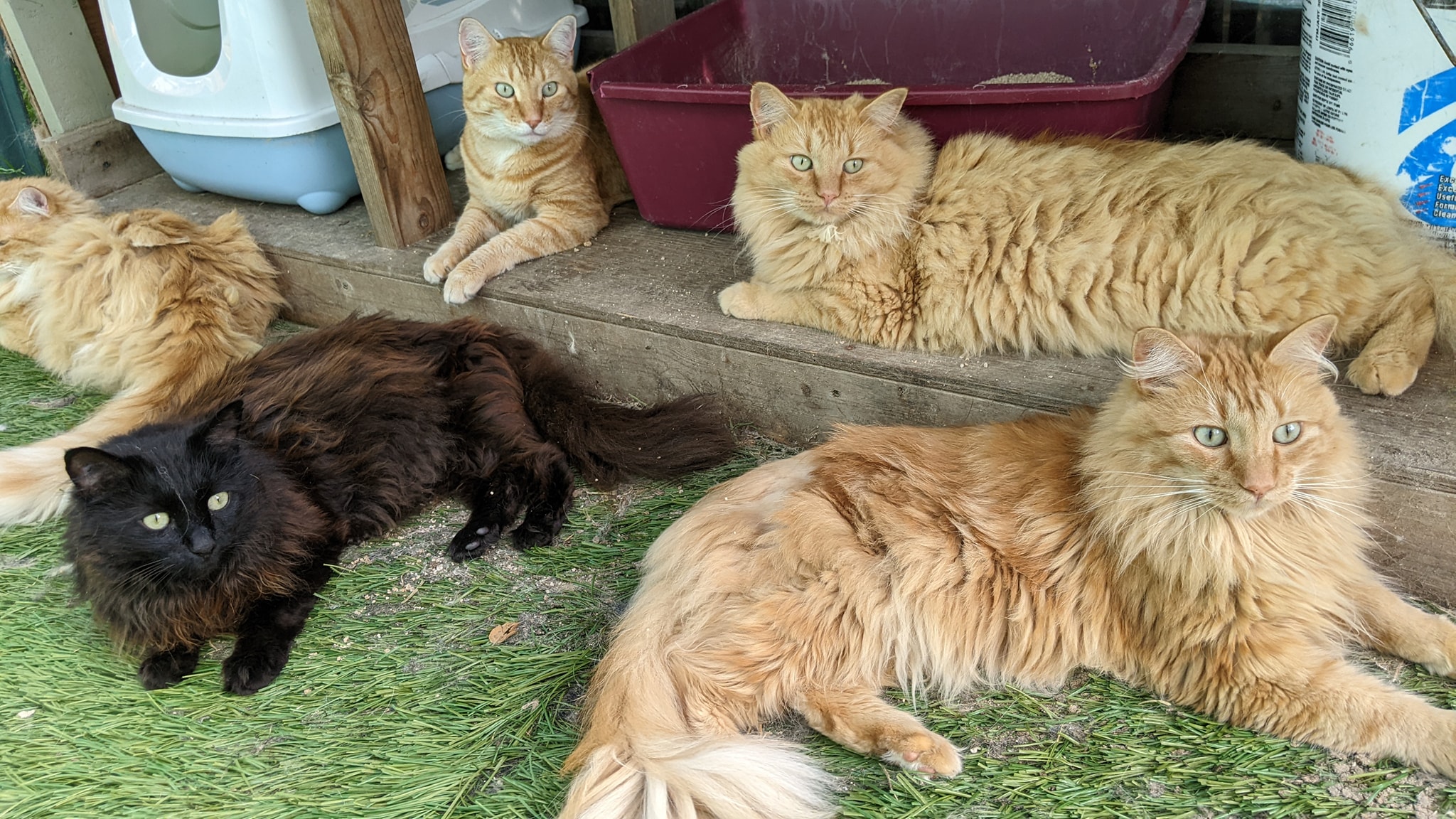
Though they tend to move around together, there are clearly two sub-groups of bonded cats.  The first is visually very obvious; pretty grey Chamomile always draws the eye, and she can usually be found either cuddling with or interacting with her buddies Chaga and Creamsicle.

Chamomile  (MW)

Chamomile looks very much like the other long-haired cats in the colony except for her colouring which is not a plain grey, but shows a lovely variety of dark and light patterns with the tabby facial markings. Chaga is a very dark brown rather than black, and slightly more pointed in face than many of the other nearby black cats. Creamsicle lives up to her name with her ice-cream bib setting off her orange fur.

Chamomile & Chaga (LBF)

The three of them – or any combination thereof – are nearly always found together. They like the table bed in the TeaRoom, and are ready to allow a little gentle contact with humans, though it’s important to read their body language, and back off when it’s a don’t-touch-me day.  They also like the courtyard crossroads, and can often be found on the ground there, showing off to visitors, and doing a lot of rub-and-snuggle with each other. They actually seem to be more comfortable with ground contact, and will interact with visitors who can show patience and gentleness.

Cheddar & Kelvin (KN)

If you find a long-haired and a short-haired cat together, the pair is usually Cheddar and Kelvin. Both belong to the “you may look, but not touch” school of thought, and love to find a tight space that they can snuggle in – one of the shelf cubbies; a basket on the counter-top; a chair on the deck of a cabin. Kelvin is braver than his short-haired brother Billy, and will allow a little contact, but he prefers Cheddar to be his comforter.

Kelvin & Cheddar  (LBF)


Blog by Brigid Coult
Photos by Lisa Brill-Friesen, Karen Nicholson, Justin Saint, Michele Wright


Next week: More orange cats from Kamloops

Wednesday, November 20, 2024

Location, location...

Some of The Crew  (LBF)
The group we call The Kamloops Cats (though we have many others from Kamloops!) came into our care from Sammy's Forgotten Felines more than three years ago and were initially established in a closed Pen 6 while they settled to a new situation.

Chaga, Chamomile & Creamsicle - best pals  (JS)
Many of them were orange, in various shades from deep gold to blond, but we also had a few non-orange ones – grey Chamomile and black Chaga were clearly related to the other floofs, but there were also a few shy tabbies, both brown and grey.  

Thorne has lots of floof to groom  (KN)
About a year later, we welcomed two more cats from the same colony who had been fostered out, but refused to tame; it had been decided that they would do better with their feline family. Big tabby Thorne seemed to recognize his former pals and settled quickly;  shy Daffodil, though clearly showing the orange floof genetics, stayed apart and found her alternative community..

Many cat-tree beds to choose from  (KN)
Most of the Kamloops cats like to be together. 
Kelvin & Cheddar are the devoted couple - always together,
though still a bit wary round people  (KN)
But unlike the Pen 3 cats from Calgary who visit around freely, but base themselves firmly in their own pen, this family tends to relocate as a group. In the summer of 2022 the hot weather made Pen 6 an uncomfortable place to be, and the whole colony moved out, preferring the cat-trees around the TeaRoom and in the breezeway;  in the winter they moved inside the tea-room TeaRoom itself, searching for warmth, and we frequently found piles of cat-cuddling on the table or the cage-top.
Room for a cuddle-puddle, high and out of reach   (JS)
When the weather improved, they relocated again – this time, not back to Pen 6 but to the much larger Pen 5 – some of them opting to base in the cabin, while others preferred the shelves around the back. The braver ones learned to interact with visitors here – pretty blonde Rapunzel loves to play and flirt, and comes looking for petting. Chamomile, Chaga and Creamsicle preferred to hold court with visitors right at the courtyard corner, where they could be admired; collectively, they are braver than when we encounter them separately. 

Evening conference - clearly drawing the other cats
into plotting larger dinner portions!  (JS)
I have often written about the Sanctuary’s Garbo cats – the ones who don’t like other cats, and prefer to be alone, or just in one-on-one interaction with humans. Our Kamloops cats are at the other end of the spectrum, and are very bonded with each other; colony is clearly a key concept, and they will often move around as a group – it’s like walking through a shoal of goldfish.

They're from Kamloops - they don't fear the snow!  (LBF)
Now, as we head towards the colder weather, we’re seeing a repeat relocation as the clowder returns to the warmth and food of the tea-room. They can still get warmth and food in Pen 5 – every cabin is insulated and has a heater on thermostat.  But the TeaRoom gives them the opportunity to sleep together in piles rather than on separate shelf beds, and they also know that it means they will likely be the first to be served in the evenings.

...but warmth and comfort comes first!  (BC)

It’s not so hard to live a cat’s life at the Sanctuary!

Blog by Brigid Coult
Photos by Lisa Brill-Friesen, Brigid Coult, Karen Nicholson, Justin Saint


Wednesday, September 7, 2022

Floof on the Move

Mega-floof in Pen 6 (LBF)
In the early summer of 2021 we welcomed an influx of feral cats from Kamloops and it turned out that the majority of them were varying shades of orange, and many were long-haired.  They came to us as feral half-grown adolescents - living wild too long to be easily tamed.

Sharing a chair in pen 8  (BC)
After the mandatory cage-stays they were moved together into Pen 6. This enclosure has been the home for a variety of new groups of cats – a group from the Sunshine Coast in the summer of 2016 -  the ones we called The Candy Cats in the fall of 2017  -  the McLeod cats in the summer of 2019   – and now these Kamloops cats.  The last three groups have all been fearful ferals – only Skittles of the Candy Cats and Aphrodite of the McLeod cats broke out of feral behaviour to enjoy human attention.

Anxiously waiting for dinner  (LBF)
Pen 4 remains a closed pen for ferals, but we like to open up new colony pens as soon as we feel the cats are fairly settled.  Pen 6 has been open for some time, but the Kamloops cats initially remained very determined to stay inside its bounds or within easy reach. Sometimes in the evenings, waiting for dinner, they would move into the courtyard as a group, and then escort the volunteer bearing plates as food was delivered – it felt rather like wading through a shoal of orange fish!

Food is served!  (JS)
Two things have happened recently, and I suspect they’ve both affected the status quo. We’ve had a burst of hot days, and despite adding some shading to the area above the door, Pen 6, which is one of the smaller ones, has felt very hot. Hoses deliver misting around the perimeter, but when your fur is floofy, you don’t necessarily want to get it wet!  And another group of cats coming in – this time a colony from the Kootenays (details to come) – have necessitated turning the shy inhabitants of Pen 8 out. Most of them are fairly happy to relocate around the courtyard – they spend a lot of time there – but the three Candy Cats (Hershey, Butterscotch and Purdy) have relocated themselves back to their old turf in Pen 6, which is now starting to feel very crowded!

Claiming the bench in the garden  (LBF)
So the Kamloops cats have started to explore!  Persimmon has always been the bravest of them, and the most ready to accept human attention, but we’re finding the others in Pen 1 and Pen 5 as well, and recently a collection of them braved the Tea Room to find a cool corner on the stairs. 

Cheeto/Kelvin/Cheddar in the Tea Room (JN)
Black Chaga (black with a lot of rust colour in his fur) is also an adventurer and has been found in all sorts of corners.  Pretty grey Chamomile is now allowing herself to be groomed by Lisa, but others have needed more drastic shave jobs to cut out the mats that develop in floofy fur.

At night on the Pen 6 cat-tree (JS)
They have always enjoyed using the cat-tree at the Pen 6 door; frequently every level has mounds of orange fur taking up the space.  Now they’re expanding their territory to the group of cat-trees outside the tea-room, and there were eight orange cats and Chaga occupying the perches several days ago. Most recently, they’ve gone still higher, to establish themselves on the top of the adjacent food cupboard. 
Floofs on the roof - Cheeto, Cheddar, Persimmon
with grey Chamomile photo-bombing at the back  (JS)
 It’s very satisfying to see them feeling so much more comfortable in their wider surroundings, and more receptive to approaches from staff and volunteers, although they are still wary of contact with humans.


Blog by Brigid Coult
Photos by Lisa Brill-Friesen, Brigid Coult, Joanne Nicholson, Justin Saint

Thursday, September 2, 2021

Gardens and Gattos

Mercury (LBF)
Many of our cats have come to the Sanctuary as untamed ferals, and the experience of being caged is very uncomfortable for them – necessary, initially, because we need to take time to assess them and have the Kitty Comforters work with them – but often not something that can be sustained.

Fabian  (KN)
These are the cats who, in other circumstances, would be deemed unadoptable, and euthanized;  they don’t want anything to do with us, and in the buildings, they try to stay high up and out of the way, or hidden behind a drape. In the gardens they can find hiding places in the greenery.

Chirpy supervising planting  (KN)
Lindor helping with choices   (KN)
The Sanctuary is truly a sanctuary for them, because there are so many places they can hide, especially if they are back-courtyard cats. We have several volunteers who are gardeners, and much work has gone into filling flower beds, so that they can also be safe cat-beds. 

Leonardo diCatprio  (KN)
Preparing the garden to do some new planting always brings a few feline helpers, and planting needs to be done quickly to avoid too many deposits in the fresh soil. 

Hillie  (KN)
Some plants, like lilies, are not good for cats to be around, and they have been carefully eradicated; roses rather than lilies have gone into the beds, as well as splashes of colour with red runner beans (tasty for humans) and nasturtiums.  Summer interns have seen to the regular watering of both front and back gardens, and emptied water-bowls keep things moist.

Rico  (LBF)
Charlotte staying out of reach  (KN)
There is netting all around the Sanctuary to keep the cats in and the coyotes out – but the mesh is hidden for the most part by shrubbery, which offers shy cats all kinds of place to hide. Japanese knotweed springs up very quickly around the edges, and needs constant cutting back – but the cats in the north pens like it for shade and sleeping places.

Kramer   (LBF)
Some of the pens are grassed, and it’s often allowed to grow to give comfy corners for snoozing; maintaining it is hard, though, since the little feline “gifts” in the grass make a standard mower impractical, and the weed-whacker is pretty noisy.

Racks  (MRJ)

Potted Holland  (KN)
In the pens that are largely paved, greenery is provided with potted plants, and climbing plants. And if the pots are large enough, they provide another comfy place for resting.

Chaga  (MW)
Pen 6 has both real and artificial grass – but many of the inhabitants like to be up on the waist-level walkway where they can have shade and hiding places in overhanging plants, or sitting on the window-ledge of their play-hut.

Sandy goes climbing (KN)
Trees have their place too – both to provide leafy hiding places, and to allow for some height. We were all concerned when feral Sandy needed a back leg amputation to rid her of a cancer; it’s good to see that it hasn’t slowed her down much, and she’s even trying a little tree-climbing.

Ollie  (LBF)
Even Ollie will abandon his bed on the clean laundry to go out and enjoy a little sunshine and smell the flowers - and Alfred will take time out from bugging other cats to enjoy the garden world.

Alfred  (LBF)

Blog by Brigid Coult
Photos by Lisa Brill-Friesen, Marla Rae Jenkins, 
Karen Nicholson, Michele Wright