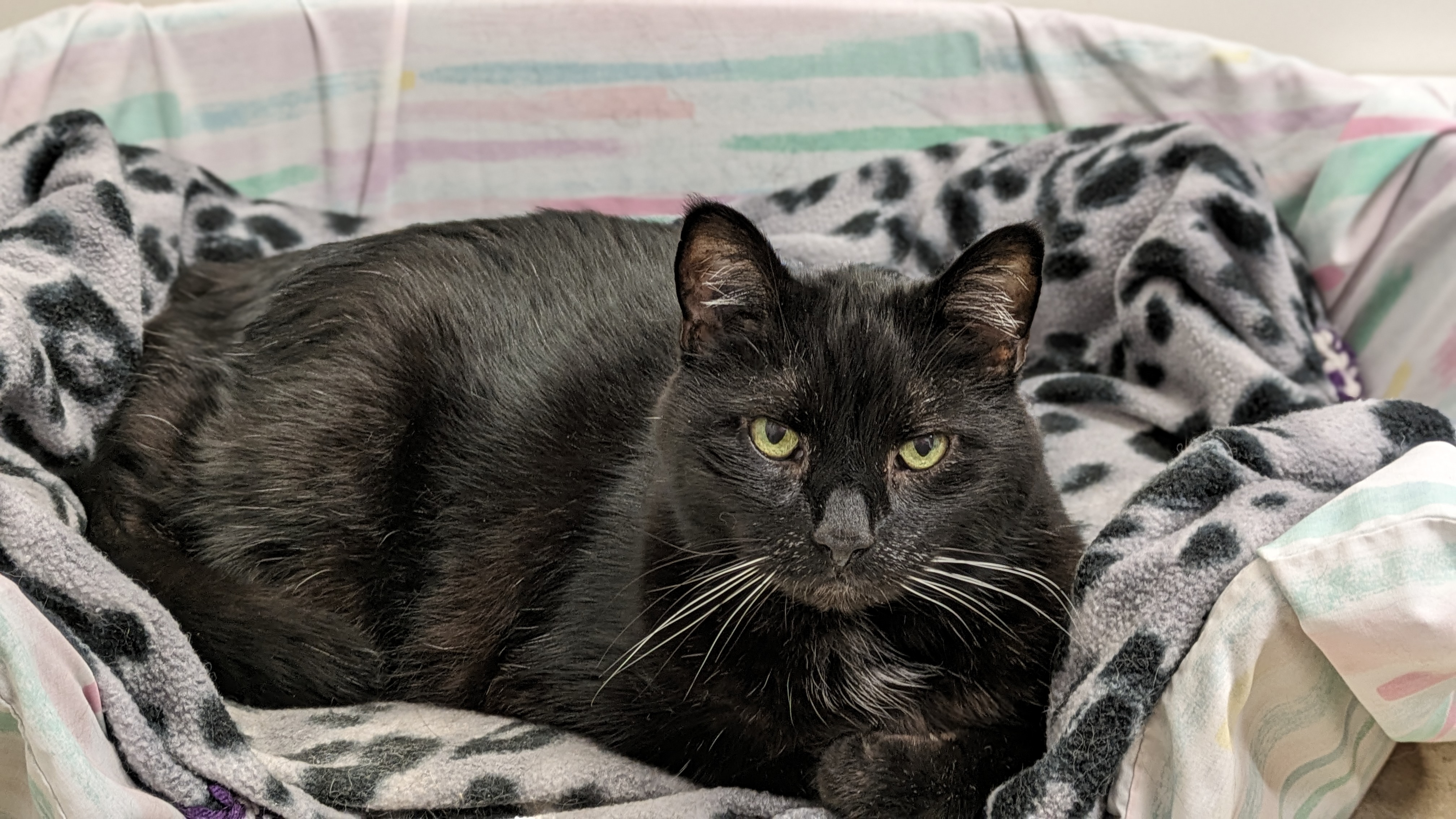
RAPS is short for Regional Animal Protection Society, a registered charity and operator of a sanctuary which houses and cares for nearly 500 homeless or abandoned cats in Richmond, BC, Canada. The Neko Files is a celebration of the sanctuary and all those who live and work there.
Showing posts with label Luke (II). Show all posts

Wednesday, October 29, 2025

Two Timid Tuxies

Motley  (BC)
The Sanctuary has its share of handsome tuxedo cats who have made us their home.  Everyone in the front courtyard knows sweet Vesper who has the attention of not one but two adoring girlfriends.  Luke, on the DoubleWide deck, was feral when he came in, but constant handling in the course of treatment for his diabetes have increased his confidence, and he is a great comfort to his shyer friend Bodhi. Boston, in New Aids, is a cat magnet for his buddies Rocket and Drake.

Winter-coated, mats, dreadlocks and all  (BC)
Motley came to us in the spring of last year. As far as I can find out, he is a local cat; someone reported a pregnant female, our trappers went out, and Motley walked into the trap. I don’t know whether he was the “pregnant female”, but he still had his shaggy winter coat, matted and unkempt, which I guess gave rise to his name, which means “varied in appearance”.

Scared, but also interested  (KN)
He settled himself in the back courtyard, establishing himself as a look-but-don’t-touch boy.  At some stage the name Ivan was suggested and officially changed, but somehow he has remained Motley to most of us – wary and scared, but attracted by treats. We think he’s about three years old, but perhaps it’s his size and shaggy fur that makes him appear older; he’s one of those unfortunate cats whose fur can mat, and that in its turn leads to the necessity of netting and grooming him – which in turn causes a setback in socializing him. On the positive side, his fur means that winter holds no fears for him.

Winter weather means nothing with a fur coat  (KN)
Marty is one of the volunteers who is exercising patience and persistence in attracting Motley; he can be found hiding behind a chair as he offers Churu treats, and Motley will venture closer with the chair-back a perceived barrier that protects cat from human. Chicken is always acceptable, and Motley is starting to take it from Marty’s hand. He is wary around some of the other, pushier, cats; there are several who don’t hesitate to rush in and steal the goodies if Motley is not quick to react.


Recently Motley’s been joined in the back courtyard by another little tuxedo.  Dr Flint also came into our hands last spring, but from SARC, the Surrey Animal Rescue Centre. This is the city shelter, and its animal control; they don’t have the no-kill mandate we hold to, but they do their best to find barn placements for ferals. However, they will pass to us some of the cats that they feel have potential but who need more time. This little boy was about 6 months old, and pretty hissy – in fact, they named him Hiss. When he came to us, that was changed to Flint, and then to Dr Flint.

Dr Flint, curious but wary  (BC)
Convention holds that young kittens can be tamed easily, if you do so before they're 12 weeks or so, so Dr Flint was well past his "best by..." date. He went into fosterage with Kate, who worked really hard to socialize him. However, he remained fearful and wary, and a move to the Adoption Centre was not thought to be possible – so he came directly to the Sanctuary instead. Initially he vanished – mostly into the long grass around the edges of Pen 5. Occasionally we would see a little head pop out of the gate and venture across into Pen 1 – and then dash back. Kate could visit him and occasionally make contact, but all other humans were just too scary.

Observing from a distance  (BC)
With the upheaval caused by DoubleWide renovations, we’re seeing more cats in areas that have been unfamiliar to them. It may be that Dr Flint is following some of those visitors, but he’s been found coming and going from the Newcomers area, much closer to human activity. Obviously it’s warmer and drier there, and though he’s not given up his Pen 5 base, it’s no longer so vital to his comfort.

Chicken was the bribery to get him this far  (BC)
Last week I did a feeding shift, and then sat outside the TeaRoom with my chicken baggie, and the usual hopeful chickaholics. Motley was not venturing too close, and about half of his bits got stolen by Walker and Mandarin. But Dr Flint joined us – initially hiding under the table, and then jumping up onto a chair, where he could monitor the action better. He still didn’t want me to touch him, but that session represented a big advance for him.

Hoping to be bribed   (BC)
So – a call out and a challenge to all our back courtyard volunteers:  two timid tuxedos need our attention and patience. They may never make it to “really tame”, but the more they learn that not only do we mean no harm, but we also come bearing treats, the sooner they will relax and understand that they have truly found Sanctuary with us.


Blog by Brigid Coult
Photos by Brigid Coult & Karen Nicholson
Video by Marty Corey

Wednesday, October 16, 2024

Hickory & Mitzi

Mitzi & Hickory  (KN)
For several years the DoubleWide Deck was known as tuxedo central, but in the last while the tabbies have been staging a takeover!  Luke, Bodhi and Denzel are still present, but they are also wandering more freely, and looking up at the furry pile on the mattress, there’s often more brown fur than black.  

Did you say chicken?  (BC)
Floor level is dominated by tortie Gwen, who doesn’t like other cats any more than she did at the beginning. They have learned to avoid her, and to stay outside her personal “bubble”. While the weather has remained fine, there is a steady flow of Deck cats out to the cat-tree by the New Aids entrance, and some of them venture further.

Hickory  (LBF)
Hickory and Mitzi are two of the most regular venturers.  They may well be litter-mates; they arrived four years ago from CATS rescue, in the Comox Valley on Vancouver Island. They are not particularly bonded, but may often be found together, since they both use the DW Deck as their base.   Hickory is a handsome dark tabby with the classic-tabby whorls on his coat. He is initially wary with humans, but ready to accept attention; he can often be found visiting cat-pals in Pen 1.  When the cat-door was first installed on the Deck he was one of the first to explore – and then got a bit panicked when he couldn’t find his way to return; he’s much more sure of himself now.

Luke with Hickory  (KN)
Hickory extends his social presence outside the Deck cats; if there is a courtyard gathering for chicken tidbits, he is often part of it. However, he’s not really interactive with the dominant boys of the Boys’ Club – Pumpkin, Walker, Quinn and their buddies. Hickory sits back and observes. Most of his socializing is with his tuxedo pals on the Deck.

Mitzi   (KN)
Mitzi is a big-eyed, stripy-variety tabby with a large white bib. She is very food-motivated, but not enough to make her act nice with humans;  she has a lightning front paw that is quick to smack. But the potential for tasty tidbits, brings her closer and closer, and though she’s not happy about being touched, she will tolerate it for the sake of an adequate pay-off.

Seeking a little sun-worshipping  (KN)
Like Hickory, she enjoys little excursions into the gardens, but tends to remain close to home-base; the platform with the cat-tree is her favourite place on a nice day; and she can dodge human attention easily.  Though the two of them mostly do their own thing independently, just occasionally we will see moments of affection (or possibly annoying-the-sibling moments) that signal a loving family connection.
Hickory & Mitzi  (KN)


Blog by Brigid Coult
Photos by Lisa Brill-Friesen, Brigid Coult, Karen Nicholson


Wednesday, February 28, 2024

KCs At Work

Raisin - a pen 4 feral girl   (KN)
Visitors who come to the Sanctuary at the weekend are often astonished and delighted by the number of cats who come to greet them.  What they will not see are the cats who are hidden away – either by their own choice as ferals, or because they are caged. Cages are not what the Sanctuary is about – but they are occasionally a tool to lead to something better for the cats. Most of our felines are here either because they are feral or because they have been surrendered. If they are immediately adoptable, then they will go to the Adoption Centre – but many of them are not ready for that when they come to us. 

When Creampuff came to us, she spent most
of her time hiding behind a drape   (BC)
Because a new cat needs to be assessed, and have all its vaccinations current before it is released into the general population, it will often spend 4-6 weeks in a cage. There is always a drape or a carrier or somewhere that they can hide.  Some cats are happy to be hidden away in a quiet dark place – but that doesn’t help them when they finally emerge. So there is a team of volunteers who will happily spend time sitting quietly in a cage, allowing the cats to learn that humans are not always scary.

Marianne & friends - by Selena Marchetti
The team of Kitty Comforters was the creation of the late Marianne Moore, a longtime Sanctuary volunteer, who passed in 2018. Six years before that, she established a group of “cat-whisperers”, volunteers who had proved themselves to be calm and patient and occasionally willing to be scratched or bitten by a scared cat. The team is still operating under the leadership of Anne Marchetti, and they appear faithfully each afternoon to spend time with cats who are receiving medical care, cats who are new to the Sanctuary, and some of our shyer inhabitants. 

Food bribery   (LBF)
Sometimes kitty-comforting time involves food bribery, or gentle grooming; sometimes it may be no more than a quiet voice. We learn which are the cats that are aggressive in their fear, and which are the ones who will only hide. Most of our time is spent with caged cats, but we also look for the shyer cats who live in the open pens, and connect with them as much as we can. Kitty Comforting is about much more than just having fun with your favourite cats; it’s about searching out the ones who need us, and establishing trust by whatever means we can.  Most of the KC’s have done their share of cleaning and feeding, and are known by Anne to be really patient and persistent in reaching out to scared cats.

Shy Tibby hid in her cage for weeks;
now she's out, and much more confident  (AA)
My recent KC session began with a visit to the Adoption Centre, where Benjamin and Olivia are still awaiting someone to offer them a home. Benjamin came out for a visit and some cuddling; Olivia has a bit of a cold, and stayed in her bed. From there, I paid a visit to the SingleWide offices, which are much quieter than usual, with a lot of the admin transferred to the Adoption Centre. Mojo and Licorice like the quiet, but they also need some stimulation and love. They have been joined recently by pretty Tibby, surrendered for inappropriate urination, and, like Oscar and Winston, on a diet to see if there is a physical basis to her problem. Licorice believes firmly that all visitors come to see him, and took exception to my paying attention to Tibby by backing up and peeing on my leg – sometimes a penalty of being around our cats!

Li'l Bit outside the DW deck   (KN)
A quick visit with Oscar and Winston and a check in to compare notes with fellow KC Catherine, on her own rounds, and then I moved to the back pens for a bit, checking in there with Lisa who is one of the “magic people” with ferals. She has been working with shy Raisin in Pen 4, who still hides away from everyone else.  We are watching for a gradual relocation of some of the Cranbrook College cats who base themselves on the high shelves on the DoubleWide deck, but who have also discovered the cat-door and the potential for visits to the back pens. We will occasionally see Li'l Bit and Foster exploring in Pen 3 – though their explorations tend to be around sunrise or sunset, when there are fewer humans around. 

Sweet Audi is beginning to be curious about us  (BC)
There are more caged cats in the DW because it’s closest to the med-staff. Some of the cages still bear “Staff Access Only” signs; in a few of those cases, Anne may let us know that the KCs do have access to start the familiarization process. Sometimes we’ll barely see the cats in question, who have places to hide and prefer to use them with strangers – sometimes the offer of a treat will be met with a well-placed claw, or with warning hisses. With these cats, little and often is the key; they need to discover that humans may feel scary, but don’t intend them any harm.

Sylar enjoying petting  (BC)
From visiting with shy Audi, I move next door to visit with an old friend. Sylar has been my sponsor cat for years. He’s a very wary feral who loves his chicken, and has progressed to occasionally accepting it from the hand, though he prefers to have it tossed to him. Currently he’s in for observation; he’s lost some weight and has become pretty matted, so I hope blood tests will show the problem. As always, there is fierce hissing as I enter his cage. Because I know that he knows me, I loop his drape back so that he has nowhere to hide; I offer his favourite chicken and he accepts it without biting my fingers. Very carefully I hold tidbits in my right hand and pet him with my left; he allows it without protest, and the bum comes up as I pet down his body. By the time I leave him, he’s allowing petting (but not grooming) without hissing. I suspect, though, that once he’s out, he’ll be back to not permitting touch!

Sometimes the best Kitty Comforter is another cat -
Denzel is being visited by his buddy Luke    (BC)
I visit with sweet Denzel, who’s had dental surgery and is caged so that he only eats wet catfood for a while, and with Mortimer, who’s just out of a cage; Mortimer came to us as an unneutered tomcat and was a little reactive while he waited for release. Now the hormones are under control and he has his freedom, he’s become one of the cuddle-bugs on the DW couch.

Espoir is listening, but doesn't want to interact  (BC)
One more scared cat to visit, and I return to the front courtyard to be with Espoir in the Hill House. She pretends I’m not there and hides behind her cat-tree; it’s too soon to push her for contact, so I just sit and talk with her for a bit. There’s a series of interested visitors at the door; many of the Hill House cats enjoy company, both human and feline, and Espoir will not be a total stranger to them by the time she’s finally allowed out.
Magnus (front) and Jim  (GA)
My shift is finally over as the evening feeders-and-scoopers start to appear – I stretch my time with a short visit to my buddies in the Val Jones pen. The porch chair is vacant, and as soon as I sit down, Magnus and Jim occupy my lap. These guys don’t need the work we put into the more scared cats, but they do need us to spend some time with them because the Val Jones is closed off as an FIV pen – they just need to know they’re not forgotten, and most of the regular volunteers will happily spend time with them as well.

Blog by Brigid Coult
Photos by Graham Akira, Alicia Almeida, Brigid Coult, Karen Nicholson

Wednesday, November 22, 2023

Our Sweet Diabetics

Careen (MW)
November is Diabetes Awareness Month – but not everyone may be aware that cats, too, can suffer from diabetes.

Nikki and his Shadow  (KN)
There are two types of diabetes in cats. In Type I there is a decrease in insulin production, and therefore blood glucose concentrations are high. In Type II diabetes, glucose levels are high because cells in the body do not respond appropriately to insulin. In both types, the body cannot access the sugars needed, even though there is plenty of sugar in the blood, because insulin can’t transport the sugar from the bloodstream into the cells that need it.  Type II is the more common variety, and though it cannot be cured, it can be controlled with injections of insulin, and in some cases, with dietary management. 

Mojo is one of our larger cats  (BC)
Currently we have five cats with diabetes at the Sanctuary: Luke and Careen in the DoubleWide, and Nikki, Blaze and Meepos in the SingleWide. Two other cats are watched: big Mojo lives in the offices, where we can control his diet; his diabetes is currently in remission, and as long as we don’t let him overeat, we can probably keep it that way.  And newcomer McGregor (in next week's blog) came into our care with possible diabetes, but also seems to have it in remission – we watch him carefully for signs of recurrence. In his case, elevated blood sugars may have been a sign of stress.

Nikki holding court - look at those big
polydactyl feet!   (KN)
Nikki Sixx-Toes was diagnosed diabetic when he came into our care. He was a semiferal cat, wary about being handled, and the pen where he was living did not allow the med-staff to treat him without additional stress to his system. Reluctantly, we brought him inside and caged him – and unlike most feral cats, he grew to love it, and the attention it brought him. He got lots of fussing in his enclosure near the staff office, and received visitors with regal enjoyment.  Four years later, his throne has moved to be the papasan chair on the deck, where he is attended and guarded by his girlfriend Shadow.

Shy Meepos (KN)
Also on the deck, but usually hidden away, is fellow-diabetic Meepos, whose condition is of more recent diagnosis. Meepos has been with us for more than eleven years; he was trapped as a feral on Mitchell Island in the company of his buddy Bossanova, and the two of them were initially pretty shy, and took great comfort in each other. Meepos was initially the friendlier of the two, but never became as sociable as Bossanova – he will emerge and accept gentle attention if it’s quiet, but he prefers to stay out of the way. His is late-onset diabetes – most of his time with us, he’s been fine, but he’s not an active boy, and between his inaction and aging, his system quit processing blood-sugars properly.

Blaze (MW)
Sweet Blaze is the sister of fellow-tortie Toes, who lives in the front courtyard. The two were separated when Blaze developed skin problems and was brought inside where she could be treated more easily. She can usually be found on the shelves backing on to the big cage, and loves to have attention so long as she can remain in her own space. Like the other diabetics, she’s something of a chonk – it’s hard to balance the need to give them extra food at the same time as they get their insulin injection, with not overfeeding them. Their extra is mostly protein, with a few treats, but with so many cats around, there’s no way of stopping them eating more of the crunchies that are out for the cats who prefer to graze. With food and insulin every 12 hours, they have no reason to be hungry, though, or to raid the crunchie-bowl.

Luke (BC)
In the DoubleWide, Luke is the younger of the two diabetics. He is part of the Tuxedo Club that hangs out on the deck, and he has also suffered from dental problems, which have necessitated occasional caging while he heals. He’s an active and social cat, both with humans and with other cats, and just loves attention – which makes it much easier to give him his doses.  The other diabetic in the building is Careen. Careen was an outside cat for some time, and shared cuddle space with sweet Willow in Pen 5. When we recently noticed her changed habits in terms of eating and peeing, she was brought in for testing, and remained caged for a bit longer. As an outdoor cat, there was some discussion about her release – she’s friendly and handleable, but trying to find a grey cat on a dark night to give her insulin could well be a problem. However, Careen decided that having been moved into the DoubleWide, she might as well stay in warmth and comfort. She can usually be found peering down from the cage-tops, and her one bad habit is that when it’s meds time, she moves herself to the most inaccessible spot, and takes some coaxing to come and enjoy her special plate of goodies (and the minimal needle prick that goes with it).

Careen on the DW cagetops (BC)
Diabetes in a cat is a long way from being a death sentence, and doesn’t need a vet to do the injections; the insulin needle is very fine, and the dose is very small – the only disadvantage is that the cat-parent needs to schedule their activities in order that the dose is regular. And getting special plates of food – they must feel as if they are being treated as the royalty they consider themselves to be.

Blog by Brigid Coult
Photos by Brigid Coult, Karen Nicholson, Michele Wright

Wednesday, April 19, 2023

Caging Cats

Plum caged for one of her Manx-syndrome bladder infections (MW)
One of the things that visitors love about the Sanctuary – well, we do, too! - is the way that cats roam freely. They can choose whether to be in or out, hidden or in sight, alone or cuddled with a buddy.  There are limitations, of course, the Leukemia (FeLV) cats need to be kept isolated from the general population for everyone’s good, and we keep the AIDS (FIV) cats separate for similar reasons, though, strictly speaking, it’s not essential.

For BB, being in a cage is sanctuary; she's not a fan of other cats  (KN)
But the concern that so many people have before they experience the place is the thought of dealing with cats in cages – and that’s simply not the norm with us.  In fact, some of our cats have come to us from the Adoption Centre because they don’t handle the inevitable cages in that smaller space, and show shelter aggression – as happens to many animals in confined spaces. Elvis, Hunter, Mango, Lunette and many others have settled well now that they are no longer shut in, and can take their time to find the person who is right to adopt them from the Sanctuary, rather than returning to the Adoption Centre.

LittleCat & Menjosie have claimed their cage in the SW,
and do NOT want to be moved   (BC)
Cages are necessary, though. Most of our cats are caged when they first arrive. The caged period gives them a chance to settle, to hide behind a drape if they need to do so, to encounter first the highly cat-savvy med staff, then the calm, encouraging Kitty Comforters, and then the other volunteers, and to learn that no harm will come to them and they’re getting food and care.  This is the period when they get their vaccinations and health checks, and when we get to work out whether we have a scared stray on our hands or a fearful feral. Many scared or angry cats choose to stay in their cage once it's opened; it becomes a place of security for them.

Ariel took a long time to move out of her cage after it was opened (GA)
Cages are also necessary when cats need specific medical attention. For many receiving care, it’s a matter of getting a little plate of something tasty with meds in it, and you will often see the med staff around with a tray of little dishes, watching that a cat eats all its dose (or turns its nose up, because the food is chicken and it wanted fish!). But there are many cats who will not take their meds that way, or who need it syringed into the mouth, or who need eye-drops or cage rest for an injury – and each of the main buildings has cage space, so that cats who need caging can at least have it in a familiar area.

Luke and Bodhi were photographed for Valentines,
while Luke was being caged for insulin adjustments  (LBF)
Sometimes there’s even an advantage to caging. When big tuxedo Luke was diagnosed diabetic, he was one of the semiferals on the DoubleWide Deck. Because he needed twice-daily insulin, he was initially caged so that the med staff could monitor his intake, work out what his favourite foods were and give him his “treat” plate along with his insulin shot. From being a wary boy, Luke decided that he was definitely on to something, and when the cage was opened he decided to stay – after all, that was where the good food was!  And with all those humans who came and fussed over him, Luke became a lap-cat, and persuaded his pal Bodhi that he should join in too. Luke now loves lap-time and fuss – he doesn’t need food-bribery, just love.

Amelia in Pen 4 - anxious eyes, ready to swat  (LBF)
I just spent time this evening with Amelia, similarly caged. Amelia is interesting, because she’s a feral farmcat from Pen 4;  she came in many years ago with her sister Willow and was named Amelia Earheart for her flattened aeroplane-ears. Most of the Pen 4 ferals want nothing to do with us – it takes the patience of Lisa or Catherine to make any headway at all, and it’s measured in inches.  But both Amelia and her friend Annie had to come in for medical care, and while Annie preferred to hide behind the drape, Amelia would emerge at mealtimes and let us know what she thought of this restaurant and the service.  Annie is now back in Pen 4 and still hiding, but Amelia is bunting and preening and talking in a way that makes us wonder how she’ll be when she’s returned to her home pen – will she forget all about her enjoyment of human company and go and hide with her cat-pals, or will she be more like Ranger, and come looking for attention? 
Amelia loving cage-pets  (BC)
The general rule is that if you don’t tame a feral cat within a specific window of time, you probably won’t – but general rules are made to bend, and sometimes a feral will decide that humans are OK, after all.  We do often see it with the old cats – when an old feral becomes friendly, it’s often a side-effect of senility.  But though Amelia’s no spring chicken, she’s got plenty of life in her still, and we would be delighted if the rest of that life was spent enjoying more contact with humans at the Cat Sanctuary.


Blog by Brigid Coult
Photos by Graham Akira, Lisa Brill-Friesen, 
Brigid Coult, Karen Nicholson, Michele Wright

Wednesday, November 23, 2022

Crinkle

 Meet Crinkle.

Crinkle  (KN)
We don’t always know where the names of cats who come into our care come from – but there’s no question with this girl – her left ear is crinkled, and sometimes turns back on itself, displaying a good showing of fuzzy ear-hair. It may be a birth thing, or something like the haematoma ears that Bossanova and Little Orange have – but it’s enough that it makes her easily identifiable, and more than just yet another little tabby!

Crinkle mooches with the best  (BC)
Crinkle came to us from the Kamloops area; she was gathered in by Sammy’s Forgotten Felines, who do a stellar job with minimal resources, rescuing and rehoming feral colonies. I wrote about them briefly last May, when I introduced Len and Lloyd in Pen 4; what I didn’t realize was that Crinkle had arrived from the same colony, though a little later. It's pretty obvious that they're likely related.

Lloyd & Len  (LBF)
But there was a hitch; all cats coming in to us are tested for both FIV and FeLV – and Crinkle tested positive for the latter, and was sent to the Leukemia House to join the other cats there. She settled quite well, buddying up with equally shy Pewter (who came with her from Kamloops).  But when we heard that her kittens had all tested negative at six months old, the med staff suspected that her test might have been a false positive, and Crinkle was taken away from the leukemia area and brought to the Double Wide trailer, where she tested negative, and spent the next three months in quarantine in one of the large cages, before the final SNAP test confirmed her leukemia-negative in spring. 

Crinkle & Pewter  LBF
Crinkle snuggling with sidekick Pewter  (LBF)
So where to put her? She could have gone to Len and Lloyd in Pen 4, but she’s not as feral as they are, and was used to humans around her, having had daily visits from the med staff and then from volunteers.  Catherine put her in a transfer cage out on the back deck, which gave her the chance to smell the inhabitants there, and to be investigated in return – and once released, she settled down very well with all the other tabbies.  Occasionally she would investigate outside, but as the weather has become colder, indoors is the place to be, negotiating for space on the mattress under the heat lamp.

Crinkle & Sooke, begging for chicken  (BC)
Crinkle has also joined the “gimme chicken” group.  The dominant males – Denzel, Hamlet, Luke and Bodhi, have already decided that they’re up for treats, and Pancake hurries through to join in begging. But the littles are not going to be overlooked. Fargo is getting ever braver about coming forward to ask; little Sooke dashes down to be in position on the floor, and Crinkle is getting closer and closer on the shelf by the stairs. She’s not ready to be petted yet, and her version of “taking food” is to smack it out of your hand, but she’s less afraid, and her appetite will bring her to us in the end!

Blog by Brigid Coult
Photos by Lisa Brill-Friesen, Brigid Coult & Karen Nicholson

Wednesday, October 19, 2022

Fargo & Della

Fargo  (KN)
Cats who come into the DoubleWide are generally released there after their cage-stay is over. Some of the more feral ones are quick to make a getaway into the back pens, but there are always some who get as far as the back deck and think “this isn’t too bad!”  The back deck is full of good hiding-places. In the area overlooking the Tea-Room there’s a big comfy mattress for those who like to snuggle, and when the temperature drops, the heat lamp will go on and offer a magnetic attraction. In the rest of the room, there are draped shelves and stuffed armchairs that can be slept on or under; for the cats who want to be out of reach, there are always the runways up close to the ceiling. And there’s a cat-door in the corner for those who like the outside option.

Fargo & Della  (BC)
In the spring of 2021 we took in a group of cats who had come from a rescue in Salmon Arm. Many communities in our province are doing good work, trying to control a feral cat problem. Some of them work with fosters to tame scared kittens; some have barn-cat programs; some simply TNR (trap-neuter-release) and maintain the feral colonies. Sometimes none of those options will work, or an existing colony is under threat from urban development and an already stretched-to-the-bone rescue will turn to us for help, knowing that we can allow ferals to be ferals, and we won’t euthanize them if they can’t be tamed.

Della (BC)
Having been TNR’d and released to colonies in 2019, this group of scared, hissing cats was gathered up, arrived with us, had their cage-stay, and were released. The little black ones vanished into the back courtyard; Arwen, Keno and Orson can be found hiding around the back of Waldi’s Hut on the south side, or in the shrubbery at the east end. They are very wary of humans, and being little black cats, manage to stay mainly out of sight.  Two of the clowder, however, decided that the DoubleWide Deck offered better things. They discovered the cat door, but they also discovered more comfort, warmth and food indoors, and their outside visits rarely last long.

Fargo  (BC)
Fargo is the more courageous of the two – minimally... The DW cage in which they spent time remained open to them, and occasionally one would see a grey streak darting from it to the deck or back.  Gradually he became brave enough to stop and look, and as long as you stood still and didn’t make any moves, just talked quietly, he was ready to make visual contact.  

Fargo (BC)
He joined the group that gathers around when chicken tidbits are offered, and is ready to advance and ask for more, though not yet comfortable with coming too close. In the warmest weather, he joined the other deck cats in finding somewhere outside to relax where it was cooler.

Della on guard  (BC)
Della is much more wary. She stands out among the other little tabbies in the area because of her dark colouring – a contrast to the lighter shades of Ursula and Dior. She is not a chicken addict like Fargo, but is comfortable enough with him to share a plate at dinner time, even with a scary human watching. When I went to visit with them earlier this week, I climbed up to sit on the edge of the platform and was immediately surrounded by the bolder cats – Denzel and Hamlet, Bodhi and Luke – all wanting attention and food. Fargo couldn’t decide whether to join the crowd or to jump down to floor level, and finally made the leap, joining the equally chicken-addicted Sooke. 

Della  (BC)
Della held her ground and refused to get drawn into competition, but watched, letting me know that I should keep my distance for now.  The med staff tell me that she was used to being fed by humans as a colony cat, but has not so far allowed touch.

Dinner-time!  (BC)
The change in their behaviour in the last six months or so is notable. They are around cats who are not afraid of us, and they’re picking up the hints. They’re not ready for physical contact yet, but it will probably come – and with the winter months ahead, they will probably be joining the other former ferals in accepting our presence more calmly.

Blog by Brigid Coult
Photos by Brigid Coult & Karen Nicholson