RAPS is short for Regional Animal Protection Society, a registered charity and operator of a sanctuary which houses and cares for nearly 500 homeless or abandoned cats in Richmond, BC, Canada. The Neko Files is a celebration of the sanctuary and all those who live and work there.
Showing posts with label Esme*. Show all posts

Monday, July 15, 2019

Adopting a Feral

More than half of our Sanctuary cats have come in as ferals.
Smithy's first reaction always used to be a hiss;
 recently he's become more curious than aggressive - BC
Feral cats are those born wild, or living wild from a very early age. They run the range from the cats that take one look at you and turn to hide (or to hiss angrily at a human interloper) to the cats who have decided that there is no better life than sitting in a human’s lap. Ferals and strays are not the same thing; a stray knows what human contact is, and though scared, may more easily revert to tame behaviour.
Our beloved Dell came in as a terrifyingly aggressive cat;
we are sure he was a stray because of how quickly he settled with us.  - MD
For many years the Sanctuary has been a refuge for ferals, as well as for owner-surrenders and health-problem cats. When we’ve had a particularly friendly cat, we have sometimes transferred it to the Shelter at 5 Road, so that it can have its chance at finding a new home.  And because for many of those years, the Sanctuary was Richmond’s best-kept secret, that was very often the only way those cats might make a new start, if they weren’t adopted by one of our volunteers.
Sandy (L) and Pebble (R) are feral sisters;  Sandy still has the horrified
feral stare and is wary of humans; Pebble loves to be petted.  - KN
What we call the semi-ferals are those cats who have adapted well to life with humans at the Sanctuary; they are often among the welcoming committee at the gate, and come looking for petting and attention. But just because they seek attention doesn’t always mean that they are adoptable – experiences with cats like Esme and Jenny led to a general no-feral-adoptions rule. A cat that appears happy to be handled at the Sanctuary may freak out when taken out of its familiar turf and put into a new home.
Sweet Jenny is entirely at home in the Single-Wide - MW
Many of us, of course, have ferals or former ferals at home. My own little Kissa, who passed last year, would hide when anyone except me or her favourite cat-sitter entered the house.  It took her more than two years of living with me before she allowed herself to lap-sit.  I have friends who care for neighbourhood ferals, who have adopted them as their humans, and who come and go from their home with great comfort.
Watson was very scared when he came in to our care;
he now lives happily with one of our volunteers.  MW
But at RAPS we feel a strong responsibility to the cats who we allow to leave in someone’s care. A cat that escapes from a new home may never return if it’s on unfamiliar territory. When you adopt a cat from the RAPS City Shelter, you will complete a questionnaire intended to ensure that you will provide a safe home for your new friend. If you adopt from the Sanctuary, you can expect, in addition, to be grilled by our Manager and/or med staff. Will this be an only cat? What is the potential access to outdoors? Do you have a room that can be a sanctuary for its first days or weeks? What’s your experience with ferals?
Peony - now called Twinkles - was a half-grown feral kitten from a composting
centre when she came to us; she's another cat who has found a home with a volunteer.  MW
Some of our former ferals we will never adopt out – cats like Simone and Latte have lived with us for years, and we would not want to have a relocation make them unhappy. For them, the compromise is sponsorship – the knowledge that you are contributing to their welfare and to a continued happy life with us. But others have become contented outgoing members of the welcoming committee, and when the right person comes along an adoption may be possible. The impetus has to come from the cat; when a visitor appears weekly and the cat makes a bee-line for them every time, discussions can take place. Sadly, many of those bonds happen with people whose situation may not allow for an adoption, and they become among our most faithful visitors in order to have time with “their” cat.
Pretty Cher is mostly a one-man cat,
and her guy comes to visit with her every Sunday - MW
The majority of adoptions from the Sanctuary are actually owner-surrender cats who may have been too stressed at the Shelter to show well, but who blossom in our hands.  Tiger, Terra, Suki (now Cassie - first blogged here by her new owner), Mookie and several others are doing very well in new homes – but the Sanctuary was never really home for them. Cats like Cricket or Silky in the front courtyard, and Willow or Hillie in the back are all a very different affair – they are all cats who have known the wild life as youngsters, and they are all used to a life without boundaries (other than the Sanctuary walls). We would need to be very sure that they had bonded with a human they had chosen, and that the potential owner understood that giving a home to a feral may be a much longer process than with a tame cat. Cricket, in particular, is outgoing and sociable with visitors (as both Jenny and Esme were), but that is no guarantee that she would be a good candidate for adoption.
Cricket loves attention - but she loves her relative freedom still more - MW
We do have feral adoption success stories – especially from among our volunteers, who establish a relationship of trust with one cat or another. But even with a feral-savvy adopter, it can take much patience, waiting for the cat to decide that it can trust again after relocation - Watson's human tells me that it took more than three months for him to come out of hiding.
Many of our ferals, friendly and shy alike, will need to live out their lives in our care, confident that with us they are in a place of safety.


Blog by Brigid Coult
Photos by Brigid Coult, Melanie Draper, Karen Nicholson, Michele Wright

Sunday, April 12, 2015

Adoptable? or not? - Part 4: the semi-ferals

In an earlier “Adoptable? – or not?” blog, we were reminded that most of the cats at the Sanctuary are here for life – because it is just that: a sanctuary. We all know that there are too many cats out there, and that there are municipalities in which they would get brought in and “euthanized” immediately if not deemed adoptable. Because of the vision and determination of Carol Reichert and the Board of RAPS, a no-kill shelter and sanctuary are a blessing for the city of Richmond, and for the animals they serve. Feral cats, cats with feline AIDS or leukemia, cats with behaviour problems – all get to live out their lives in well-tended and well-loved peace.

The fourth category, that of “semi-feral” is a hard one to define, though. Experts tell us that there is a window in the life of a kitten during which it is usually possible to socialize them and get them used to human handling, and if you don’t hit that window correctly, the kitten won’t tame. For that reason, during “kitten season”, the litters that come in, go to volunteers for home fostering and intensive hands-on care.

Foster-mom Kati's V-litter - all now safely adopted out
Even within a group there will sometimes be one who never really tames, and who, rather than going to Number 5 Road for possible adoption, will end up coming directly to the Sanctuary to join the other ferals.
Sandy & Pebble - MW
Sandy and Pebble came to us at the age of about 6 months. Staff and volunteers spent considerable time with them, but to no avail – they continued their feral behaviour and are much happier out in the back pens.


My own little girl, Kissa, is technically a feral – she came to me (privately, not through a shelter) as a very young mum with four kittens; the kittens all got adopted out, and I was left with this skittish teenager on my hands. She has to be nearly 15 now, and with me she’s very affectionate; but when anyone else comes in the house she goes into hiding. It takes a special person with a lot of patience to get to know her.
Kissa - BC
That patience applies to many of the Sanctuary semi-ferals.
Gilbert - MW
Gilbert is a prime example of that – from being a terrified feral hiding on a shelf, he now allows himself to be a lap-cat (with a little help from tasty treats!). But our experience with Esme and Jenny has taught us that a semi-feral reverts very quickly when in unfamiliar territory. If there is a strong bond with the adopter (most frequently a volunteer who interacts with the cat on a regular basis), the hurdle may be overcome, but for the most part we’re reluctant to remove a scared cat from an area it knows, and from a community of cats with which it is familiar.
 
Lana & Salty - MW
And in some cases, the cat in question is a valuable member of the community. When we lost our dearly beloved Mario to cancer, it was not just the volunteers and staff who grieved, but also Mario’s “harem” of boyfriends and girlfriends. It was Salty that stepped into the breach and took on something of Mario’s mantle as the comforter and the cuddler; brought in as a feral kitten, Salty belongs on the double-wide couch with his snugglers.
The couch cuddlers - with Salty at centre
There are many other cats like this. They accept human attention (especially where food is concerned), they seem to be tame – but when under stress, they revert to the wild things they were when they arrived. The stories about Jenny and Esme are warnings for us all, that being comfortable in their environment is vital for these cats, and an adoption can be more traumatic that we know – and even tragic, if a former-feral takes the opportunity to escape.
However, let’s differentiate between former ferals and strays – with the latter there is hope. 
(See the last in the Adoptable? or not? series - upcoming....)

Blogger: Brigid Coult
Photos: Brigid Coult, Kati Degraaf, Michele Wright

Sunday, March 29, 2015

The Sound of Mew-sic

Visitors to the Sanctuary are often surprised by how quiet the place is. Other than the occasional plane passing over, and some distant traffic noise, all is very peaceful. Unlike dogs, who are often very vocal, most cat communication lies in body language – both posture and touch.  There are, of course, sounds we would prefer not to hear – the hiccupping noise of an incipient hairball, the occasional spat as Treacle warns someone out of her space, the muttering of grey Leland telling us he’s in one of his bad moods. 
 
There are one or two particularly noisy cats, chief among which has to be Booster, who perches in the corner of a cage and yells until someone comes to pay attention to her.
 
Josie waits impatiently for Doug (or any other Josie-fan) to come and pat her bum – whereupon she trills her little Josie-song.

Other cats are noted for more subdued vocals.
Bubba, in Old Aids, talks to his favourite people until he is hugged, as he wishes.
 
Lucky is pretty quiet for a Bengal – but when he raises his voice, you hear it!
 
Cisco (on right, with Yoda & Fred) is vocal in his impatience in the tea-room as he waits for someone to pour coffee, and give him a little taste of cream.
 
Max, in the Val Jones, talks in a whiskey baritone.

On Sundays the vocals are dialed up as afternoon visitors arrive, and cats swarm the gate, saying “Feed me!  I’m starved!”  Wayne appears with his chicken offering, and the clamouring gets desperate. The same phenomenon occurs every evening as the feeds begin – there is always a chorus of already-well-fed but hungry cats.
Back courtyard Owl is particularly vocal when chicken is about,
though in this case it was a small moth he was after!


Pictures of cats with open mouths got me thinking about what they might be singing

O Solo Meow - Dodger
 
Purrrfidia - Esme

The (would-be) lion sleeps tonight - Achilles
 
Stray Cat Strut - Birdie
 
My purr will go on – Little Orange (PH)
 
(Everything I mew) I mew it for you - Skye
 
You got a fur-iend  - Skouch
 
Good vibrations - Arnie
 
 
What does YOUR cat sing?
 
Blog by Brigid Coult
Photos by (mostly) Michele Wright
with Brigid Coult & Phaedra Hardman


Saturday, February 14, 2015

Warm and fuzzy feelings

To mark Valentines this year I decided to look at some of the cats that have obviously developed deep attachments to each other. For a few of them, they’re family relationships – mother and son or siblings – for others there is obviously The One Important Cat – and then there are a few who just send out the pheromones that say “I’m lovable!”, and the other cats gather around.
BantamSimone - CF
Any visitor to the single-wide will be greeted by the cuddle-puddle on the dryer – led by two grey cats who came from the same source, and are probably siblings. They are happy for a little interaction with humans, but they really love to be with each other.

Garfield and Diamond- MW
Blog-readers may remember Hiro and Sophie, who are often found together – Hiro is a mama’s boy, but has recently started to be a bit more independent. We have just welcomed to the Sanctuary Garfield and Diamond, who are similarly attached. They are in fact adoptable, but being at the Shelter was too scary for them in the small cages there; with us they have room to move as they please – but mostly to snuggle.
 
Liam and Lady Lightfoot - PH

Liam and Lady Lightfoot in the New Aids are often found together, but Phaedra tells me it’s rather a one-sided affair – Lady has something of a crush on Liam, which isn’t entirely reciprocated. Phaedra says, “When Lady snuggles up to Liam he will slowly move to another spot; usually she doesn’t take the hint, and follows him. Liam usually relents because he's a peaceful little guy.”

Many readers will remember our dearly loved Mario who had a harem of devoted followers of both genders who trailed round after him
Mario & Shrek (RIP) - CF
Just over a year ago we lost Mario to cancer and for a while his followers were bereft; Nelly in particular is wary both of people and of other cats and hasn’t found another love. But it was apparent that Mario’s mantle had, at least in part, descended on Salty, who can often be found on the double-wide couch, absolutely surrounded by furry bodies.
The couch cuddlers - MW
He does seem to have a favourite, though – he’s most often seen with Lana – so much so that we chose their picture for the February picture in the calendar this year.
Lana & Salty - MW

There are a few other cats who seem to have that magnetism.  Kiddie is a double-wide table-top cuddler - frequently found sleeping (or trying to) with another buddy
Prince & Kiddie - BC
 Shy black Jet in the back courtyard has a devoted following – here he is with one of his favourites
Jet & Mad Max - MW
and beautiful Foxy (Silverfox) in the front courtyard is usually found with his buddy Cheetah
Silverfox & Cheetah - BC
Sweet Pea is often avoided by humans, because of her dirty back end, but quite often she can be found cuddling with one of her buddies – Lillix, in this case
SweetPea & Lillix - LL

When Shuga was diagnosed with feline leukemia, she and her buddy Esme were delighted to be reunited in the Val Jones enclosure.
Shuga & Esme - BC

Many of the AIDS cats have become so as a result of fighting in their feral days – at the Sanctuary, “fixed” and fed and warm, they’re more often found cuddling together than doing battle. And now we discover that the newcomer in Old Aids, Bubba, is another charmer like Mario, for both cats and humans. Even the alpha male, Merlin, seems to gravitate to the new boy, and shy Kojak was seen being tenderly washed by him.


Happy Valentine’s Day – to cats and humans alike!

Blog by Brigid Coult
Photos by Brigid Coult, Phaedra Hardman, Claire Fossey, Leslie Landa & Michele Wright


Monday, September 29, 2014

From Swatty to Sweetie

The majority of the cats we have at the Sanctuary are ferals, coming to us from having been living wild, or born of a feral mother. The “tame” cats that call the Sanctuary home are usually here because of behaviour problems: pooping or peeing in the wrong places, or occasionally for biting.
The number of ferals surprises visitors, who see the welcoming committee on Sunday afternoon, and can’t believe that these cats aren’t all dying to find their own homes. Our experience, however, is that semi-ferals are easily spooked by a change in surroundings (see Esme’s story). They’re happy to accept pats and treats and occasionally a good cuddle – but the Sanctuary is home and unknown territory is scary stuff!
That being said, there are degrees of feral – and one of the joys of working with the cats comes when a previously scared, angry cat seeks a volunteer out for head-rubs and stroking.
Bossanova
Bossanova was a pretty scary cat when he first came to us. His cage in the double-wide was to be approached with caution; offering food took a certain amount of nerve; angry growls and hissing welcomed any intruder. And then gradually he realised that we weren’t going to harm him; he progressed from allowing scratches with a back-scratcher to pats from a hand, and eventually to head-rubs.  He now hangs out on the single-wide deck, where he recognises the voices of his favourite people and comes looking for attention. He’s still wary, and a stranger will send him back to his high-up corner, but a familiar hand will bring him down the ramp, drooling in delight as his head is rubbed.
Sarah
Sarah hung out for a long time in the feral area of the front courtyard. A delicate little grey cat, she hovered on the edge, fascinated by action, but not willing to join in. Sarah’s tipping point was that she’s a chickaholic – when chicken was offered, she wanted in on the action, and increasing exposure to humans handing it out has convinced her that we’re not so bad – she’s become brave enough to be a lap-cat on occasion.
Gilbert
Claire also reported on ginger Gilbert who was first coaxed by Ann into becoming much more sociable and is now positively assertive when food is being offered.  He stands his ground with some of the pushier cats, and will occasionally come for a cuddle for the people he counts as friends when things are quiet.
Orlean
Orlean is one of our little ginger females in the double-wide. Claire’s blogs have noted her progress from a scared and hissing feral to an attention seeker that enjoys (with the right person) being carried over the shoulder, and who, like Josie, seeks bottom-slapping attention with great delight.
Georgina
In the back courtyard, sweet Georgina, who used to run away from everyone now waits in the mornings to get petted by Phaedra – and is coming to accept that other people may have gentle hands as well. 
OJ - "What have you got for me?!"
OJ, in one of the feral pens at the back, now comes towards the gate to greet a visitor instead of hiding and swatting.
And our greatest success-story, in the pen opposite, is our beloved Dell, who was once impossible to handle and now waits anxiously at the gate for his friends to pay attention to him.
Dell
There are still many ferals in the RAPS Sanctuary population – and some of them may never accept that the humans only want to help them. But it is one of the great joys of working here, to gain the trust – even if for only a few moments – of a formerly scared and suspicious cat.
Blogger: Brigid Coult
Photos: Michele Wright

Wednesday, April 20, 2011

Abby

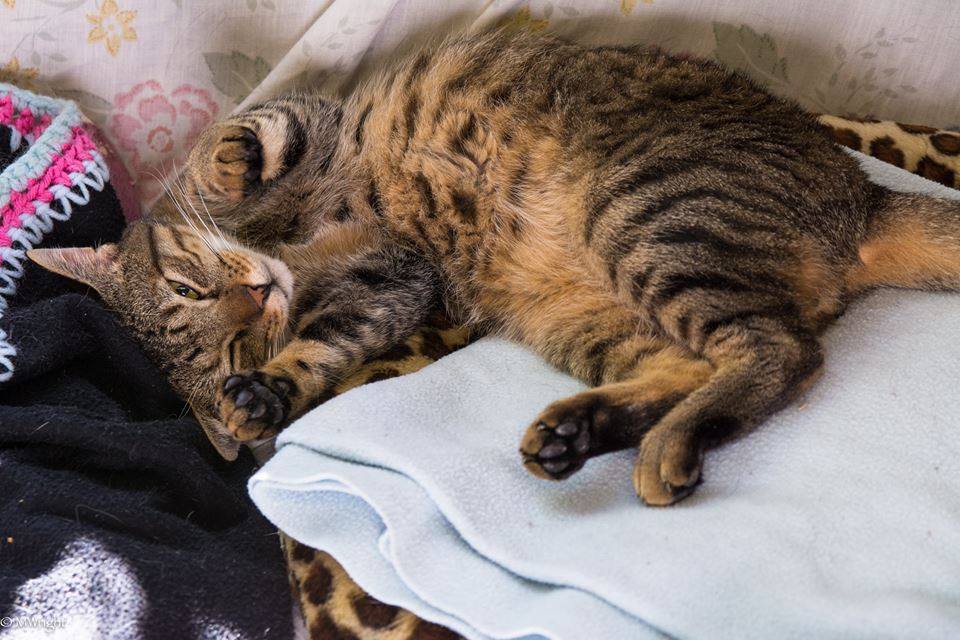
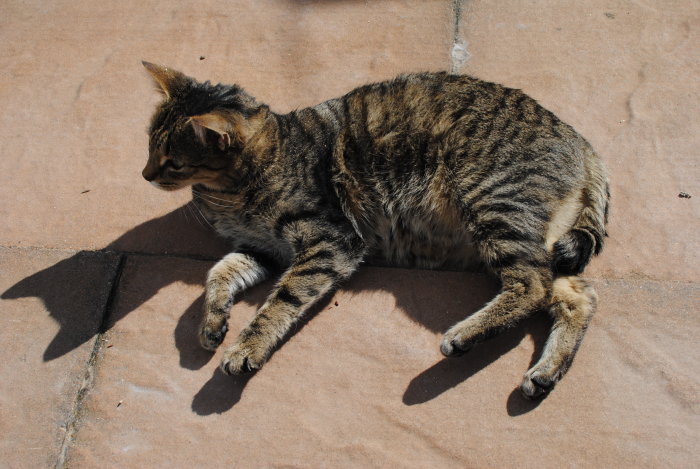
It's been over a year since front courtyard kitty Esme introduced herself to me and became one of my favorites. This week, I finally met her sister, Abby. The two have been at RAPS since they were kittens

While Esme chose a series of prances, weaves and tail waves to charm me, Abby opted more for a what I could only call a deluxe cat wriggle.


If you want to seek out this pretty girl for yourself, look for the small tabby with a shortish tail and a friendly, inquisitive face.