RAPS is short for Regional Animal Protection Society, a registered charity and operator of a sanctuary which houses and cares for nearly 500 homeless or abandoned cats in Richmond, BC, Canada. The Neko Files is a celebration of the sanctuary and all those who live and work there.
Showing posts with label Rusty. Show all posts

Sunday, July 5, 2015

At Large No More

For several years, Sunday visitors to the Sanctuary have entered, anxious to report that we have escaped cats in the parking lot, and needing to be reassured that yes, we did know those cats were out. 

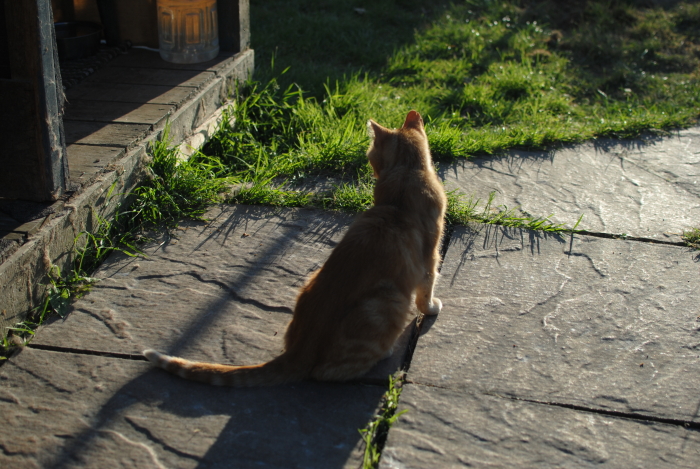
The two “strays” were Jordy (brown tabby) and Schatze (torby). Both had been taken in to the Sanctuary and for various reasons they never settled. Jordy made his home-base in handyman Doug’s work-shed; Schatze hung out mostly under the Moore House.  Staff kept an eye on both, necessitating the occasional capture and vet-visit, but both were so unhappy and so quick to escape, that they were just accepted as the outside cats.
Jordy
On his last vet visit Jordy was diagnosed with a heart condition, and his outside feedings soon included medication, which he accepted happily. And then recently he vanished – we hope he just found a hiding place and passed away quietly. Schatze, deprived of her parking-lot buddy, was more active and vocal, and the decision was made that, like it or not, she should come in. We’re situated on agricultural land, and the inevitable predators are a danger to even a savvy cat like Schatze.
Schatze
So she came into the Moore House for a while, caged, to try to settle her, and there was discussion about where she should go – should she stay in the Moore House where she could see out to the area she used to hunt? Or should she go somewhere else?
In the end the decision was made that she needed space more than she needed visual familiarity, and last week she was released into pen 4, one of the feral-cat pens at the back. It’s a spacious pen, totally fenced in and covered, and the other cats in it – who include OJ, Rusty and Sandy & Pebble – all seem to get along peaceably. They get Kitty Comforters in from time to time, and many of the cats are more accepting of human attention than they used to be.

For the first few days in the new pen, Schatze sulked; she found herself a corner under a bush and stayed there. Staff and volunteers visited her, and made sure she had food, water and attention. On Friday Michele went in to try to get some pictures, and Schatze emerged to do a little exploring. The following day I visited and was greeted by the familiar chirping, and a little cat looking for her favourite treats.
Time will tell whether Schatze will settle or will pull a Houdini – we hope she realises she really has it good in there!

Blog by Brigid Coult
Photos by Michele Wright
 
Note: Schatz/Schatze/Schatzi is a German term of endearment for a girlfriend - treasure, sweetheart.  People spell her name a variety of ways; I've left the spelling as in Claire's original posting.


Monday, January 5, 2015

Adoptable? – or not? – part 1: the ferals


When visitors first come to the Cat Sanctuary, they are told that most of our cats are unadoptables, and that if they’re looking for a new cat, the No 5 Road City Shelter is the place to go.  Typically, visitors will look around and say “but they’re so tame!” – but what they’re seeing is cats who are comfortable with their surroundings.

The usual four categories of non-adoptable cats are ferals, semi-ferals, behaviour problems and health problems, and on this basis, many of our cats would be killed by the typical animal control system.

The definition of feral is usually a cat that is born wild, or a stray that has had minimal socialization with humans, and has reverted to wild state. It does not include the typical “lost” cat, who may have many of the feral behaviours, but can sometimes be reminded that humans are friends.

There’s not much question about the true ferals – the majority of them want nothing to do with humans, and they are much happier living in a pen at the back of the sanctuary where people will let them be.
Ginti
Our med staff know all these cats, and keep a careful eye on them; medical treatment usually means netting, and a certain amount of human blood shed. Typically cages with big red signs saying "Med staff only" house ferals who are in for care, and are not happy with the situation.
Nelly
There are a fair number of ferals who prefer to live indoors. Nelly was one of our beloved Mario’s “harem”; when we lost Mario last year, Nelly was obviously searching for him. She lives entirely on the top of the double-wide cages and refuses to interact with humans other than the occasional disdainful finger-tip sniff. Her horrified stare is a typical feral look.
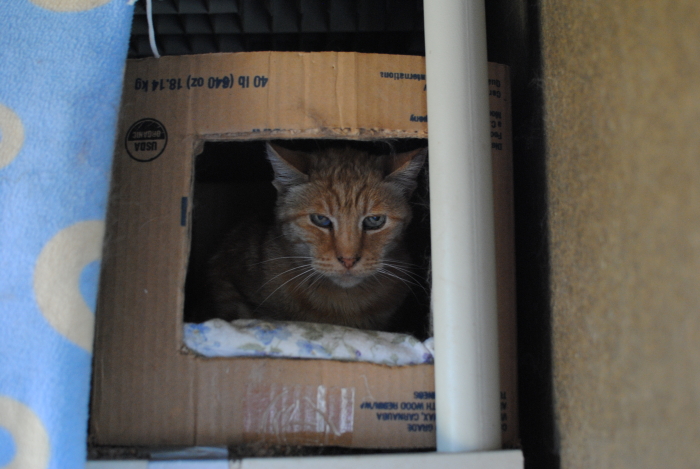
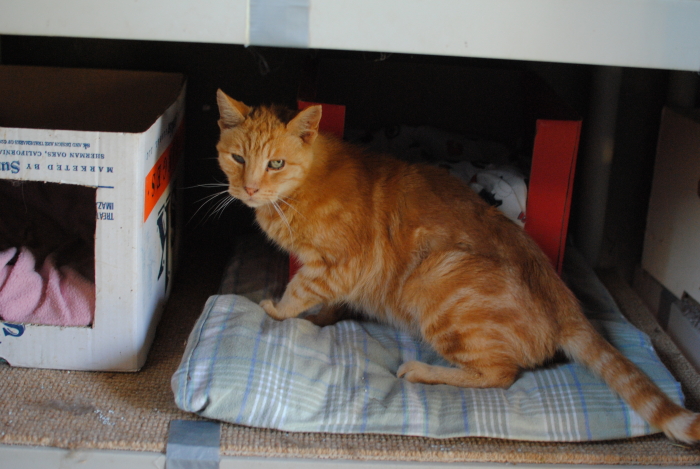
Rusty
Cats like Rusty are very selective about the humans they will allow around them. Sometimes, like elderly people with memory loss, they forget that they should be scared, and a feral who becomes approachable is very often a sign of an aging cat.


Coming up in the Adoptable – or not? series: 
Health problems / Behaviour problems / Semi-ferals and strays.


Blogger: Brigid Coult
Photos by Claire Fossey and Michele Wright

Friday, August 2, 2013

Rusty


Rusty and fellow feral Patches had been fed for years by people who'd come across them at their workplace. As the cats aged, the people noticed with concern that Patches didn't look well. They asked RAPS to trap and treat Patches and then return him to the site where they would continue feeding and looking out for him and Rusty. RAPS did this, but Patches's problem, ear polyps, returned, and so RAPS was asked to give him a permanent home at the cat sanctuary. Rusty, who was also getting on in age, was later trapped and brought to the sanctuary as well.


The people who'd cared for the cats all that time didn't forget about them and paid regular visits to them at the sanctuary. Patches sadly died earlier this year, but Rusty continues to live out the back in a feral-friendly pen. He's still scared of strangers and will flee if approached. He's much more comfortable with the people he knows, though, and the people who used to feed him have no trouble getting close enough for a proper visit.


Rusty has recently started letting Leslie get close enough to administer fluids when he needs them. Like more than a few of the cats at the sanctuary, he can be more willing to make friends if there's food in it for him. I hear he particularly likes ham.