RAPS is short for Regional Animal Protection Society, a registered charity and operator of a sanctuary which houses and cares for nearly 500 homeless or abandoned cats in Richmond, BC, Canada. The Neko Files is a celebration of the sanctuary and all those who live and work there.
Showing posts with label Little John. Show all posts

Thursday, September 1, 2022

Bandana Boys & Belles

One of the most frequent questions from weekend visitors is about the adoption of Sanctuary cats.

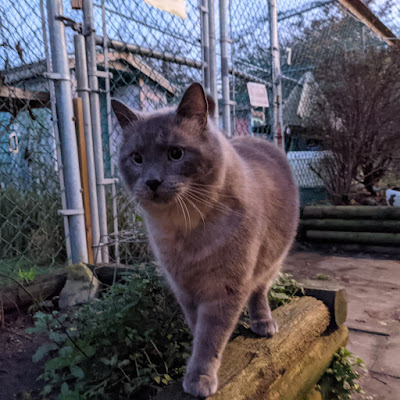
Little John is one of our biggest cats,
and affectionate when you read his signals correctly!

My usual response is that we have four sorts of cats - 
-  we have a lot of ferals who don’t want anything to do with people
-  we have a number of semi-ferals who came in as ferals, and who have tamed up quite considerably
-  we have owner-surrenders – usually “the poopers, the pee-ers and the biters” – cats with bad bathroom habits, or aggressions problems – or the older cats whose owners may have gone into care, or passed away
- we have the cats with health issues: feline leukemia, feline AIDS, plus all the standard cat-problems like kidney disease, hyperthyroidism, diabetes and other conditions – all of which require vet-care.

Cute Hunter has just come to us from the 
Adoption Centre  (KN)

So, the official line is that the Sanctuary is the home for non-adoptable cats – and if you want to adopt, you need to go to the Adoption Centre.

But it’s not as easy as that. 

Adopting a seemingly tame semi-feral cat may work well – or it may terrify the cat to be taken away from its home and known community. More than once we have had to go and rescue a cat who hides in an inaccessible corner.  That situation is eased when the cat in question first bonds with the adopting human – which is why some of our adoptions are to volunteers who have first got to know the cat in question. Sometimes it’s a visitor who comes every week, and it’s obvious to staff that the cat has come to trust the person.

Sweet Raymond is FIV+ (in the Val Jones pen)
and polydactyl - look at those toe-beans!  (BC)

Cats surrendered for bad bathroom habits sometimes show no sign of it at all with us, and we have to come to the conclusion that something in the original home was stressing them. Given a home without those stresses, it is possible the cat may adjust well.  The same is true for cats labelled as aggressive – a very calm cat-savvy adopter who doesn’t push the cat for handling or cuddling may end up being a place where that cat will cuddle very happily.  We also have a number of cat-aggressive cats who might do well as the only cat in someone’s home, where there is no feline competition.

Older cats often find it hard to find new homes – when younger cats are available for adoptions (and kittens are SO cute!) cats of 14-years plus are often passed over. Of course, end-of-life is closer – but older cats have so much love to give, and they more than deserve to be pampered and spoiled in their golden years!

Mango was initially aggressive with humans and cats,
but now he feels safe, he has become relaxed and affectionate  (KN)

Then, some cats do not do well in the Adoption Centre environment. Cages are smaller, and cage reactivity/aggression can be a real factor. We have several cats in the Sanctuary who have come to us from the Adoption Centre because we can give them some much-needed space either to use up their energy in exploring, running around, and sometimes making friends, or to hide away – it all depends on the cat and their personality.

Of course, nobody wants to take on a cat when you may end up paying vet-bills. Many of us, however, loving our own long-term cats, have learned to do things at home like giving fluids for kidney disease, or administering insulin to diabetics. And with the AIDS cats, they may carry the virus with only minimal effect on their bodies – even leukemia cats can live good and happy lives when their medical needs are understood. The big issue with both these viruses is not passing them to other cats, and that can mean, for instance, having a leukemia-cats-only household.

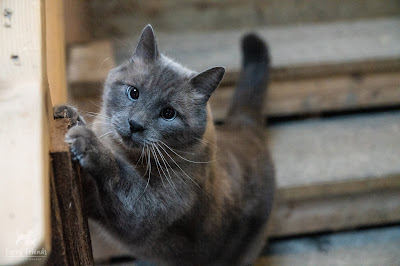
That’s where the bandanas come into play.  Visitors for this last month of the summer (September 25 is the last day we’re open to the public) are seeing a few of our cats wandering around wearing dashing bandanas. The bandanas are a signal that the cat in question is potentially adoptable. 

Gizmo is FIV+, but a friendly, affectionate boy (KN)

The yellow/orange patterned ones are for outgoing friendly cats that would likely do great in a home but may have some conditions to their adoption. For example, they may need to be adopted in a pair as they are bonded to another cat. Or maybe they have FIV (feline aids).

The red patterned bandanas are for the adoptable cats that have a spicy side where their cattitude likes to shine through in the form of teeth and claws. From time to time they get over stimulated or their boundaries are crossed and they scratch, bite or both to express their emotions. So potential adopters need to be understanding of this behaviour and be willing to respect the cat’s boundaries.

If there is interest, the Sanctuary Manager can be contacted for more information.

Blog by Brigid Coult, with thanks to Shena Novotny
Photos by Brigid Coult & Karen Nicholson

Thursday, January 13, 2022

Big Chances for Two Big Boys

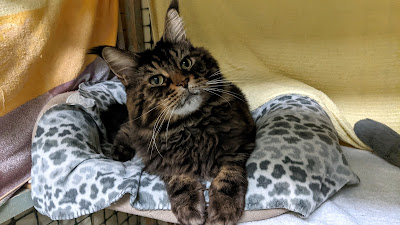
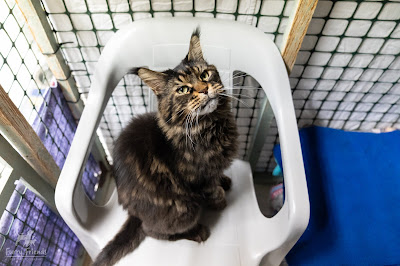
Nishka   (LBF)
It’s been a custom to end the old year and begin the new one with a Neko-RAPS retrospective focused on those cats who have passed – but I just can’t do it this year. We lost a number of well-loved characters in February and March and I paid tribute to them at that time; and then we marked a Rainbow Bridge day in August and shared more sad memories.
No – this needs to be new hopes for the New Year, and a focus on a couple of the cats who are getting a new lease on life with us.  

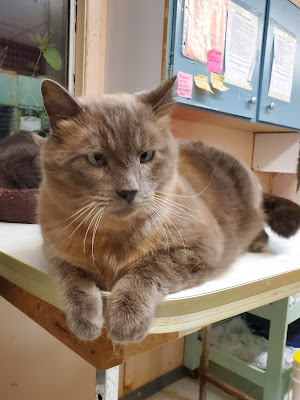
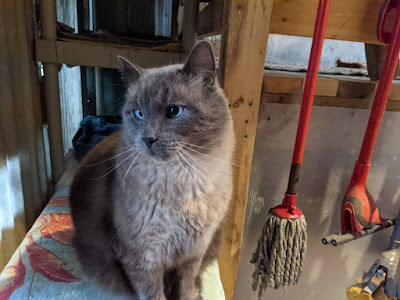
Little John  (MW)
Most of the cats that come to us, come because someone has given up on them. They’ve been deemed unadoptable for some reason – they’re feral, or they’re pee-ers, or aggressive...  And here, they discover that they can just be what they want to be; they can stay distant or allow human touch, they can live inside or outside, they can be a loner or cuddle up with a whole bunch of other cats.

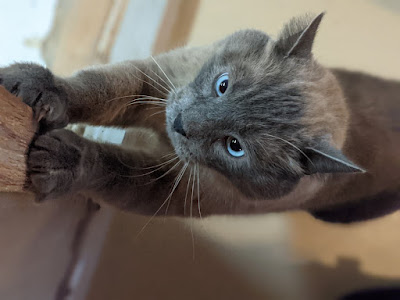
Enjoying attention   (JS)
In the fall we welcomed a big Siamese mix from Kamloops – and I mean Big!  This guy is a good 20lbs of solidness – not obese, just large. His owners had given him the quirky name of Little John (for those that don’t know, this was Robin Hood’s big sidekick) but I’m also hearing people refer to him just as LJ. Sadly, he’s a biter, and apparently always has been – and it’s not just love nips; this guy bites down, and we don’t know what sets him off. It’s probably something that over-stimulates him.  

"helping" with the cleaning   (KN)
We saw this with Benji and Mango (next week's blog) too – when caged, everything was intensified for them, and a visitor preparing to leave the cage was particularly at risk. In this situation, it’s perfectly acceptable for a volunteer to ask a staff member to deal with a cage;  many of our volunteers are experienced cat-people, but for those that aren’t, we don’t want to make them feel at any sort of risk.   Cages of newly-arrived cats are often initially marked for med-staff attention only. Little John liked to have visitors – especially Assistant Manager Valerie, who already knew him well – but even she came in for the teeth treatment occasionally.  

Out and about in the gardens  (KN)
In a regular shelter, this would not be a good situation; he’s too big a cat to keep caged the rest of his life;  he couldn’t be offered for adoption because of the biting; he would probably be put down.  But with us, once he was past his initial cage-stay, Little John was given the freedom of the back courtyard, and visibly relaxed.  If we are ever allowed to have visitors again, he will probably be one of the cats that has to wear a warning-collar, but for now he is happy to wander, to investigate every open pen and to interact minimally with other cats. We’ve not seen signs of aggression with them, but he’s so imposing that not even Jasper and Gizmo (our usual troublemakers) are getting in his way.

Big paws mean big claws....   (KN)
He can’t be offered for adoption, but that’s not to say that he might never find a home – many of our staff and volunteers are suckers for a cat with personality like LJ, and though he’s not part of the cat-crowd, we know that he tolerates them, and that he lived with and loved a dog-friend.

You may admire me....   (MW)
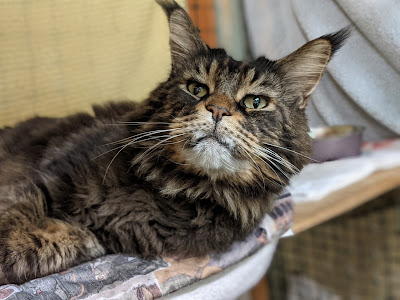
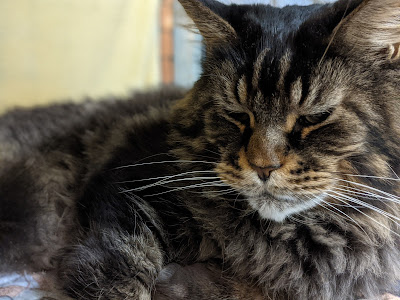
Our other Big Boy has just come to us. Nishka is a pure-bred Maine Coon cat who was kept by his breeder for stud services.  At the age of 3 he was retired because of stomatitis - they didn't want to risk that in the bloodline - and most of his teeth have been removed.   Maine Coons often have an “angry” face (I have a friend with a T-shirt that says “I’m not angry; this is just my Scottish face”) and Nishka has a formidable presence that was interpreted as aggressive – hence the surrender to RAPS. We are delighted to welcome him.

Interested in conversation   (BC)
Obviously, he is not entirely happy about being here, and about being caged. But he has quickly realized that he can have a rotating stream of volunteers coming to visit him, and has accepted some lap-sitting and gentle petting. Sadly, he doesn’t much like being groomed, which he badly needs!  He lives up to the Maine Coon nickname of “gentle giant”, and can occasionally be heard talking to himself in that characteristic chirpy voice. We’re looking forward to having him out of the cage and interacting with the SingleWide population. Because he was surrendered for aggression, he will not be going to the Adoption Centre, but I wouldn’t be surprised if he didn’t find a home with a volunteer or staff member.

Sometimes I sits and thinks....  (BC)
Both Big Boys have another chance for a good life in 2022. A very Happy New Year indeed!


Blog by Brigid Coult
Photos by Lisa Brill-Friesen, Brigid Coult,
Karen Nicholson, Justin Saint, Michele Wright