RAPS is short for Regional Animal Protection Society, a registered charity and operator of a sanctuary which houses and cares for nearly 500 homeless or abandoned cats in Richmond, BC, Canada. The Neko Files is a celebration of the sanctuary and all those who live and work there.
Showing posts with label Creampuff (II). Show all posts

Wednesday, June 11, 2025

Creampuff & Malibu

Siblings Creampuff & Malibu  (JS)
These two gorgeous floofs were part of a trapped group from Surrey in the fall of 2023 – a situation that was partly hoarding, partly a badly-maintained colony.  Many of the cats were semi-socialized – not so much that they could be scooped up, but not so fearful that they refused to enter well-baited traps. And several other rescues were involved in the project, so that nobody was overwhelmed by numbers.

Creampuff when she arrived (AM)
Looking at these two, it’s very likely that they are siblings, though they’re not strongly bonded. Initially Creampuff was caged in the Connor building, as was orange Cornbread;  the two of them could often be seen together on the north side of the courtyard. Malibu was a Hill House cat;  I suspect the two of them were separated because neither had been spayed/neutered, and by the time they re-encountered each other, they’d forgotten family ties.  

Malibu's markings were clearer when he was young  (AM)
At first glance they’re pretty well identical – Malibu’s ears are a little more orange, and he has white markings on his face, where Creampuff’s fur is more even.  Currently it’s easier to distinguish them;  like many of the semi-feral cats, they dislike being groomed, especially given the mats that are common in long-haired cats, and they were among the first customers that Gracelyn tackled in the salon-project.  

Malibu's lion-tail is furring out again  (BC)
Unlike Alfie, who had a complete lion-cut, these two just had a remedial cut, zeroing in on the specific problems.  Their shaved patches are in different places, and the most useful identifier is that Malibu now has a lion-tail, down to the little tuft at the end, while Creampuff still sports her beautiful plume.

Creampuff enjoys lounging on a high shelf  (BC)
Weekend visitors are always struck by these two, and we are often asked about their adoptability. They still fall in the semi-feral category, which ranges through a spectrum from “look, but don’t touch!” to “pet me, pet me!”.  Neither one of the pair comes looking for petting; they will tolerate it for a while, but they’d rather not have much contact. As cats that have lived wild, their bathroom habits are erratic; some cats settle to using litter-boxes easily, but from the mess around the courtyard in the mornings, it is clear that some do not. We could probably have adopted out orange Cornbread, but she is definitely not bathroom-trained!

Malibu  (KN)
So until either cat demonstrates a strong bond to a human, AND is seen to be a consistent litter-box user, they remain on the unadoptable list – they get to enjoy life in the front courtyard with their feline buddies, and we get to admire their beauty.

Blog by Brigid Coult
Photos by Brigid Coult, Anne Marchetti, Karen Nicholson, Justin Saint

Wednesday, February 28, 2024

KCs At Work

Raisin - a pen 4 feral girl   (KN)
Visitors who come to the Sanctuary at the weekend are often astonished and delighted by the number of cats who come to greet them.  What they will not see are the cats who are hidden away – either by their own choice as ferals, or because they are caged. Cages are not what the Sanctuary is about – but they are occasionally a tool to lead to something better for the cats. Most of our felines are here either because they are feral or because they have been surrendered. If they are immediately adoptable, then they will go to the Adoption Centre – but many of them are not ready for that when they come to us. 

When Creampuff came to us, she spent most
of her time hiding behind a drape   (BC)
Because a new cat needs to be assessed, and have all its vaccinations current before it is released into the general population, it will often spend 4-6 weeks in a cage. There is always a drape or a carrier or somewhere that they can hide.  Some cats are happy to be hidden away in a quiet dark place – but that doesn’t help them when they finally emerge. So there is a team of volunteers who will happily spend time sitting quietly in a cage, allowing the cats to learn that humans are not always scary.

Marianne & friends - by Selena Marchetti
The team of Kitty Comforters was the creation of the late Marianne Moore, a longtime Sanctuary volunteer, who passed in 2018. Six years before that, she established a group of “cat-whisperers”, volunteers who had proved themselves to be calm and patient and occasionally willing to be scratched or bitten by a scared cat. The team is still operating under the leadership of Anne Marchetti, and they appear faithfully each afternoon to spend time with cats who are receiving medical care, cats who are new to the Sanctuary, and some of our shyer inhabitants. 

Food bribery   (LBF)
Sometimes kitty-comforting time involves food bribery, or gentle grooming; sometimes it may be no more than a quiet voice. We learn which are the cats that are aggressive in their fear, and which are the ones who will only hide. Most of our time is spent with caged cats, but we also look for the shyer cats who live in the open pens, and connect with them as much as we can. Kitty Comforting is about much more than just having fun with your favourite cats; it’s about searching out the ones who need us, and establishing trust by whatever means we can.  Most of the KC’s have done their share of cleaning and feeding, and are known by Anne to be really patient and persistent in reaching out to scared cats.

Shy Tibby hid in her cage for weeks;
now she's out, and much more confident  (AA)
My recent KC session began with a visit to the Adoption Centre, where Benjamin and Olivia are still awaiting someone to offer them a home. Benjamin came out for a visit and some cuddling; Olivia has a bit of a cold, and stayed in her bed. From there, I paid a visit to the SingleWide offices, which are much quieter than usual, with a lot of the admin transferred to the Adoption Centre. Mojo and Licorice like the quiet, but they also need some stimulation and love. They have been joined recently by pretty Tibby, surrendered for inappropriate urination, and, like Oscar and Winston, on a diet to see if there is a physical basis to her problem. Licorice believes firmly that all visitors come to see him, and took exception to my paying attention to Tibby by backing up and peeing on my leg – sometimes a penalty of being around our cats!

Li'l Bit outside the DW deck   (KN)
A quick visit with Oscar and Winston and a check in to compare notes with fellow KC Catherine, on her own rounds, and then I moved to the back pens for a bit, checking in there with Lisa who is one of the “magic people” with ferals. She has been working with shy Raisin in Pen 4, who still hides away from everyone else.  We are watching for a gradual relocation of some of the Cranbrook College cats who base themselves on the high shelves on the DoubleWide deck, but who have also discovered the cat-door and the potential for visits to the back pens. We will occasionally see Li'l Bit and Foster exploring in Pen 3 – though their explorations tend to be around sunrise or sunset, when there are fewer humans around. 

Sweet Audi is beginning to be curious about us  (BC)
There are more caged cats in the DW because it’s closest to the med-staff. Some of the cages still bear “Staff Access Only” signs; in a few of those cases, Anne may let us know that the KCs do have access to start the familiarization process. Sometimes we’ll barely see the cats in question, who have places to hide and prefer to use them with strangers – sometimes the offer of a treat will be met with a well-placed claw, or with warning hisses. With these cats, little and often is the key; they need to discover that humans may feel scary, but don’t intend them any harm.

Sylar enjoying petting  (BC)
From visiting with shy Audi, I move next door to visit with an old friend. Sylar has been my sponsor cat for years. He’s a very wary feral who loves his chicken, and has progressed to occasionally accepting it from the hand, though he prefers to have it tossed to him. Currently he’s in for observation; he’s lost some weight and has become pretty matted, so I hope blood tests will show the problem. As always, there is fierce hissing as I enter his cage. Because I know that he knows me, I loop his drape back so that he has nowhere to hide; I offer his favourite chicken and he accepts it without biting my fingers. Very carefully I hold tidbits in my right hand and pet him with my left; he allows it without protest, and the bum comes up as I pet down his body. By the time I leave him, he’s allowing petting (but not grooming) without hissing. I suspect, though, that once he’s out, he’ll be back to not permitting touch!

Sometimes the best Kitty Comforter is another cat -
Denzel is being visited by his buddy Luke    (BC)
I visit with sweet Denzel, who’s had dental surgery and is caged so that he only eats wet catfood for a while, and with Mortimer, who’s just out of a cage; Mortimer came to us as an unneutered tomcat and was a little reactive while he waited for release. Now the hormones are under control and he has his freedom, he’s become one of the cuddle-bugs on the DW couch.

Espoir is listening, but doesn't want to interact  (BC)
One more scared cat to visit, and I return to the front courtyard to be with Espoir in the Hill House. She pretends I’m not there and hides behind her cat-tree; it’s too soon to push her for contact, so I just sit and talk with her for a bit. There’s a series of interested visitors at the door; many of the Hill House cats enjoy company, both human and feline, and Espoir will not be a total stranger to them by the time she’s finally allowed out.
Magnus (front) and Jim  (GA)
My shift is finally over as the evening feeders-and-scoopers start to appear – I stretch my time with a short visit to my buddies in the Val Jones pen. The porch chair is vacant, and as soon as I sit down, Magnus and Jim occupy my lap. These guys don’t need the work we put into the more scared cats, but they do need us to spend some time with them because the Val Jones is closed off as an FIV pen – they just need to know they’re not forgotten, and most of the regular volunteers will happily spend time with them as well.

Blog by Brigid Coult
Photos by Graham Akira, Alicia Almeida, Brigid Coult, Karen Nicholson

Wednesday, January 24, 2024

Thanksgiving for Cats

Shy Malibu   (KN)
Back in the fall, Lisa and Ken spent quite a bit of time patiently watching traps.  

Can we trust you?   (LBF)
There are generally two circumstances in which trapping needs to be done. The first is when we discover a colony of cats who are producing kittens – and it only takes a couple of unfixed females, and we suddenly have a flood of felines. The fall colony was discovered in an industrial area – not a safe place for kittens – and it was important that they were brought in before kitten season extended itself yet again.

Truffle in his hideaway   (BC)
The second is when we discover a situation in which a colony is being claimed and “maintained” – but not really...  too many cats living freely inside and out, not enough food so they’re annoying the neighbours, in danger from traffic and predators. In this case it was largely a human hoarding problem, and a mental health one – and the best Ken and Lisa could do was to get cats to safety wherever possible. Other rescues were involved here, and RAPS has played our part in solving the problem.

Hissy Creampuff is calmer now  (BC)
In the first situation, trapping is largely a matter of time and patience; food resources for the cats are limited, and food offered is tempting, and brings them into the trap.  In the second situation, the trappers were handicapped by well-meaning neighbours (and probably the “owner” herself) who were feeding a variety of (not always cat-food) things, and causing the cats to turn their noses up at the food in the traps because they weren’t hungry.

Misty & Windy safe in fosterage  (LBF)
Patience and persistence usually wins, though. Through October, lots of little black kittens from the industrial area have come through the care of fosterers to the Adoption Centre and on to their own homes. They were initially given Thanksgiving names like Cranberry, Stuffing, and Turkey – and then moved on to other fall names: Hayride, Windy, Stormy, Misty, Moonlight... Foster-moms have been very busy, and are now taking that last painful step of sending their beloved kittens on to better things - a process made easier by the fact that Lisa takes wonderful kitten pictures!

Caramel's babies   (LBF)
One of this collection of hoarded cats ended up being whisked away and into fosterage. Pretty Caramel really wanted attention, and got plenty of it while she awaited the birth of her kittens.  With all that handling, she will probably go to the adoption centre with her babies when they are ready to find their own homes. Their sweetness is reflected in their names: Sundae, Donut, SugarCookie, Shortbread, ButterTart and CandyCane.

Misty & Windy have extra toebeans!  (LBF)

The cats from the hoarding situation are mostly adult, semi-feral or very shy, and have needed time to settle down at the Sanctuary.  Many of them also acquired food names: Cornbread, Truffle, Tater, Creampuff, Tamale...  A few non-food names also snuck in – beautiful Malibu can be confused with Creampuff as they bound across the front Courtyard until you see Malibu’s markings clearly.  Tater is doing no bounding – she is very shy and spends most of the time hiding behind the drapes in the ORA.

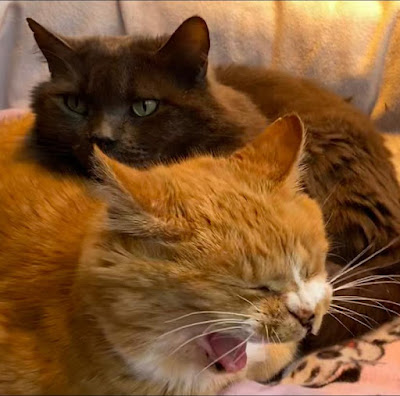
Creampuff & Cornbread  (LBF)
Cornbread is probably the youngest of the group, and loves attention but is easily over-stimulated. Her jumping and running rapidly changes to smacking, and it’s important to read her body language.  My own favourite among these cats is Truffle; he’s a handsome lynx-point who hangs out now in the yellow-door shed, but who is happy to emerge and visit with a human.  I think, as with many of this group, he prefers the crepuscular pattern of morning and evening; when I arrived early one morning last week, he and Cornbread were playing near the gate, and were ready for some fussing and attention; when I left, late morning, he’d retreated to his hidey-hole.

Cornbread loves to play   (BC)
Tamale is not very social; he hovers between the Hill House and the ORA, putting himself wherever the humans are not. Karen managed to get this wonderful picture of him with a distance lens; usually if he sees us around, he hides. But he’s interested; often I’ll be visiting in the ORA and look up to see him peering through the window from the Hill House.

Tamale  (KN)
With all these cats, we’re dealing with a mixture of ferals and strays. The ferals will probably remain wary, and appreciative of all the many hiding places we offer them;  the strays know about human contact and we hope that patience will eventually bring them around. Whichever way it turns, we are thankful for their presence with us, and grateful for all Lisa and Ken’s trapping efforts.  Thanksgiving is not just for one time of year!

Blog by Brigid Coult
Photos by Lisa Brill-Friesen, Brigid Coult, Karen Nicholson