RAPS is short for Regional Animal Protection Society, a registered charity and operator of a sanctuary which houses and cares for nearly 500 homeless or abandoned cats in Richmond, BC, Canada. The Neko Files is a celebration of the sanctuary and all those who live and work there.
Showing posts with label Yma. Show all posts

Wednesday, October 15, 2025

Colourful ferals

Sarah (KN)
Sometimes it feels like we have a flood of new cats that come in from different rescues, and it may take awhile for them to settle enough that we can really get to know them.  One such inundation happened in late 2023 when we took in the colony that had lived at Cranbrook College of the Rockies, until the College demanded their removal. The feral colony came into our care, and is now well settled in pens 2 and 3 in the back courtyard; most of them remain fearful and avoid contact with humans.

Raya - newly arrived  (BC)
At about the same time, a trio of little cats came to us from Broken Promises Rescue, on Vancouver Island,  and were placed in a DoubleWide cage opposite the College cats. Like the larger group, the trio was feral, and spent all their cage time huddled behind their privacy drape. Efforts to visit with them were met by fearful hissing; they definitely didn’t want people around them.  They were a colourful little family – a short-haired calico, a long-haired tortie, and a long-haired pale one with raccoon eyes. The two long-haired ones were found behind a Port Renfrew restaurant, on the west coast; the calico came from a First Nations reserve near Ladysmith. Broken Promises works largely with fostering, and these three were in care together for some time, before it was decided that they were too scared to tame, and would be better at the Sanctuary.

Sarah, in Pen 3  (KN)
Typically the Sanctuary cage-stay is 6-8 weeks, allowing us to administer necessary vaccines, do spay and neuter when needed, assess health issues and dental care, and with luck, enable the newcomers to encounter humans and learn that we mean no harm. Practically, most ferals don’t change that quickly – and because they’re sharing cages, their proximity both gives them comfort, and reinforces that they’d rather be with their own companions. When the med staff feel we’ve done as much as we can, the cage doors are opened, and the cats can decide what their next move will be. The majority of the College Cats made their way out – first to the DW Deck, and then out into the pens; only Tabitha (also known as Tubbitha) remained indoors – and her attitude to people didn’t change much, though she appreciated the food service!  In the opposite cage of Broken Promises cats, little Sarah, the calico, summoned up courage and headed for the great outdoors;  since then she has mostly located in pen 3, where she has made friends with other small ferals, and with the Calgary colony who live there. I most frequently see her in company with black-and-white Tofino, who is very cat-social.
Madeleine & Raya were always together  (BC)
The other two little girls were definitely bonded, and decided to base themselves in the cage and refuse to move; their drape was left up, and I think many of us almost forgot that they were there. Occasionally little Madeleine would be seen scooting from cage to the Deck door, like a little grey ghost; tortie Raya was not to be dislodged. They must have come out at night to share from the wet-food plate – but only the evening med-staff might occasionally spot them.

Madeleine in the great outdoors  (BC)
Then big changes:  the 25-year-old DoubleWide trailer badly needed refurbishing: pee-sodden wood had to be torn out, wiring and insulation replaced, shelving installed, all the cages rebuilt. Much to the dismay of the regular inhabitants, everyone was moved out and doors closed behind them.  Madeleine took herself right out of the building and to pens 2 and 3 – I don’t see her much in company with Sarah, but she can sometimes be found hanging around Yma, who is still very shy.

Raya, out on the deck with the other ferals  (BB)
Tortie Raya vanished completely, but has been discovered hanging out on the DW deck with the other semi-ferals; like Madonna, she hides out in the beds that line the shelf above the windows.  When the work on the main room is done, it will be interesting to see whether she returns to it, or whether she prefers to stay where there are new friends. And as the weather gets colder, who knows if Madeleine will manage to make her way back to the main building to be with Raya, or if she will let Sarah show her how to manage, out in the gardens.  

Madeleine, still hiding out (BC)
All three remain fearful of human contact – unlike the Cranbrook cats, who are getting increasingly brave at being around humans (Li’l Bit actually spent Sunday visiting time out in the open – not interacting, but not running away!).  Sarah’s had a winter outside, and knows how things go;  once the DoubleWide renovations are complete, the med-staff will make a decision on whether to net Madeleine and return her to keep company with Raya, or whether to leave her to do her own thing with Sarah and the other ferals in the back pens.

Blog by Brigid Coult
Photos by Braden Burgess, Brigid Coult, Karen Nicholson

Wednesday, February 5, 2025

A Cat Who Walks By Herself

Yma  (KN)
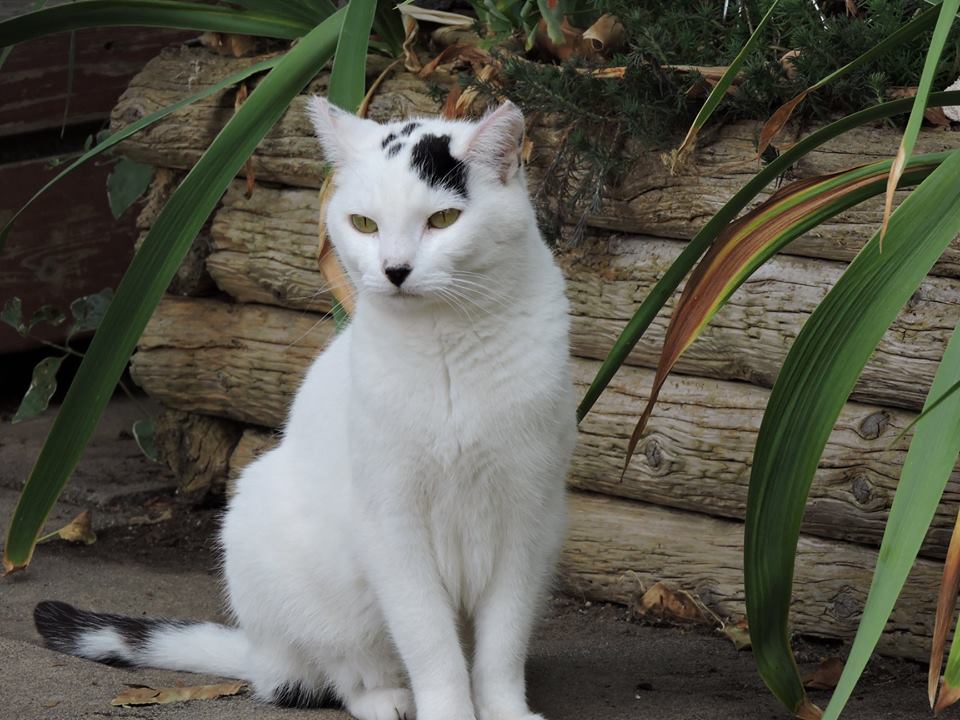
Yma came into our care almost nine years ago – one of a colony of cats Stephanie trapped at a nearby composting facility. Some of them may have been dumped cats;  others were born wild.  Life for ferals is often short and terrifying – this site was also a hunting ground for hawks, eagles and coyotes (there were a LOT of rats!) - and we tried to rescue as many as possible.  Many of the cats we brought in were dubbed “the cow cats” for their black-and-white Friesian patterns, though there were also tabbies like pretty Merran.

In her favourite place, alone, in the gardens  (BC)
Stephanie and her helpers made regular visits, setting traps and waiting patiently. We knew that it was not possible to rescue them all, and she had identified at least one big tomcat, who she named Pavarotti, who was too wily to venture into a trap, even with the tastiest food to bait it.  But over the course of months, cats made the protesting journey from the feral life to life with RAPS. I was with Stephanie when one of the last of these was trapped, and was given the privilege of naming her: since Pavarotti was likely her sire, I named her for Yma Sumac, the extraordinary soprano of the ‘50s

Early days: Yma in hiding  (KN)
The youngest cats trapped, of course, went to fosterage and eventual adoption. Stephanie still has one of those cats: Hammy (Hamish) - one of Hillie's kittens - still has the former feral’s wariness, and is a one-woman cat, trusting Stephanie alone. The cats that came to live at the Sanctuary were split between the SingleWide and the Back Courtyard. Mya and Kirstie settled to the comfy life in the SingleWide – so comfortable that they both became roly-poly cats, with all the snacking that was available. Luckily, they had also tamed to the point where they were both able to go to the homes of experienced cat-people who could put them on a measured diet, and they’re both doing well. 

Kirstie & Mya remain happy indoor cats (LBF)
In the Back Courtyard Hillie and Yma ignored one another – their similarity meant that there was probably a strong genetic link, but they were trapped at different times, and there was no mutual recognition. Hillie made a breakthrough with us, and realized that people were not so bad! - Yma relocated herself from the DW deck to the outdoor life, and settled in Pen 2, preferring to keep her distance.  In all the time she has been with us, she has elected to avoid humans at all costs. She was one of the cats who preferred to climb the tree in the back courtyard, and continued that habit until we finally extended the netting to prevent access to the branches and a possible escape route. 

When she first discovered the gardens,
Yma liked best to hide up in the tree  (MW)
Through much of the year she would base herself in one of the straw-lined kennels around the perimeter, actually going into the cabin only when the weather made it really necessary;  nowadays she usually sleeps in the cabin, but a sudden human visitor will make her explode out through the cat-door. I try to remember to speak as I approach, to give her some warning.  

You can look, but not touch!   (KN)
Unfortunately she has that curse of white cats – ears that are sensitive to sunshine, and that develop skin cancers. We have had several cats like her who have had cancerous ear-tips nipped off to prevent further growth. But going in for even minor surgery means netting and caging her, and is stressful – two steps back, behaviourally, in order to be one step forward, health-wise.

Ears now rounded, rather than pointed  (KN)
So, so slowly, she is adjusting to us. When she is sitting quietly, it is sometimes possible to approach her, even to sit with her; a gentle voice is accepted, but any sudden movement, and she’s gone.  She will occasionally hover at the cabin door when I’m cleaning, but she shows no inclination to come closer or to accept tidbits. She has some favourite perches around the edges of Pen 2, and is ready to sit there peacefully even when visitors are around; she obviously knows that the ropes marking access limits are there to protect her.  She’s not a cat-social girl, like Tofino, in last week’s blog; mostly, when you see Yma, she will be alone. Behind the cabin doors, who knows? – but in the gardens, she’s a lonely figure – the other cats don’t bother her, and she rarely approaches them.

Watching the visitors from a safe distance  (MW)
I sometimes label our loners as Garbo cats – but in many cases, their alone-ness comes from their active dislike of other cats, and we need to encourage that separation in order to keep the peace.  Yma simply chooses to be alone.  Greta Garbo would approve of her.


Blog by Brigid Coult
Photos by Lisa Brill-Friesen, Brigid Coult,
Karen Nicholson, Michele Wright

Thursday, August 19, 2021

Pen 2 Pals

Calvin on "his" doorstep  (MW)
 Some cats are strongly territorial – not in the sense that they will defend their territory, but that they establish their space and stay there. In some areas in the Sanctuary that is enforced, of course – SingleWide cats stay in their building, as do the Aids and Leukemia cats.  But in both front and back courtyard there is the potential for a lot of movement between areas, and it’s interesting to note the cats who like to visit and those who stay in their own space.

The newly-painted pen 2  (MW)
Pen 2 is very much that sort of area. The cats who live there came to us in 2016 from the Shelter, and were all cats who for one reason or another had not been adopted or were deemed unadoptable. I blogged about them in the following year with an intro and a look at the blacks/tuxedos, a feature on the tabbies and one on the coloured cats.

Cadbury (KN)

Four years later and most of the same cats are still living in the same cabin.  We’ve lost Tubby and Minnow, Sophie migrated to the TeaRoom and Celeste to the DoubleWide, Zivko has set up his Boys’ Club next door in Pen 1, and Kevin is often with him – but everyone else is usually there. They have been joined by Skittles’ beautiful brother Cadbury, who occasionally craves petting, but is usually shy – and by Hillie’s sister/cousin Yma, who still does NOT want to be touched, but is curious.

Yma - watching from a safe distance  (KN)
My Friday morning is spent out in the back pens.  There’s a routine – a quick circuit closer to the TeaRoom to pick up plates from the night before, and put them in to soak. Then, gather scoop and bucket and start at the back to pick up the remaining plates and do the clean-up simultaneously. Pen 4, where I usually start, used to be very quick and easy, but needs more work these days, with more cats living there. Across to Pen 3 where I always used to spend cuddle-time with Dell – these days pen 3 is full of teenagers, and quiet cuddling isn’t yet on the menu.

Paula, Chase, Calvin (KN)
As I enter Pen 2, Yma scurries from the door to one of the kennels. If Cadbury is outside, he usually takes himself out of the way – if he’s indoors, he will stay on his shelf till he knows who it is. As I open the door, there is a rustle of activity. I don’t know if they recognize my voice or if the reaction is common to all volunteers – once they realize it’s me, they are active and interested.  On Fridays I bring a baggie with some of my own cat’s diet food, and some dental kibble. You wouldn’t think that stuff that’s “good for you” would be so popular, but it’s different from their regular kibble, and therefore “special”. Cats don’t do deferred gratification very well, so there’s a certain amount of edginess as I scoop their boxes and sweep out the cabins; a quick check to see that all the bedding is clean, and the excitement builds. 

Salina (MW)

Calvin, as always, is the ringleader, and comes down the ramp to take over the window-ledge and demand his share. He’s actually not good at sharing, and Chase will often get stuck on the ramp, unable to access his brother’s goodies or to go backwards to the shelves. Salina paces anxiously till she gets her portion.  Barbie usually remains in her bed; she likes the odd treat, but often she feels it’s not worth the effort; Booty is often the same.  Palma and Paula are still shy and hover on the top shelf or in the corner – they want their treats, but without direct human contact, please!

Chase and Calvin (KN)

On a cleaning shift there’s often not time to spend the sort of quality let-me-touch-you time with cats that we would like.  I don’t know about other people, but I tend to focus on getting the job done, and then I’ll go back afterwards for more time with favourites.  Sometimes that involves treats, or grooming; sometimes it just means contact.  Most of the Pen 2 cats will remain in their cabin for the greater part of the day – as it cools and dinnertime comes, Calvin, in particular, will wander round and make a few visits in the vicinity. Shy Paula is sometimes an honorary member of the Boys’ Club.  But it’s rare that you’ll find the Pen 2 cabin empty – it’s a much-loved homebase for the cats who live there

Blog by Brigid Coult
Photos by Karen Nicholson & Michele Wright

November 2024:  Sad to report the passing of Calvin - loved and loving - gone to be with his brother Chase


.

Thursday, August 15, 2019

Formerly Feral

Many of the cats at the Sanctuary have come into our care as ferals.
Pen 8: Selena, Hailey & Johnny - KN
Some of them will remain feral in behaviour all their lives.  Many of the cats in Pen 8 are examples of this – as you enter the pen, they take a horror-filled look at the intruder, and make a beeline for the closest cover. It is clear in their eyes that they want nothing to do with humans, and when, in areas like pen 4 that cover may be in a free-standing kennel or in the bushes, they present a significant challenge for the med staff who need to check on them.
Pebble (front) and Sandy (rear) - DW
In this pen, only OJ and Pebble are comfortable being touched (the links take you back to their early days, but a little searching by name will yield updates); both enjoy petting, but you can see the wariness in their body language. Pebble’s sister Sandy is almost identical but sends out a very clear “don’t touch me!” vibe.
Yma prefers to climb out of reach - MW
These cats, together with many though not all) of the ones in Pen 3, and a good number of those from other open pens, were born wild, missed being socialised at the optimal time, and have it well ingrained that humans are The Enemy – we may be a source of tasty food, and of occasional touch, but we are not really to be trusted. We occasionally worry when an old feral suddenly becomes friendly and handleable; it’s often a sign of a kitty dementia, as the cat forgets that it should be scared, and it may be an indicator that it’s coming to the end of its life.
Little Calista only became touchable in her last months - MW
Common cat-handling wisdom has it that a kitten should be socialized by the age of 3-4 months, or it won’t socialize at all. In fact, those of us who have had semi-ferals in our homes know that they can become very handleable to their own people, though they may always be wary of strangers in their space. At the Sanctuary we have tried to keep some of the younger ferals together around the back deck of the Double-Wide, and the Kitty Comforters have worked with them as much as possible.
Bubbles loves to play - BC
Gradually we see behaviours changing:  hissy Luke is now allowing us to touch him; Bubbles is enjoying interactive play;  shy Ruff is coming out of his hiding place; beautiful Scooter, who hovered just out of reach on the cage-tops, smacking at us when we coaxed her closer, is now coming down to an accessible shelf and enjoying being petted.
Scooter original (L) and relaxed & happy (R)
In pen 3 former feral Napoleon has decided that humans are worth cultivating – both regular volunteers and Kitty Comforters have charmed him to the point where he will approach, asking for petting. His buddies at the back of the pen are not ready for much contact yet, but Napoleon is happy with human company.
Napoleon - LB-F
My own former-feral triumph has been with Skittles, formerly of Pen 6. That pen has now been vacated in preparation for another group of ferals coming in, and Skittles and his friends have the run of the back pens. Most of them are now based in Pen 2, where there are other semi-ferals, and lots of places to hide. But Skittles, who was always the bravest and most social of them, has decided that he likes to be around people. Chicken tidbits help – he’s always been a chick-oholic.  But he recently decided that since I was a source of Good Things, he might try something new, and he hauled himself up on my lap.
Loving a lap - DW
This was not just cupboard love – he wanted petting and attention, not just feeding. It’s a little painful on the legs – he’s a big solid boy and doesn’t jump much, so lap-climbing is mountaineering!  But it’s happened often enough now that we can really feel Skittles has earned the former-feral label. And he is now transferring that trust to other people.
Skittles - MW
All these cats may some day become very used to human touch, but they will always remain cats that we will hesitate to adopt out because of their background, and because new experiences will likely cause them to revert to the fear-filled wild creatures that originally came into our care.

Blog by Brigid Coult
Photos by Lisa Brill-Friesen, Brigid Coult, Karen Nicholson, Debbie Wolanski, Michele Wright

Thursday, January 31, 2019

Up Is Best

Emery surveys the world - PH
As all good cat-owners know, one of the keys to a happy cat-home is offering your cat a choice of levels on which to rest. Whether that means clearing shelves, installing steps on a wall, or just bringing in a good-sized cat tree, your cat will probably enjoy being above ground-level. For many cats, climbing behaviour is instinctive – it gives them a vantage point to watch for potential danger, and often offers a warmer place to rest.
Towels are warm - so Cole ignores the sign - TV
At the Sanctuary, it’s also one of the means of keeping the peace – cats who might not get on with each other can find different levels on which to co-exist, and the feral cats, in particular, like to stay well out of the way.
Even our handicapped Terry likes to go climbing - MD
All the space is set up with this in mind. In each of the main areas, cages are built with an extensive cage-top surface, well-equipped with bedding – and part of the morning clean-up involves volunteers and staff climbing up to check and change bedding as necessary. Every area has at least one cat-tree – often more than one – and we are most grateful to the donors who bring new ones in. Uninhabited cages are left open and provided with boxes and beds so that shyer cats have upper levels where they can hide.
Comet ready to launch from one cage-top to another - MW
In both the Double and Single-Wide, runs are set up around the room so that cats can choose to stay off the ground if they prefer. Some of the more feral ones may rarely venture down; food and water, litter-boxes and bedding are all within their reach.
exploring on the gazebo roof - BC
When the gazebo was installed in the front courtyard, it didn’t take long before some adventurous souls made their way up through the central lantern and onto the roof; that access has now been blocked
KitKat likes to be on a shoulder - TV
Some cats don’t wait for shelves or cat-trees – KitKat is one of our gate-greeters, and is quite ready to do a vertical take-off to land on an unsuspecting shoulder; she likes to be higher up than all the humans around her. If someone taller comes into range, she’s quite ready to transfer to the higher vantage point.
Skittles loves to show off on his shelf - MW
In all the pens at the back, the cabins contain several sets of shelves, well-equipped with bedding, so that cats can choose their preferred level. And out in the open there are also places where they can climb, and look out over the area with a greater sense of security.
Magnus, Duke and Max sunning outside New Aids - KN
One of the other functions of a cat-tree, of course, is to offer a surface for scratching – both to exercise the claws and to give the cat a chance to stretch their leg and back muscles. In many places around the Sanctuary untreated wood is used for stair and door posts, and there are a few places where there are signs that it will soon need to be replaced.
Albi gets in a good scratch - MW
The best scratching post, of course, is the tree in the back courtyard, and it is well-used both for that purpose and as a vantage-point by a variety of cats.

For a big cat, Leo is an agile climber - MW
Yma feels safer up high - MW
Pico loves to explore heights - MW


Blog by Brigid Coult
Photos by Brigid Coult, Melanie Draper, Phaedra Hardman,
Tanisha Vincent, Michele Wright

Thursday, January 24, 2019

Feral to flirty

Hillie enjoys watching the activity around - MW
One of the important differences between RAPS and many other shelters across the country is that we have the Sanctuary, and are able to walk the talk about being a no-kill organization.  Most shelters are set up to take in stray animals and to try to adopt them out – and many do an excellent job of it. But when it comes to cats, and especially cats born in the wild, it’s very difficult for the average shelter to find homes for them.  In a rural setting, it may be possible to create cat colonies on a farm, to help with rodent control, and there are an increasing number of municipal experiments on the same principle, where feral cats are being used in warehouse facilities to restrict a rat problem. But it’s a sad fact that there are still many shelters where they look at a feral cat, name it untameable, and euthanize it.
These feral cats prefer to live at the back of the pen.  MD
When feral cats come to RAPS, we are able to find them a home at the Sanctuary. They may end up being incorporated into one of the feral pens, or they may be allowed to find their way into the general population, and hide or not, as they please. Their initial period spent in a cage gives our Kitty Comforters a chance to see if any progress can be made, but we know that you can’t force-tame a cat, and some will never become comfortable around humans.
Autumn likes to flirt for attention - MW
That being said, we have had our share of successes. Pretty Autumn, in the front courtyard, has made the transition all by herself – even if it has taken her six years to do so.
Cricket is now totally at ease with us - MW
Cricket’s transition was faster – she came in as a half-grown kitten, just past the usual tameable window. We worked very hard with her, and her brother Beetle, and she resisted all our efforts. But when released into the front courtyard, she made a quick about-turn, and has become one of the friendliest cats in the place (though Beetle is still very shy).
Horatio is waiting for someone's lap - JC
Orange Horatio spent a year being untouchable, and then decided that he was in love with the med staff.  Bossanova, Gilbert and many others are now irrepressible cuddle-bugs.
Hillie is a nature girl - PH
Two arrivals within the last couple of years came from the same source; one of the places our trappers have kept an eye on for some time was a composting facility. A clowder of cats made their home there – some obviously feral, some possibly dumped. The group we call the “cow cats” came from there, and the black and white markings were common to many of them. Hillie  and Yma look very similar, but actually came to us some two years apart. The most recent arrival was a little tabby who looked nothing like the other cow-cats; his name is Merran, and he was put into the SingleWide.
Merran within reach of a hiding place - MW
For some time he was a ghost cat – mostly spending time out on the deck. Working there, you would become aware, at the edge of your vision, of a little cat watching every move but reluctant to come much closer. Gradually and with much patience, with grooming and toys (and not with treats!), Merran discovered that humans weren’t so scary.
Merran has now become an established member of the SingleWide family. He still loves his original tamer best, but he will accept play and petting quite happily from other volunteers.
Hillie allowing us closer and closer - MD
Hillie has been a familiar figure in the back courtyard for the last couple of years, but wary of contact. She is frequently found lurking in the flower-beds, or in one of the open pens; she’s not quite such an enthusiastic tree-climber as is Yma.
Yma would rather be out of reach - MW
One of our volunteers has been watching her for some time and encouraging her with play. Quite suddenly something in Hillie’s brain clicked, and she became very enthusiastic about touch, rolling and flirting and generally making it clear that she thought this was a Good Idea!
Other staff and volunteers are now reporting that Hillie is coming to them looking for attention.
Now who’s the next cat to decide to forsake the feral way?

Blog by Brigid Coult
Photos by Jackie Chappell, Melanie Draper, Phaedra Hardman, Karen Nicholson (videos), Michele Wright