RAPS is short for Regional Animal Protection Society, a registered charity and operator of a sanctuary which houses and cares for nearly 500 homeless or abandoned cats in Richmond, BC, Canada. The Neko Files is a celebration of the sanctuary and all those who live and work there.

Friday, November 25, 2016

Jobie

Beautiful – but approach with caution!
MW
Like so many cats, Jobie came to us because of peeing problems. It’s likely that she was always highly-strung, but added stresses tipped things over the edge for this poor girl.
      She was a gift to the owner from a friend, and we don’t know what the background was.  Ragdoll cats are frequently very cuddly – typically they go limp when picked up. Jobie was not hardwired for this; being picked up or petted was not a happy experience for her and she acted out with aggression and peeing. It’s quite possible that she was mishandled at some point, and many owners don’t know how to give a nervous cat the time and space to come to terms with their surroundings. The final straw was the arrival of a baby in the household; the peeing and swatting became too much, and Jobie found herself living at the Sanctuary.
CP
Like all new cats, Jobie was given her own large cage in which to come to terms with the fact that life had changed.  Initially she spent a lot of her time in her carrier, hidden from sight, but finally emerged and showed us her not-so-sunny disposition.  Her cage was the first in the double-wide, with a lot of traffic, human and feline, passing by; we shielded her cage with a drape to give her some privacy.
BC
Eventually we felt she was as ready as she could be, and opened the cage up. Jobie was NOT happy; this was her space, and she didn’t want any of these other cats coming into it! She rarely came out, and when she did, it was usually in order to find another corner where she wouldn’t be bothered. She would accept human attention with wariness, growls and swats; the Kitty Comforters spent regular time with her, but always very carefully.
CarolP
It became obvious that she wasn’t happy, so we tried a move, and shifted her to one of the cages in the Tea-Room. Here she found there was less traffic, occasional human attention, but quite a lot more quietness. When that cage was opened, it was clear that the location shift was a good one for her; though there are still growls and swats, she is more accepting of attention, and has now started to investigate the gardens (though she still doesn’t like to use the cat-door, preferring instead to wait for a human servant).
MW
I don’t think we’ll ever make a happy camper of Jobie – she has the typical Grumpy Cat outlook on life. But she’s gradually reconciling to her new situation, and even tolerating the occasional cat that trespasses in her space.

Blog by Brigid Coult
Pictures by Brigid Coult, Chris Peters, Carol Porteous & Michele Wright

Saturday, November 19, 2016

Gracie-Mae

This sweet little Persian lived happily with her human owner until the latter suddenly passed away. The person who came to clean out the townhouse unfortunately left a window open, and Gracie-Mae got out. She was a very shy girl, used to being an indoor cat, and an only cat with a single human.  Having got out, she was too terrified to approach people, and had no experience of living in the wild.
 CP
A friend of Gracie-Mae’s owner knew of RAPS, and contacted us for help. Chief trapper Stephanie stepped back from trapping at the nearby composting facility from where she had brought in the cow cats, and she focused on finding Gracie-Mae. The housing complex where she was living was surrounded by green space, so on the one hand, Gracie-Mae had a chance of catching mice and voles, but on the other hand, she was also possible prey for raccoons and coyotes.
BC
Stephanie and I spent several evenings on watch, with traps set – initially set in regular format, but after having caught a skunk, we moved to a remote-trigger trap. No luck – though she was seen around the complex, there was obviously a lot of human noise in the evenings that made her very wary. Eventually med staff Leslie Landa got into the action. Leslie’s a real night owl, and a couple of nights with a number of traps finally produced a scared and very hungry little cat.
hiding (BC)

She came to us at the Sanctuary, rather than to the Shelter – we felt she would do better in the quiet of the Moore House (geriCatrics) than in the Shelter cat-rooms. We kept her caged for some time, to give her a safe space, and to let her settle before decisions were made about her future. Her owner’s daughter wanted to take her, but it would have meant a long flight for the fragile girl, and to a home where there was already a cat, a dog and a baby. Eventually, after a vet-check to make sure she was in good health, the decision was made that she should stay with us, and the door to her cage was opened to allow her to integrate with the other Moore House cats.

MW
Gracie-Mae is still very wary, and prefers to stay in her own space, but she’s now starting to warm up to visitors, and to stand up for herself to feline interlopers in her cage.  She’s about 12 years old, so a senior in cat terms, but she still has good years in front of her, and we hope that someone knowledgeable in dealing with a shy cat might befriend her and some day take her to a new home.

Blog by Brigid Coult
Photos by Brigid Coult, Chris Peters & Michele Wright


Update:
Gracie Mae has been adopted to a loving quiet home!  Happy life, little one!

Saturday, November 12, 2016

Bibi & Eva

I think most of our volunteers would agree that we can deal with any amount of scooping poop, mopping up throw-up, washing stinky bedding, and so on – the hardest thing at the Sanctuary is when we lose a cat. Sometimes it comes out of the blue; sometimes we know it’s coming – whichever, it always hurts. And for those of us that love the leukemia cats, we know that it’s inevitable – we keep them happy and healthy as long as we can, but the virus is hard on their systems. But losing a cat very often means that we have space to welcome a new one, to give it attention, and reassure it that it will be cared for by loving hands.
Bibi - BC
Bibi and the cat we think was possibly her mother, Brenda, came to us at the Five Road Shelter as strays, trapped and brought to us by a Richmond resident. Both girls were filthy – infested with fleas, anaemic and emaciated – and the older one had deformed paws and no bladder control. When tested, it was found that Bibi was FeLV-positive, and she was transferred to the Sanctuary. Unfortunately Brenda’s condition didn’t improve and her prognosis was poor, so sadly the Shelter staff had to have her put down.
Bibi peeking - PH
While at the Shelter, Bibi was terrified; she cowered in her cage and never felt comfortable enough to lift her head or explore. Within a few weeks of being with us she was peeping out from behind her drape, and accepting treats (though she would quickly vanish behind the drape again!)
Bibi in her "den" - BC
When she was finally released into the room, Bibi decided discretion was the better part of valour, and she went to ground in the little space between the armchair and the cage. Well-meaning volunteers set up her own little feeding station, but that just encouraged her to continue hiding.  In fact, when the treat offered is tempting enough (chicken is favoured), Bibi is quite happy to emerge and be served – she’s just a little wary of some of the larger cats.
Eva - MW
The vacated cage was quickly allocated to another new resident. Eva came to us from another shelter.  She had been diagnosed FeLV, and her family had other cats and were unable to keep her separate. Because leukemia is transmitted in saliva, you either need to have ALL leukemia cats or NO leukemia cats – unlike FIV (Feline Aids) cats, who can live happily with FIV-negative cats as long as the cats get on and don’t fight.
Eva - MW
Eva quickly endeared herself to the volunteers, but is obviously not entirely happy with us – Merlin and Dexter are alpha males who like things to go their way, and she does not appreciate their company! She likes to have her own space, with a little human attention –  like our late and beloved Yoda, I find she’s another of those cats who likes to sit behind me and play with my hair. Visitors are encouraged to spend time with her; she’s not really food-motivated, but a little conversation and gentle petting makes her feel much better about life at the Sanctuary.

Blog by Brigid Coult (with contribution from Julie Desgroseillers)
Photos by Brigid Coult, Phaedra Hardman and Michele Wright

Friday, November 4, 2016

Tara

Tara - BC
From the Neko-blog founder, Claire, we’ve had an introduction and update to shy orange Tricia, in the double-wide – Tricia used to have to be backed into a corner in order to be reminded that petting felt quite good. She was named for a RAPS supporter who fell in love with her when the little feral first came to us.
Tricia - CP
Tricia didn’t come alone – she was accompanied by her sister, Tara, named for her sponsor’s sister. We’ve had no such taming luck with little sister Tara. This pretty girl hangs round pen 1; she’s fairly social with the other cats, especially her best buddy Gabby, but she feels that humans are still not to be trusted.

Tara lets Gabby know how good it is to see him again - BC

Tara was caged for a couple of months recently while we treated her for a bout of vestibular disease. Often the process of caging a cat gives us the opportunity to swing the kitty comforters into action and habituate a shy feline to more regular handling. It didn’t work this time. Tara regarded all intruders into her cage with horror, and once released, returned to her haunts around pen 1.
"No closer, please!" - MW
But things aren’t quite the same – now she is more inclined to hover just out of reach, allowing the human to approach just to touching range before scuttling another metre away and then turning to stare. She now sports the distinctive post-vestibular head-tilt, as does her pen-mate Tibet – and she has the same half-scared, half-fascinated attitude to people. Tibet now has his favourites with whom to interact; we really hope that Tara will make that final jump to trusting us.


Blog by Brigid Coult
Photos by Brigid Coult, Chris Peters, Michele Wright

Saturday, October 29, 2016

It's always Black Cat Day!

This past 27 October marked Black Cat Day.
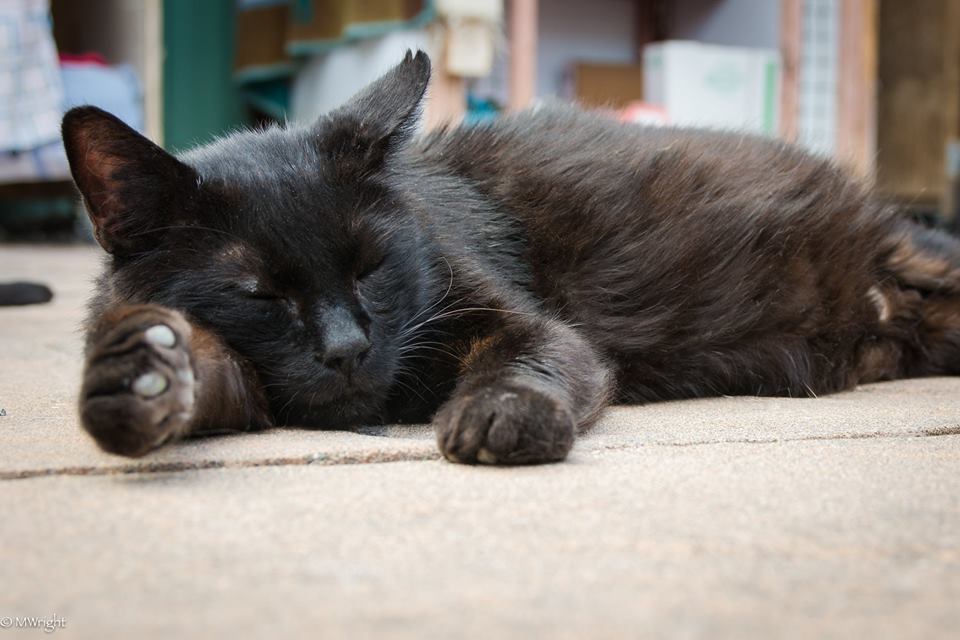
Sid having a cat-nap - MW
True cat lovers will tell you that every day is black cat day – but it is unfortunately true that for black cats in a shelter, adoption comes less easily. Sometimes that's in part because it's so hard to take a picture of a black cat - lighting and contrasts become more important than in a cat with other colours, Even a single white spot or streak helps to make the cat more defined, but even in the Sanctuary where we know and love our black cats over years, it's sometimes hard to tell who you're looking at, so you can understand how a shelter cat can become overlooked.

Colin - MW
Superstition may have something to do with it – but superstitions vary enormously from one culture to another, when it comes to black cats.  Going all the way back to ancient Egypt, the view of black cats being favorable creatures is attributed specifically to the Egyptian goddess Bast (or Bastet), the cat goddess. Egyptian households believed they could gain favor from Bastet by hosting black cats in their household.
Chrissie - MW
In some fishing communities, black cats are considered good luck, and fishermen’s wives keep their black cats safely at home, believing that their husbands will be kept safe as well.  We would really like to see all cats kept safe at home – cats allowed outside are more likely to be harmed by traffic, predators or poison.
Zanda - PH
Black cats have often been looked upon as a symbol of evil omens in much Western history, specifically being suspected of being the familiars of witches, and so many Europeans consider the black cat a symbol of bad luck, especially if one crosses paths with a person. But there are also conflicting superstitions:  in Germany, some believe that black cats crossing a person's path from right to left, is a bad omen. But from left to right, the cat is granting favorable times. In the UK it is commonly considered that a black cat crossing a person's path is a good omen.
Beetle - MW
Many shelters hold off on adopting black cats out around Halloween, for fear of people harming them in superstitious rituals.  It actually makes more sense not to be encouraging any adoptions at all until fireworks season is over – a cat in new surroundings is going to be easily spooked by lights and bangs.
Mirror cats - MW
At the Sanctuary, we’re happily crossing paths with black cats all the time. Volunteers know that many of our black cats are accomplished cuddlers with awesome purrsonalities. It does take time to get to know them and tell them apart, of course, but that’s time well spent!
Ninja lives up to his name - MW


Blog by Brigid Coult
Photos by Brigid Coult, Phaedra Hardman, Michele Wright

Saturday, October 22, 2016

The 2017 Calendar's Coming!

As we’ve done for the last five years, a selection of the Sanctuary cats will be featured in a calendar,  – this year, it will appear on 22 October at our fall pub-night fundraiser  and, for the first time, will be accompanied by a dog edition from the City Shelter.

And as always, it was hard to make a selection of pictures, and inevitably, to say no to this or that one. I always try to choose a variety of cats – so I’m looking for a black cat, a calico, a tabby, a grey, a pair, a group... and so on. We made the decision to allow some new photos of cats who had been featured in previous years, but not of any cat who appeared in the 2016 calendar.

Here are some of the pictures that just missed being selected – not because they were less worthy in any way, but because they just didn’t fit with the sequence that emerged.
Albi - the first of a series of orange boys on the shortlist!
Boomer - in New Aids

MiuMiu was going to be our January 2018 cat
- but she may just possibly be adopted!

The light on our lovely Rudolph makes this a wonderful photo
 - but he's already in another picture!
Ian Tom sent us a couple of lovely photos.
This is Autumn, who was featured in the 2016 calendar
We discussed making this the cover - but decided that
being stared at with horror by a feral was not a welcoming image!
Buddy has the most beautiful eyes!
He's another one on the verge of adoption...

Henrik was on the cover of the 2015 calendar.
This is his brother Daniel, another of the orange guys on our list
The calendar will be available at the Sanctuary, the Shelter, the Thrift Store, and at several other venues around the city - for more information check the RAPS webpage  

Blog by Brigid Coult
Photos by Ian Tom and Michele Wright


Friday, October 14, 2016

Feline Weightwatchers

Cats, like humans, come in all shapes and sizes. We have our share of little cats (like Marilee, Shady, Emily…) all of whom are far from being kittens; they’re just small slim cats.  But we also have our share of the plus-size cats, and just like humans, we need to consider whether the plus-sizing is a health issue, or just the way the cat is.
Capilano & Chinook - MW
When we had Pen 5 closed, it was more noticeable how many of those cats were large-size varieties. Chinook, Adam, May, Capilano – none of them were shrimps. With some concern for their size, their food was changed to a higher-protein variety, but they liked it so much, they just ate more of it and seemed to gain more weight!  We soon reverted to the ordinary variety...  Now that Pen 5 is open, some of them are getting around a bit more, and with the constant stream of feline visitors, the concentration of large cats in there is no longer so obvious.

Sid - BC
Being overweight, in cats as in humans, can lay them open to a variety of health concerns. Both Sid and Marmalade are plus-size and are also diabetic; med-staff monitor them carefully to make sure their insulin levels are under control.
Carla & Cookie - BC
As with humans, there are two important parts to weight-control: diet and exercise. At the Sanctuary, there is always dry food out for the sake of the shyer cats who don't want to eat at mealtimes, or who don't like the wet food. So the only way to control intake is to cage the cat – and that obviously then cuts out the possibility of exercise. Newcomers Cookie and Carla are decidedly tubby – Carla can be a bit crabby with cats and sometimes with humans, but she likes to play, and volunteers are encouraged to get her moving as much as possible.
Deety - MW
Any visitor to the double-wide trailer knows Deety; this boy likes to stay on his shelf in the laundry-room, but it was noticed that his size increased and his ease of movement decreased. Med-staff Catherine would take him down to the back gate and encourage him to walk back; Deety now not only comes down by himself, but occasionally comes out and visits in the back courtyard (especially when he feels that the dinner service is a little late)
Eiffel - BC
Another newcomer is Eiffel – this 26-lb boy is not just tubby, he’s a LARGE cat (and a very sweet one); currently caged while he’s in the settle-in phase, he should be out in the general population soon.
Autumn & Lorelei - MW
Sometimes with the long-haired cats it’s hard to tell whether it’s fluff or pounds. Looking at Lorelei and Autumn in the front courtyard, you could be excused for thinking we have too many tubby tabbies; a little petting quickly establishes that a lot of Autumn is fluff and Lorelei is solid!
Buster: preparing for the Westminster Cat Show - ML
When volunteer Maureen blogged about her beloved Buster recently, she also wrote about Buster’s size issues.
Buster was contacted by his vet’s office with a proposal to join their “Biggest Loser” contest.  We of course accepted as he is weighing in at 10.85kg (24lbs) and he is not getting any younger.  I have had Buster on a grain-free diet for a year now but to no avail.  We have found this food makes him hungrier and of course I succumb to his demands when he is hungry!  Knowing that Buster was an unwilling participant and disliked trips to the vet he participated by Skype. I brought him in  to have all of his tests done (which of course he had to be sedated for) get his nails clipped and a nice little haircut for the summer. After the full stats were analyzed Buster’s goal was to lose 13lbs over a 37 week period. 

"I am lovin' my new haircut..." - ML
We started Buster on his new food – which contains more fibre to allow him to feel fuller longer and he seems to be okay with the transition. We do of course reach his quota by 2:00pm though…baby steps, baby steps...

A phone-call recently from the vets told us that Buster was their “Biggest Loser” for the July/August period, having lost an astonishing 12% of his body-fat (1.3kg/2.9lbs) and I went down to collect his prize.

(the next update will be Buster showing off his new Speedo)

Blog by Brigid Coult & Maureen Lahaise
Photos by Brigid Coult, Maureen Lahaise, & Michele Wright