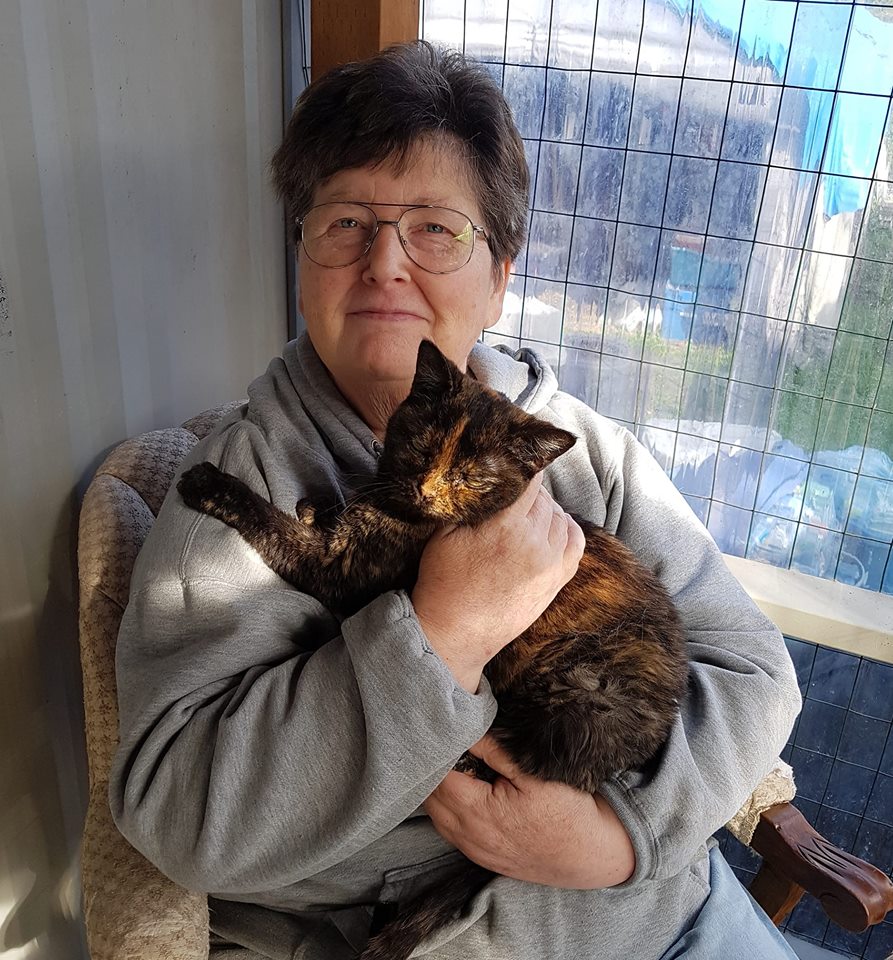
RAPS is short for Regional Animal Protection Society, a registered charity and operator of a sanctuary which houses and cares for nearly 500 homeless or abandoned cats in Richmond, BC, Canada. The Neko Files is a celebration of the sanctuary and all those who live and work there.

Saturday, October 20, 2018

Welcome Home

Mr Bojangles and Madame Hooch - MW
Our cats come from a variety of sources: local ferals, owner surrenders, and other shelters (especially when it comes to FIV cats). There are probably very few cats who come to us for happy reasons. One of the sadder ones recently brought four cats into our care – their owners were killed in an auto accident, and the family knew one of our Board members and asked for them to come to us.  There were four of them: a little tuxedo called Kelley, a big friendly white boy called Lego (short for Legolas), and a pair that were obviously litter-mates – orange tabby Mr Bojangles and tortie Madame Hooch.
Kelley in her favourite bed - MW
Initially we were given to understand that they might be FIV cats, but New Aids is pretty full right now so we moved them into the “Kitten Room” of the Moore House.  The Moore is set aside for older cats who need a quieter life. Technically these four fit there – they are 11, 12 and 14 in age, and we needed to keep them together until they were tested and decisions could be made. The word got around the volunteers quickly – this was a room worth spending time in!  Everyone who has visited them has been welcomed and purred over.
Mr Bojangles is interested in everything! - MW
Personally, I’ve had a hard cat year. I lost my 17-year-old Kissa in February to kidney disease, and then 10-year-old Peggy in August to cancer. I was still a bit raw when I met these guys, but rapidly fell in love, especially with the two older ones.  Mr B and Madame H are the sweetest pair. We don’t know what’s gone into their breeding, but we think there’s some Rex there – little round heads with big eyes and Yoda-like faces.
Madame H & Mr B snuggling together - BC
MD
Mr Bojangles (named for the celebrated dancer of the 1920s) is quick to climb into a lap, and likes to put his paws up on your shoulder and offer kisses. He has a wonderful purr.
MD
Madame Hooch (named for the flying instructor at Hogwarts) has plenty of tortitude, and could be found at the door of the room at mealtimes grumbling at the volunteer who is taking too long to bring food. The two of them get on well; they can often be found snuggling together, and they’re happy to share a lap.
Madame H loves to be held - DW
Mr B and Madame Hooch came home with me early this week, and took no time in settling in. We’ve booked a visit at the RAPS hospital to get a baseline on their health, but judging from their appetites, they’re in good shape. They’ve quickly discovered favourite places to doze, and have claimed bed-space at night.   I know as 14-year-old cats, I won’t have them for many years, but they’re a pair that need a loving home – I’d love to take all four, but I don’t think the co-op board would approve!
Legolas loves attention from people - MW
The two younger ones stand a chance of finding a home – all four have clearly been well loved and enjoy human company. Kelley and Legolas remain at the Sanctuary; potential adopters should contact the Sanctuary Manager for more information.
MW

A happy homecoming for me and for my two new buddies.

Blog by Brigid Coult
Photos by Brigid Coult, Melanie Draper, Debbie Wolanski, Michele Wright


Sadly, Mr Bojangles developed lymphoma, and passed just before Christmas 2019; Madame Hooch had sight and balance problems in the New Year that we think was probably a brain tumour and died mid-March. I only had them five months. Legolas had a bad respiratory infection and passed at the Sanctuary. Kelley, the fragile little one, is still hanging in there!

July 2020: we lost little old lady Kelley this week; we miss her, but it's comforting to think that the family is united again.


Thursday, October 11, 2018

Kermit & Gigi

Kitty Comforter Pauline Chin knows the Double-Wide cats best, but she's also come to know the cats in a more distant corner of the Sanctuary.


Walking past Pen 8, you might notice two smaller black cats.  Kermit is all-black with light green eyes. Gigi is black with a white chest patch and a white bikini patch.  Her eyes have changed from gold to yellow-green.
Gigi - MW
Kermit and Gigi are the youngest arrivals trapped from Rusty’s Towing.  These two are currently over a year old. There’s a high chance they are younger relatives of Magpie, as well as Fable and Eclipse, who hang around the back courtyard.  All sport mostly black coats, round faces, and round eyes.  All are different degrees of semi-feral and prefer to avoid human touch.  But they love food!
Gigi & Kermit - MD
The pair arrived last year and were caged with Fable.  It was a bit of a challenge to interact with all three of them, but Kermit seemed to come around first, then Gigi.  Not so much with Fable, as she was older and far from the kitten socialization window. The wand toy seemed to fascinate them and entice them to paw at it, while staying out of reach from the human.
Magpie -  PH
Once released from the cage, Gigi and Kermit went to Pen 8, along with Magpie.  Fable often sits atop the cages in the double-wide.  And I hear Eclipse retreats beneath the single-wide during the day.

The majority of kitties in Pen 8 are very feral.  Johnny and Smithy welcome humans with loud hisses before running to the back.  Hailey the tabby will sit and stare at a distance.  Entering the shack usually causes the remaining residents to flee.  A walk behind the little house reveals the cat tree where everyone is usually hiding.
Smithy & Splotch - MW
In summer 2017, feral Splotch had a stroke of sorts that caused some paralysis to his back legs, and also made him forget he was feral.  On his return to Pen 8, he became an ambassador for the cats in Pen 8.  With Splotch around, the other cats got their daily cuddles and knew they had a trustworthy friend.  He also piqued their interest by showing them humans weren’t to be feared when he came over to rub against our legs.
Kermit - MW
Kermit, in particular, followed Splotch’s example.  Play with human and earn a treat.  Simple.
Sadly, this past July we lost Splotch.  With his absence, Kermit would come to the gate and look eagerly, eyes full of hope.  “Where is my friend?  No Splotch? I sad.”  Then he would retreat to a corner, lay down with his head on his front paws, and stare off into the distance.  Death seemed to be a new and uncomfortable concept for him.  It’s taken him most of the summer to recover and he no longer runs for the gate… unless he knows you have something good.
Gigi - MW
Today, Gigi and Kermit are still playful kittens at heart.  They love their toys and treats.  If we’re lucky, we may even get to pet them after playtime.  We hope that they’ll become more welcoming with humans.  Since every cat has an individual personality, we can never really predict their future disposition, but we can befriend them along the way.

Blog by Pauline Chin
Photos by Melanie Draper, Phaedra Hardman, Michele Wright

Thursday, October 4, 2018

Mooching No More!

Our visitors are sad...
Our cats are sad...
But it's all for the best – or so we believe.

For some years, the Sanctuary has welcomed visitors on Sunday afternoons.  And week after week, visitors have brought the cats treats – usually the commercial ones, marketed for just that purpose. And week after week, the same cats got pushy about getting their share, and we dealt with little piles of throw-up, and the Sunday evening feeding had to be limited because we ended up discarding so much wasted food on Monday mornings.
Sweet Precious claimed her own bag - DW
No more!
With the sudden influx of visitors, prompted by social media, we have had to establish much stricter rules around visits. We try to limit numbers so that the cats are not overwhelmed and stressed out by so many strangers. We try to establish no-go areas so that the more stressed cats have somewhere to hide. And we're saying
NO FEEDING!
Jake begging: "Is that for me?"  -  PH
That's disappointing for a number of visitors who have come before and had the experience of cats like Jake approaching them with delighted anticipation – Jake never saw a treat he didn't like. But he would push shyer cats out of the way to get his share – and then his not-too-happy gut would rebel, and we would have the cleaning-up!
Cagney's belly after too many treats - MW
Cagney is a front courtyard favourite – and it's mostly because he hangs around the front gate hoping for handouts.  And as you can see from his picture, he is not a small cat, and treats were not helping!
For cats, as for people, food works on a number of levels – basic nutrition, a reward for certain behaviour, an incentive to try something new.  Offering treats is often a useful tool when working with shy cats; it can be comforting or a stimulus to accepting touch.  But when too many people are present, those shy cats are the last to appear. And for the not-shy cats, handing out treats is like handing out candy at a kids' party - they can't ration themselves.
Debo gets a hug from Jocelyn - MW
So the no-food rule during visitor hours is remaining, and we are encouraging visitors to find other ways than food of interacting with cats.  Sitting, with quiet petting, is always welcomed by the social cats – and by some of the shyer ones too. There are a few who love to be cuddled.
Leland lets his favourite human cuddle him - BC
Sometimes it's enough for the cat just to sit next to a visitor. Some of them like to be groomed, while the offer, with others, is greeted with tail-swishing and airplane ears!  Many of the younger cats like to play, and wand toys are available; younger visitors need to be taught that "play" is hunting behaviour, that toys need to mimic the movement of prey, and that a happy cat is one who feels that s/he has caught the prey!
Gizmo is better with feathers than fingers!  MW
Staff and Kitty Comforters will continue to use food occasionally out of visiting hours to coax shy cats into contact, though we are trying to use mostly high-value proteins – chicken and fish – in an effort to curb the increasing incidence of diabetes and overweight cats. The decision was made to request that even these "good" foods are not offered during visiting hours, since we have no way of confirming how the food is prepared. Barbecue chicken from the supermarket, for instance, needs to have the fatty seasoned skin carefully removed; one of our volunteers purpose-cooks plain fish, and with her we are able to ascertain that there are no added ingredients.
Albi & Chimo contemplating catnip - CP
Even catnip can be an issue. Some cats are unaffected by catnip, or it blisses them out; for others it not only produces a temporary "high" but makes them more aggressive. Our already-overaggressive cats like Cole and Gizmo can get really nippy with this stimulus. Gizmo has been calmer in the last few months, and more willing to interact with visitors without aggression, and too much catnip can undo all that work.  A catnip pillow for a caged cat or one in its own home is a different prospect from handfuls of catnip scattered around the sanctuary. And with catnip, more is not necessarily better - it's just being wasted. So catnip has been added to the "not on Sundays" list.
Restful back courtyard - AV
We want the Sanctuary to be just that – a place where cats and people alike can find calm and peacefulness; where our cats can eat healthy food rather the feline equivalent of MSG-infused fast-food; where the natural hunting instinct in a cat can be turned on a feather rather than on a human hand or on another cat.
And if you really HAVE to feed the cats, come sign on as a volunteer (see the RAPS website), and help us keep them happy and healthy.

Blog by Brigid Coult
Pictures by Brigid Coult, Phaedra Hardman, Chris Peters, 
A. Vandenbrink, Debbie Wolanski, Michele Wright

Thursday, September 27, 2018

Lumi

 CF
One of the questions a number of Sunday visitors ask is, “Do you have any white cats at the Sanctuary?”  I guess I shouldn’t be too surprised, because in fact we have very few real white cats, though there are several white ones with black markings (like Hillie and Yma) and others that are white, tinged with orange (like Tara and Ollie).
Dexter (PH) & Timmy (MW)
Dexter, in with the Leukemia cats, is white, as is Timmy in the front courtyard, who hates other cats, but loves to find a human who will offer a lap for a while.
MW
In the back area, our only pure white cat now is Lumi, and I was interested to note that she had never been blogged, though she’s been living here for nearly ten years now.  Lumi came to us from the home where she’d lived for several years since being adopted as a kitten. We don’t know much about it, but we were told that she became very aggressive, and both husband and wife were nervous about being around her, because she would suddenly attack. When she came to us, med-staff Leslie pulled on her big bite-me-now gloves and went in to visit her;  she says Lumi was most disappointed to have no reaction to her attack.  It sounds as if, like Chimo, Lumi had been encouraged to play-fight, with hands as targets, and had never learned that there were better ways of interacting with humans.
MW
She’s still a little dangerous to be around; she “makes nice” and then suddenly turns and swats. Mostly now, it is just swats, though for some years Lumi wore a red collar – Sanctuary shorthand for “This Cat Bites”.  The collar is no longer there, though still present in the minds of a few volunteers who have been on the receiving end of Lumi's attentions.
MD
Lumi is one of a number of cats who prefers not to meet us at ground level, but likes to take the superior position high on a shelf or on a cage-top. There she is excellently sited to make a decision about whether she will allow a little gentle petting, or whether the offered hand will be slapped away.
 MW
A recent bout with pancreatitis has had Lumi caged for a while and within reach. Once her initial physical discomfort had decreased, she seemed to enjoy sitting in her cage and watching all that was going on – letting us know with loud vocalizations when a plate of food had been placed on the floor near her cage and her own plate had not yet arrived. Now the cage is open again, she can return to the upper levels, but so far she is still remaining in “her” space, and apparently enjoying her interactions with humans.

Blog by Brigid Coult
Photos by Melanie Draper, Claire Fossey, Michele Wright

Friday, September 21, 2018

One-Eyed Love

At the Sanctuary, we’ve had our share of one-eyed cats, many of whom hold fond memories for us.
Val, Harry Potter, Fred, Simba - we loved you!
Sometimes the cat has come to us with only one eye; sometimes an infection necessitates the eye’s removal. It’s never a decision taken lightly, but is always one made for the better health of the cat in question.
At the moment we have three one-eyed cats in residence.
Fiona - CP
Fiona is the sister of tuxedo Miller, and of the late Schatzie who once preferred to live in the parking lot. Fiona was the shyest of the three, and still prefers to be out of the way when visitors arrive, emerging from her hiding place at 4:15pm when everyone has been ushered out of the gate.
Fiona with two eyes - MW
As well as her lovely torbie colouring, Fiona was notable for having eyes of two colours, one yellow and the other dark brown.  Last year, showing signs of discomfort, she was taken to the vet, where it was determined that the dark brown eye had a tumour, and immediate enucleation surgery was called for.
Fiona - MW
Fiona sailed through the surgery, and has learned to compensate for the monocular vision loss, managing to negotiate jumps without falling.
Barn-cats enjoying a fishy treat - MW
Pen 7 in the back is known as the barn-cat pen. Browsing through the Neko Blog, I was surprised to note that none of these cats have previously been featured in the blog. They have lived there for almost ten years and are still pretty feral, though some of them will allow touch, and they love their share of chicken or tuna treats used by the med staff to encourage trust. They came to us as a farm-cat colony, and they are obviously related – a number of them are gingers, there are a few stumpy tails, and several of them have a tendency to eye problems.  Med staff take particular care with orange Vera, whose eyes frequently flare up with an infection.
Rodan - MW
My own favourite in the pen is one-eyed Rodan, whose cage stays for eye-treatment, and for occasional colds have left him very comfortable with human contact. Rodan is frequently found at the front of the pen waiting for a volunteer to come and pet him, and he’s the only cat in the enclosure that will lap-sit.
Popeye - BC
Popeye is a newcomer to New Aids, but he has been quick to make himself at home with us.  He is one of the Island cats, coming to us from a shelter in Courtenay. Few shelters are able to give dedicated space to FIV cats (much less FeLV), and we have established a relationship with several of them that allow us to give these cats a home.  AIDS cats, unlike leukemia cats, can live long lives and do not transmit the virus to other cats unless they fight. Several of our AIDS cats are quite adoptable, with the one restriction (common to all RAPS adoptions) that they should remain indoor cats.
Popeye poses for attention - MW
This sweet boy arrived with us bearing the name Sambuca, but with another black Sambuca already in the population, his name was changed. Popeye is a quiet affectionate boy who enjoys petting, and appears to get on fairly well with the other cats.
"I'm so lovable" - VL
All three are delightful cats who would welcome your sponsorship in the RAPS program!

Blog by Brigid Coult
Photos by Brigid Coult, Vicki Lo, Chris Peters, Michele Wright

Thursday, September 13, 2018

Two Old Gentleman Cats

This week's blog is offered by Kitty Comforter Pauline Chin. Pauline introduces us to two old boys who like the DoubleWide cages they were first offered so much that they insist on remaining in them, even though the doors are wide open.
Binx holding court - BC
Many of our cats are long time residents.  Our youngest ones are around 2 years old; while our oldest may be in their twenties. Most of our current cats average between 12-15 years.  They are in various states of health; some need help in the form of daily medication, while others act like playful kittens.  Every cat receives love and attention everyday.  Yes, a perk of the volunteer job is enjoying feline company after the shift!
Binx seeking attention - PH
Binx is a 17 year old black kitty who arrived from 5 Road last year.  His amber eyes make him unique, since most of our blackies sport yellow eyes.   Binx loves a warm lap and quiet time.  He is not as spry as his younger days, as we are reminded by a sign in his cage that reads, "Binx is not an athlete.  Please keep his chair next to the shelf."  If his chair is moved, he looks at us with big pleading eyes, "Someone moved my chair!  How do I get up or down?"  
"Don't move that chair!" - BC
With some coaxing, he does take up a spot on the couch.  He’ll sit up straight, puff his chest out, and make the perfect photo op.  These days, he can also be found on the mattress on the double wide deck.  Binx is friendly and knows his name, but don't expect a warm welcome from the other semi-ferals on the deck. Benji, Jolene, Mary, and Ringo do not enjoy the company of humans.
Deenie says "This is MY box - ask before you visit!" - BC
Another elderly black kitty who arrived last year is Deenie.  He has yellow eyes, a white whisker on each side of his face, and grey-black fur.  He’s about the same age as Binx.  He’s also a homebody, preferring his cage over anything else.  Once in a while, he walks outside and rolls around on the warm tiles.  
That sun feels good on the belly! - KN
Deenie’s backstory involves coming from a household with 2 younger cats who terrorized him, forcing him to hide.  His owners felt this was a much better place for him.  He spent his time acclimating to the place in one of the middle cages.  Apparently, he was so great at hiding in the shadows of a box, he needed a sign that said, “Please feed Deenie”. 
Though he doesn't much like being brushed, he tolerates short attempts on our part to keep his coat from getting too matted.  One privilege our older cats get is… they don’t have to groom themselves; we groom them.  Give him time and the right amount of attention, and the reward is lots of headbutts and paws on the shoulder.  There’s just something magical about being acknowledged by a cat, especially one that may not appear friendly at first.
BC
No matter what age a cat is, they have a place at the Sanctuary to spend their golden years.  Some of these cats really are enjoying the best years of their lives as they’re guaranteed food, shelter, safety, toys, and human attention everyday.  The happy memories we create and the photos we take last our lifetime.  We never know when they’re going to go, so young or old, we treat them like gold.

Blog by Pauline Chin
Photos by Brigid Coult, Phaedra Hardman, Karen Nicholson

Saturday, September 8, 2018

So Shy...

Mama Gali with kitten - waiting for adoption - MW
Of the cats in the Sanctuary, perhaps 70% have feral origins – the others are mostly behaviour- or health-related surrenders.  Popular wisdom says that in order to have a tame cat, you need to make sure that the kitten is handled and familiarized with humans from four to twelve weeks, and that after that it’s unlikely to become truly tame.
Foster-mom Kati handfeeds our orphans - KdG
Feral kittens or kittens born to a feral mother will frequently hiss and attack, or cower in fear; the feral instinct can be strong.  Our wonderful RAPS foster-parents, and the staff at the City Shelter do much to diminish that fear, and most of our kittens go happily to new homes.
Pancake as a kitten - CF
Pancake was one of the exceptions; his feral mama was Autumn, who remained an angry feral for some years; Pancake’s brothers and sisters all tamed and were adopted, but Pancake was so shy that no adoption was possible, and he ended up returning to us.  Three years later, he is fairly comfortable around humans (especially with tidbits) but backs off from much physical contact – he’d rather have the company of his cat buddies.
Pancake is still wary - ML
Like him, many of our feral cats never make the breakthrough to allowing themselves any degree of trust in humans. So it’s an enormous triumph when someone reports an easing of tension in a scaredy-cat.
Keira is not sure about contact - MW
Keira KnightStreet was named for the place under the bridge where she was found about 5-6 years ago. She’s a slightly tubby little black cat with a thin tail who easily fades into the crowd of indeterminate black cats.
Dare I come closer? - BC
Initially she hid under the drapes round the entrance to the DoubleWide, but in the last few years she’s made herself more at home in the laundry room area, and can be found as part of the crowd at mealtimes. Usually she shies away from being touched, but recently the cringing has reduced to a faint tension as she realises that the sensation of being petted is actually pleasant.
You can't see me! - KN
Boop came in with Plum, both of them victims of Manx syndrome. Plum was initially shy, but has settled well into DoubleWide life; Boop hated everybody, bit the med staff who cared for him, and when released, vanished into the same hidey-hole Keira had once used. Once settled there, he started to explore further afield, disappearing into the garden foliage, which was frustrating for the med staff who needed to make sure his bottom was being kept clean.  More recently Boop has been venturing out into the open in the morning and the evening. When I was petting Albi last week – Albi loves to roll over for belly-petting – Boop ventured closer and closer and finally allowed me to give him some gentle touches.
Anything tasty for me? - BC
Donni is another little black feral who has spent much of his time hiding away.  He was one of many cats brought in to us by Donni Derr, and was frequently confused with another little black long-hair, Matt, now at the Rainbow Bridge. Both loved the tuna handouts brought by Donni-human, and Donni-cat adores chicken when it’s offered, crying out for his share. He used to stay safely behind netting or hidden behind drapes on his shelf, but more recently he’s found sitting hopefully in the courtyard, and though he’s not quite sure about being petted, he’s not shy about gnawing with a toothless mouth on a chicken-flavoured human finger.
Pen 1 do-not-touch ferals: Juvie, Buddy and Peanut - MW
We certainly have a large number of semi-ferals who are quite easy with being handled, though they’re not usually good adoption prospects for fear of what might happen if they escaped.  But it is so satisfactory to allow a formerly terrified cat take their time to learn that there can be safety in human touch here at the Sanctuary.


Blog by Brigid Coult

Photos by Brigid Coult, Kati DeGraaf, Claire Fossey, 
Moira Langley, Karen Nicholson, Michele Wright