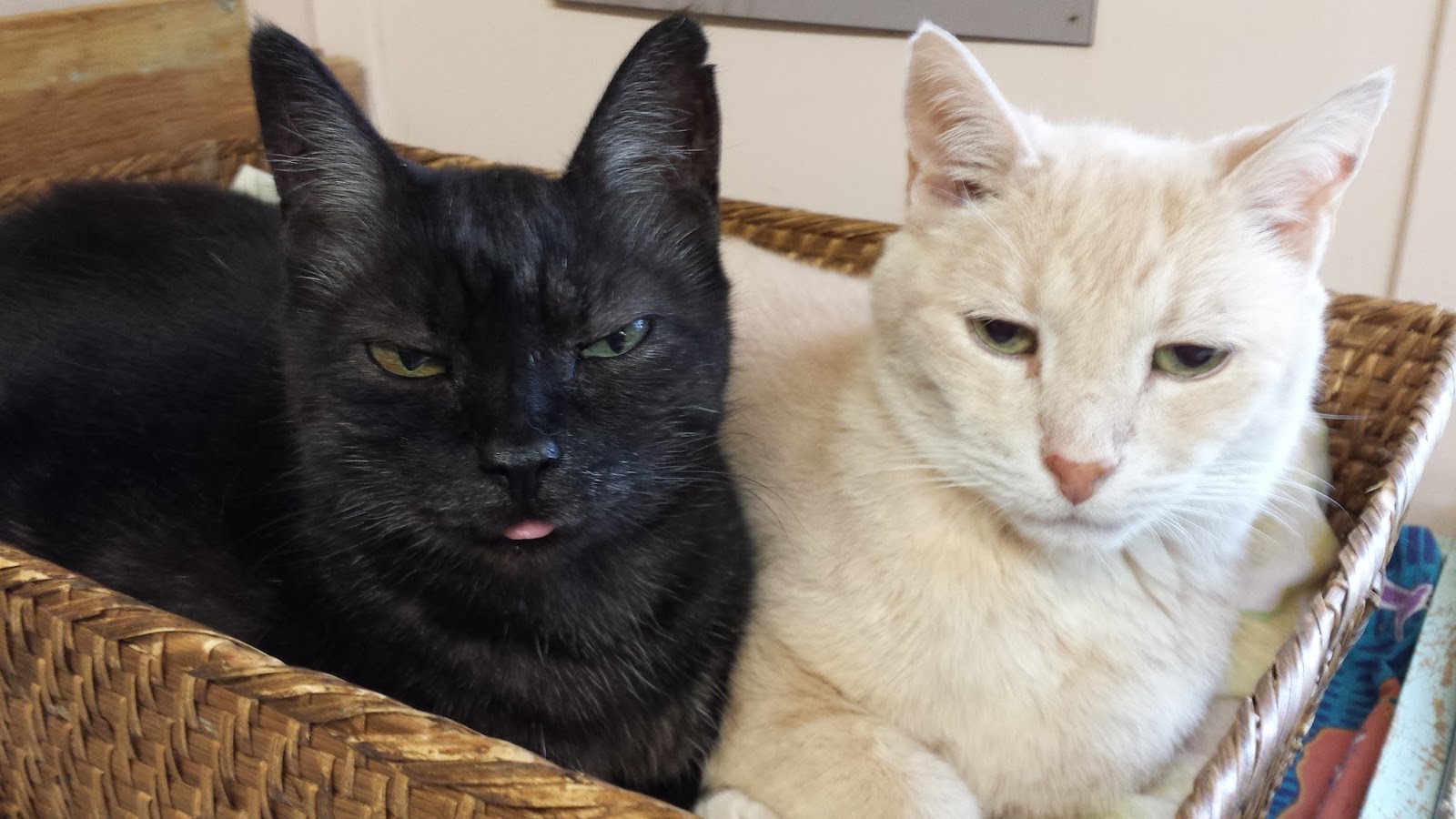
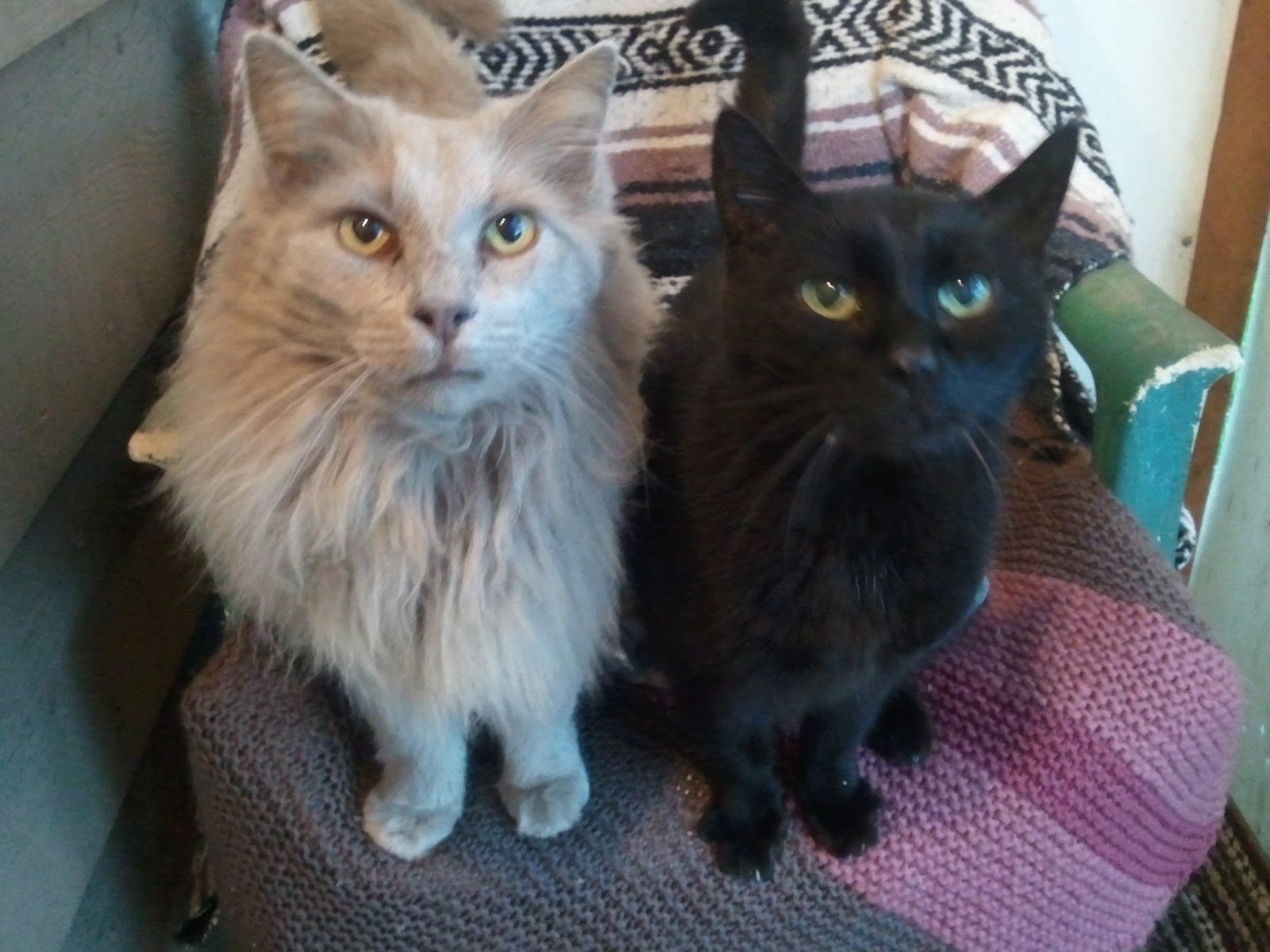
RAPS is short for Regional Animal Protection Society, a registered charity and operator of a sanctuary which houses and cares for nearly 500 homeless or abandoned cats in Richmond, BC, Canada. The Neko Files is a celebration of the sanctuary and all those who live and work there.

Friday, March 18, 2016

Garbo cats - back area

One of the first blogs I wrote, back in the summer of 2014, introduced a number of the front courtyard inhabitants as The Garbo Cats, who want to be left alone by other felines, though they may more readily accept human attention.  The back courtyard and double-wide cats seem to tolerate each other much better, but there too we have our share of loners – cats who prefer to avoid the company of others. 
 MW
The queen of these antisocial felines has to be Jingles. When I first came to volunteer at the Sanctuary, I was warned about one cage in the double-wide which was labelled as Jingles’ home.  It had formerly been the med-cage until our medics got moved to a much lighter, slightly more spacious area, and then it became the safe haven for (and from) an angry little black cat. Claire introduced her in 2009 as The Cat Who Hates Everybody, and she had herself quite a reputation for lashing out at the unwary.
 MW
These days Jingles no longer confines herself to a single cage, but she still remains a Cat Who Walks By Herself (or more accurately, lies – she’s not a very active girl!).  She’s much more accepting of petting from human passers-by, but you have to keep an eye open for other cats who think that it’s their turn for attention – at a moment’s notice Jingles will decide that someone’s in her space and she’ll swat whatever is nearest.
 Baby - PH
New volunteers are routinely warned about orange Baby, in the tea-room.  He’s been labelled a Jeckyll & Hyde cat, because his personality can change on a dime, and when Baby bites, he bites hard. Interestingly, I don’t think he’s a nasty cat; he’s very wary around other cats, and his personal space is important to him.  Most people, he just ignores, but  he’ll accept careful petting from the humans he likes.  It’s been a while since he’s actually attacked anyone, and we’re hoping he’s grown out of it, and is more accepting of his surroundings.  But we all read his body language very carefully!
 
Piper - PH / Jody - MW
Baby shares the tea-room bathroom space with two other antisocial cats, and it’s amusing to watch them jockeying for space on the three shelves by the sink. Piper, who is usually at the top, is quiet about her dislikes – she just removes herself from the space (unless occasionally she comes face-to-face with another cat).  Much more vocal is elderly Jody, with her worried face, often found on the middle shelf. When there’s a vocal protest going on, it’s usually Jody telling someone to get the h*** out of her way. She adores human attention, however, and loves to lick the caressing hand.
BC
My own favourite Garbo cat at the back is Emery. This tabby Manx boy probably has a bit of Bengal in him, with the same long legs and athletic build as Lucky.  He avoids all contact with other cats and prefers not even to look at them if he can help it.  I find that he’s quite often one of my greeters at the gate, if it’s quiet, and he will occasionally ask to be picked up and cuddled. More often, you will find him tucked away on a shelf inside an open cage, where he will often reach out and climb onto a shoulder.
 MW
 If he’s in a particularly relaxed and loving mood, he reaches up to put his paws on my shoulders and snuggles his head into my neck – totally guaranteed to melt the heart!
ML

Blog by Brigid Coult
Photos by Brigid Coult, Phaedra Hardman, Moira Langley & Michele Wright

Saturday, March 12, 2016

Holland in the open

Almost three years ago, a little colony of cats was identified by a couple of our volunteers, and eventually trapped and brought to RAPS. One of the disadvantages for cats living feral (or, for that matter, for tame cats allowed to wander freely) is that they are susceptible to a couple of nasty viruses – in particular, feline leukemia (FeLV) and feline AIDS (FIV). Four of this group ended up with us in the New Aids enclosure; early photos show a very unhappy set of cats hiding in various corners of the cages in which they began their stay.
CF
Holland was the one female in the group. Most of our AIDS cats are male, since it is a virus usually transmitted through blood among cats that fight – and fighting, of course, is inevitable among males when females come into season. We have no way of knowing if Holland had ever borne a litter, and, as with all our cats, she’s safely spayed now.
MW
King George, who seemed to be the leader of this little group, settled down fairly quickly, and has become relaxed around humans; it is possible that he was at one time a tame cat. We don’t think Holland was very old when she came in to us – possibly less than a year – and it’s likely she was a feral kitten and had no chance for socialization in the first key months.  She has remained wary and skittish; sometimes she hovers on the fringe of action, but almost always backs off. Cat-whisperer Phaedra says “When Holland was caged with her sibling Wesley I could pet her and she'd even do the bum rise thing. Her best reaction to me these days is not fleeing in terror. She's absolutely gorgeous and I think she should be my friend but I guess she doesn't agree. She seems to spend more time outdoors and up high during the day time when I'm there”.

CP
She’s such a beautiful girl, though, that she’s become something of a magnet for our photographers, and in the finer weather, it’s lovely to see her moving about the enclosure rather than hiding out in a corner, with her lovely torbie fur, and those delightful ear feathers, ruffled by the breeze.
MW
 
 
Blog by Brigid Coult
Photos by Claire Fossey, Chris Peters & Michele Wright

Saturday, March 5, 2016

Chimo has changed!

When we met Chimo  he was NOT a happy camper!  He arrived with us last August, and, as usual with new cats, spent a while in a cage to allow him to get used to the sights and smells of other cats around.  Many of the volunteers were very wary with him even when the “Med staff only” notice came off his door; Chimo was liable to dive at an intruder, and legs were fair game.
PH
Marianne wrote the blog about him in September; she heads up the team of Kitty Comforters, and she has endless patience with cats like this. As she said, it was obvious that though trapped outside, his was not feral-cat behaviour; he appeared to be eager to engage with humans, but just didn’t know how to do so in an acceptable way. She played with him gently, teaching him that feather toys and the like were fine for grabbing, but fingers were not!
MM
Towards the end of September the door of Chimo’s cage was opened. Many of the feral cats in the Double-Wide head for the back deck, and a quieter life among other similarly wary cats.  Chimo sat in his cage for a while and then made a break in the other direction, heading for the back courtyard. There was some consternation – the Sanctuary is as cat-proof as we can make it, but as little Amber taught us, a determined cat can sometimes find a way out.  It was soon clear that Chimo had gone to ground behind the building we call Waldie’s Hut, and was hanging out with ferals like Quinn and Maureen.
There were several evenings when Leslie could be seen hunting round in the corners with a flashlight, and eventually reporting that Chimo would occasionally show his nose. And then he started appearing of his own accord; usually at the end of the day when things got quieter, he would materialise and have a little visit and then vanish again.
I was away for a couple of weeks after Christmas. On my first Sanctuary shift I passed though the double gates to the back courtyard, expecting to be greeted by the usual committee – Hannah, Fat Lucy, Emily and so on.  My greeter was a little pale orange cat who weaved around my ankles, demanding attention. It wasn’t until I noticed his tail that I realised this was Chimo, totally comfortable with human contact.
Chimo has become a regular sight between the gate and the tea-room; he can be found holding court up on the table or doing his best deluxe cat-wriggle on the doormat.  He’s occasionally a little pushy with other cats, but we have to remember that he’s still quite young and full of energy; he’s ready to play physical games, while the older guys prefer to be couch potatoes. With humans he still prefers the ankle-rub technique, though careful stroking is permitted.

There are few things as rewarding as watching a formerly wary cat relax into being a comfortable part of life at the Sanctuary!

Blog by Brigid Coult
Photos by Phaedra Hardman, Marianne Moore & Michele Wright

Saturday, February 27, 2016

A Touch of Tortitude

With more than 400 cats around the Sanctuary, there’s an immense variety of types and colours. Tabbies of various kinds predominate, but there are many other coats to be seen. The majority of our orange cats are male, but we do have half a dozen orange females. The orange coat is a genetic trait that occurs through the male X chromosome, and a female cat with orange fur has to have been sired by a male orange, through the mother may be of any colour. This is also true for tortoiseshells and calicos, both of which are almost exclusively female. In both cases the gene for the orange colouring is modified by the gene for black or for white fur.
Alyssa - Lulu - Vienna - PengPeng - Sophie
We probably have more than a dozen torties, a few of whom are shown above.  Anyone who has ever been owned by a tortie will tell you that they have tons of personality – we call it “tortietude”. They tend to be assertive about their rights, possessive of their territory, feisty and somewhat unpredictable.
Treacle - BC
Nobody at the Sanctuary sums that up better than Treacle. A little stiff-legged girl (probably a little arthritic), Treacle has claimed the Hill House as her space, and once she’s found her bed, she does NOT want to be bothered by other cats!  She loves humans – she’s one of the cats you can pick up and snuggle, and she adores it – but when there are front courtyard spats, it’s usually because Treacle is laying down the law. 
Treacle - MW
She’s what’s known as a chocolate tortie, with a lot of black in her fur colouring. Treacle carries her “my space” bubble around with her, and woe betide the cat that ventures into it.

In a totally different vein is Nelly, a dilute tortie, found in the DoubleWide. She was the long-term girlfriend of our dearly loved Mario, and has never really recovered from his death – one gets the feeling she’s still looking for him. Nelly’s territory is the top of the cages, from which she stares down with the slightly horrified expression of the typical feral.
Nelly - MW
But progress is being made – though she still won’t allow herself to be touched, she will now accept treats, and occasionally comes down to join the crowd outside the med-cage.
Nelly - BC
As you leave the DoubleWide, you will encounter a tortie who exemplifies tortietude.
 
Emily - MW
Emily takes territory to an extreme. For months she hung out on a cat-tree just outside the tea-room. Then she was slated for some dental work and caged while she recovered. Once the cage was open and Emily was free to go, she decided that this was her new territory, and refused to leave. It took months before she decided that there were too many cats encroaching on her territory, and she needed to claim something more her own. Now she’s moved to the shelf just outside the DoubleWide, where she demands attention as we come and go.
Emily - PH
Now that the weather is warming a bit, Emily can once more be found outside the tea-room – especially if there’s chicken on offer – but she’s back on her shelf for the evening, and waiting to have her own special dinner delivered.
Daisy - MW
We can’t leave the torties without mentioning Daisy. She also has personality to an extreme degree – like, 180 degrees away from Treacle. Daisy has never met someone who isn’t her friend. She probably has a chromosomal disorder something like Down Syndrome (cats only have 38 chromasomes, so true Down Syndrome, which is a disorder of the 21st chromosomal pair, is not possible). We regularly have Sunday visitors who arrive asking, “Where’s Daisy?” and both cat and human enjoy snuggles; Daisy is one of the few Sanctuary cats who is relaxed when cradled like a baby.  As a feral cat, Daisy’s chances would have been poor. We feel that she’s a poster girl for the Sanctuary.
Daisy - MW
 
Blog by Brigid Coult
Pictures by Brigid Coult, Phaedra Hardman, Michele Wright

Saturday, February 20, 2016

Leukemia Losses

We lost Kojak this week.

Kojak - by Carol
This sweet boy has been a resident of the Old Aids area, where many of our leukemia cats live, since early 2013.  In that time he progressed from a scared, angry cat to one who would occasionally hop up into a lap – especially if chicken was on offer. We got to know his anxious little cries as he anticipated food being given out. He was loved by many volunteers – Carol, whose photo this is, Alice, Candy, Allison…  He was one of my own sponsor cats.
by Brigid
Feline leukemia affects the immune system, and cats carrying it have less resistance to infections – hence our emphasis on washing/sanitizing before handling them. It’s not to protect us – leukemia can’t be  transmitted to or through humans – it’s to protect them from something carried in from handling another cat.
by Michele
Kojak’s been unwell in the last few weeks, showing cold symptoms; he was caged for extra care, and a lot of loving from his human friends and the Kitty Comforters. But, as is typical with leukemia cats, his system just said “enough!” and shut down on him.  We know it can happen any time – we give them all the love we can, because we never know how long we can keep them.

As I lay in bed that night, having a little weep, I found myself naming the leukemia cats of Old Aids that I have loved and lost, and imagining them welcoming Kojak among them:  Aurora, Spot, Bella, Jeremy, Jasper, Panther, Bingo, Bobby, Frieda, Blue, Jessie, Butterbean, Bubba, Brady, Sabrina, Jackson, Max, Todd, Raven and probably many others.... I’ve included some of their previously unpublished photos here, and links where profiles have been featured.

Bella - by Phaedra
 Frieda - by Claire
Jackson - looking for handouts
Jessie - by Michele 
Blue & Sabrina - by Michele

 Aurora - by Michele
Bubba & Brady - by Debbie

We have them to love for all too short a time – but heaven wouldn’t be heaven without cats, and I’m sure these will all be waiting for us at the Rainbow Bridge

Blog by Brigid Coult
Photos by Brigid Coult, Phaedra Hardman, Carol Porteous,
Debbie Wolanski & Michele Wright


Footnote: As you will see from the initial Kojak blog, he was one of the cats that found us; he was trapped in our own parking lot, and as was traditional for cats like this, named for a fictional detective.
On the day Kojak died, another cat was found and trapped in the parking lot. He has been named Watson (for Sherlock Holmes' sidekick). I'd like to think that Kojak's spirit had something to do with a homeless cat finding a new home with us.


Saturday, February 13, 2016

Be My Kitty Valentine

Every new cat in the Sanctuary is spayed or neutered (speutered) before being released into the general population. There will be no kittens born here!
That being said, there is much to be argued in the theory that love, in cats as in humans, has very little to do with the reproductive organs.  I wrote a couple of weeks ago about some of the “just good friends” who can often be found nose-to-nose. This week’s cats, however, go beyond “just good friends”; these are cats who are deeply bonded, and who are frequently found in each other’s company – twining tails, mutually grooming, and cuddled together in a box or a basket.
Adam & May - BC
These two beauties in Pen 5 came to us from the 5 Road Shelter when it was over-running with kittens a few years ago. They would be wonderful companions in a quiet home – but they would need to go together.
Sara Lee & Kiddie - DW
Both Sara Lee and Kiddie came here with siblings, but they are much more interested in each other. They are often found just inside the door of the double-wide.
Sarah Paylan & Presley - DW
This is a new romance in the single-wide. The newly-named Sarah Paylan has taken up with shy Presley; we hope she can get him to be more outgoing.

Jax & Eleanor - MW
These two devoted lady-cats live in the single-wide

Marilee & Little Orange  DW
Feral little Marilee is still reluctant to be touched by human hands – but when cuddling with her protector, Little Orange, she’s much more relaxed
Spike & Princess - DW
These two sweeties can frequently be found nestled together on the shelf just outside the med-cage.
Sid & Pancake - BC
Feline "bromance" is alive and well.  When Sid was recently caged for healing from dental treatment, Pancake was so unhappy to be apart from his buddy that we finally caged them together.
Cloverleaf & Daniel - BC
On the feral side of the front courtyard these two handsome boys are often a pair; Daniel (named for Daniel Sedin) is friendly; Cloverleaf is still fairly wary of people.
Dell & Gregory - BC
The formerly ferocious Dell is now the complete lap-cat in his own safe sanctuary pen. He is rarely seen without his sidekick Gregory, and when a lap is offered, they both want to be on it simultaneously.

Blog by Brigid Coult
Pictures by Brigid Coult, Debbie Wolanski and Michele Wright

Sunday, February 7, 2016

Family Day at the Sanctuary

Though most of the Sanctuary cats have come in as singles – whether feral-trapped or as surrenders, we have our share of feline family relationships. Some of them have recently been featured – the “Cow Cats” – Mya, Kirstie and Teagan – are now out of a cage and hanging about in the upper reaches of the single-wide trailer. They’re unlikely ever to be very tame cats, though both Teagan and Kirstie will accept a little attention, but they still enjoy each other’s company. However many of our siblings largely ignore each other, and it’s rare that you find them together, so most of the upcoming pictures are of singles rather than pairs.  Claire introduced shy Tricia nearly five years ago and updated us on her progress back in 2013. Tricia is currently caged for a mouth infection, and actively solicits petting when visited – big progress from the shy girl she used to be.
Tricia - CF
Now we need to get working on her little sister Tara. Tara has been almost exclusively a back-pens cat – a little ghost who hovers around pen 1, but doesn’t want much to do with people. She was recently confined to treat what looks like an inner ear problem, and though still wary of being touched, is watching everything that’s going on. Having a cat caged, and accessible to the staff and the kitty comforters, is often a really good way of coaxing them into the next stage of being tamed.
Tara - BC
The last of our Val Jones family, Paulo and Latte hang out together in the front courtyard – but their togetherness is probably less about affection and more about a common goal of food and attention from humans!
Paulo & Latte - PH
Brother and sister Miller and Fiona also live in the front courtyard. Though they mostly live independent lives, we can occasionally catch them together.  Fiona’s usually a very friendly girl, though she doesn’t think much of Sunday visitors – she has a talent for hiding herself away until 4:10pm, when she emerges with an air of “did I miss something?”. Miller has progressed from being pretty feral to being everyone’s pal, and loves attention. The third of the trio is their sister Schatze (whose middle name should have been Houdini). Schatze lived in the parking lot until recently – she had a gift for escaping (though we never knew quite how). The nearby presence of coyotes encouraged us to bring her to pen 4 which is totally meshed in, and she’s stayed there – she was pretty miffed at first, but has now progressed to living in the hut with some of the other cats.
Fiona & Miller - DW
Schatze - MW
Families can be adoptive as well as blood relatives – and that’s true of the Dryer Gang: the first cats you encounter on entering the single-wide. They are centred on Simone and Bantam, who we used to think were brother and sister, but according to the vet, Simone is older than Bantam, and may well be his mom – even though he’s twice her size.  The other cats are unrelated – they all just love each other!
The Dryer Gang - MW
The single-wide is also the home of some of our maternal relationships:  tortie Sophie and her tabby son Hiro; Diamond and momma’s boy Garfield.
Hiro & Sophie - MW

Diamond & Garfield - DW
And a third maternal relationship which we thought was wheezy Marissa and her orange son Paylan,  has now been revealed to be mother/daughter (rechristened Sarah Paylan) – we should know by now that though orange cats are usually males, we have our share of the female variety.
Marissa & Sarah Paylan - DW


Happy Family Day!

Blog by Brigid Coult
Photos by Brigid Coult, Claire Fossey, Phaedra Hardman, Debbie Wolanski and Michele Wright