RAPS is short for Regional Animal Protection Society, a registered charity and operator of a sanctuary which houses and cares for nearly 500 homeless or abandoned cats in Richmond, BC, Canada. The Neko Files is a celebration of the sanctuary and all those who live and work there.

Monday, February 9, 2015

Brady

Due to some complicated quirkiness of cat genetics, all-orange female cats are quite unusual. Only about four out of every hundred orange cats are female.   There are a number of orange-and-white females at  RAPS’ Cat Sanctuary but all-orange ones were seldom seen.  Until recently anyway, that is.   For some reason, we suddenly seem to have acquired a few of them.  Brady is the most recent  orange female to arrive – more on the others in upcoming blogs.
Ten-year-old Brady joined us last December, around the same time as big orange-and-white Bubba.  Both of them have feline leukemia and were transferred to us from other cat shelters that  were unable to keep cats with this condition.   Although she’d never met Bubba before coming to the Sanctuary, Brady, like most people and several other cats in the leukemia area, has apparently fallen under his spell.  It seems that Bubba takes after Mario, another big handsome orange and white cat who was also a magnet to other cats.

At first, when still in a cage, Brady was very scared and would hiss and back away from any human encounters.  She gradually mellowed a bit but remained quite shy until she was allowed out of the cage.  Since then, although she still has skittish and reclusive days, she’s turning into a friendly and happy little cat.  I haven’t actually witnessed her cuddled up with Bubba, but she’s often part of the cuddle-puddle in the big “Papa-san” chair. 

When I found her there the other day, surrounded by Lisa Marie and several black cats, she was quite insistent that I pet her, even pushing her little head under my hand when I tried to pet Lisa Marie!  She then proceeded to do a little head-stand and somersault into the middle of the chair so that I could give her a tummy rub!  She must have realized that this was being a bit too forward  and maybe a little embarrassing so she scooted under the chair.  I was able to coax her out into the open with a stringed toy but the petting and tummy rubbing session was over for the day!

Even though she’s not totally comfortable with our attentions just yet, she’s a very different cat from the scared and hissy one who first arrived.   And, being an all-orange girl, she’ll always stay just a little bit more special than the rest!      


Blog by Marianne Moore
Photos by Marianne Moore & Michele Wright

Sunday, February 1, 2015

Living With Death

When Claire first conceived this blog, it was intended to introduce all of us to the joys of life at the Cat Sanctuary, and to the quirks and cuddles of a great variety of cats. That first post was in August 2009, and was titled 800 Cats.  And yes, it really was 800 cats – the classic Trap-Neuter-Return of feral cat management can only go so far in a community like Richmond in which you blink and a new neighbourhood is developing. Often we trapped them, knowing that their homes were likely to be destroyed before they’d completed vet care, and so the Cat Sanctuary grew… and grew… and grew…
Cat crowd - photo by A Vandenbrink
Fast forward to the beginning of 2015, and those numbers are much smaller. Some cats have gone to the No 5 Road Shelter and found new homes; some have had a visitor fall in love with them and end up with their own family; some very lucky “unadoptables” have been given a second chance with a volunteer who has known their quirks and taken them anyway. But many have died. There are still cats around who were “original inhabitants” back in 2000 and are now visibly aging, and there are many cats that came to us at an indeterminate age, and are now clearly seniors. 
Harry Potter - photo by Phaedra Hardman
The Moore House is often named the “Gericatrics” – but the cats there aren’t so much old (though they are that too) as needing quiet space, which is not always available in the rest of the Sanctuary. There are more geriatric cats in other areas – cat who we love dearly, and for whom we worry, as one worries about an elderly relative.
Georgie sleeping - photo by Michele Wright
Numbers are down, but the work load is up. Older cats mean a greater occurrence of the conditions old cats are subject to: kidney disease, hyperthyroidism, diabetes, and always dental problems. A cat who feels unwell frequently doesn’t want to eat, and has to be force-fed so that lipidosis (fatty liver) doesn’t become an issue. We’re a no-kill organization, and it’s hard to walk that line that determines when it’s time to let a cat go. For all of us, it’s painful to come in and be told that a favourite has passed – sometimes we’ve known it’s coming, sometimes it’s out of the blue.  It has to be hardest on the staff, who live with this on a regular basis. The team of kitty-comforters are often working with just those most frail, sick cats – caged for treatment, needing human comforting, and cats to whom it’s very easy to become attached. Those of us who love the leukemia cats know that they are more fragile than most; a leukemia cat can be fine one day and gone a week later.
 
Mario & Shrek; Benson; Blue & Sabrina; Felix
- loved and lost -
So how do we deal with these deaths? – how can we not have it overwhelm us? For many of us – faith or no faith – we will talk about the Rainbow Bridge, and about the feline friends that are waiting. We grieve – for the cat that has passed, and for ourselves – and that may take more or less time; grief is what it is. But we also know that these cats have known great love here at the Sanctuary; that many of them have gone from leading potentially short, dangerous lives as ferals, to being cuddled and comforted in their lives and in their passing, and that we have made a difference for them.We all of us know the grief that hits us when a loved pet dies – and we know that dealing with death is an inevitable experience for us, because their lives are so much shorter than ours. But most of us don’t make that a reason not to have another cat – out of that painful experience of death can come a new chance at life for another cat.


A Cat’s Will

Before humans die, they write their last Will & Testament, give their home and all they have, to those they leave behind. If with my paws, I could do the same, this is what I'd ask...
To a poor and lonely stray I'd give:
-My happy home.
-My bowl and cozy bed, soft pillows and all my toys.
-The lap, which I loved so much.
-The hand that stroked my fur and the sweet voice which spoke my name.
I'd Will to the sad, scared shelter animal, the place I had in my human's loving heart, of which there seemed no bounds.
So, when I die, please do not say, "I will never have a pet again, for the loss and pain is more than I can stand."
Instead, go find an unloved cat, one whose life has held no joy or hope and give MY place to HIM.
This is the only thing I can give...  The love I left behind.


Author Unknown…
 
Blog by Brigid Coult
 

Monday, January 26, 2015

Bubba

Tomcats who aren’t neutered tend to get big-jowls and wide heads, which makes them look sort of goofy and jolly.  I have to admit that I have a weakness for such big-headed toms and, if they’re also either orange or tabby, I’m a goner!

So, along comes tomcat Bubba –  big head, orange and white and a real character!   Along with everyone else who met him, I was an immediate fan.
 
Bubba was a stray who had been trapped and taken to another shelter, which wasn’t able to keep him when he tested positive for leukemia.  Fortunately, for Bubba, we were able to take him in so he came to RAPS Cat Sanctuary not long before Christmas.   He quickly proved to be a happy and outgoing guy, and seems to get along with the rest of the gang there.

He’s a chatty guy who loves chin or tummy rubs and just about any kind of human contact. When he first came in and spent his cage settling-in-time, he would welcome visitors with a cross between a purr and a chirp – and LOVED it when the cage was opened and he could climb across a shoulder for a cuddle.

He especially seems to enjoy rolling around on a lap like a goofball,  which is why it took me a while to get a photo of him just sitting upright.  However, he eventually got bored with his antics and posed nicely.   

 
Blog by Marianne Moore
Photos by Marianne Moore and Michele Wright


Monday, January 19, 2015

Adoptable? – or not? – part 2: the behaviour problems

Behaviour-problem cats are usually the chronic pee-ers, and the biters. In both cases, we don’t always know whether the behaviour is the result of some sort of stress in the original home or the sanctuary environment, or whether it’s a well-established habit.  The No 5 Road Shelter has passed on to us several cats who have been surrendered for peeing, and who have subsequently been adopted as an only-cat, with no sign of the behaviour problem in question – sometimes all it takes is guaranteeing the cat a status as the one-and-only in a home.

Sometimes the elimination problem has a clear origin – declawed cats are frequent culprits. Thank goodness, declawing is increasingly something that vets are unwilling to do – it can be a traumatic and pain-filled experience for a cat. Even after the paws are “healed”, the cat often suffers discomfort in the litter-box, and proceeds to eliminate on a softer surface. And the owner, who has declawed the cat to protect the furniture, then surrenders the cat – also to protect the furniture.
Deety - DW
Deety is one of our declawed cats. We’ve not got him as a problem eliminator, though; he has his own corner, from which he rarely moves, and his own litterbox. Instead, he is a problem biter. His very strong declawed paws are expert in catching on to his victim and pulling them in for a good chomp – and there’s nothing wrong with his teeth!
Puffin - MW
I don’t know whether Puffin was actually surrendered for biting, but while in a cage at the No 5 Road shelter, he bit a visitor who brought their face too close to his space. Puffin is another loner in the front courtyard, but doesn’t actively seek human attention. He’s so beautiful, though, that we have to warn visitors to limit their petting, and to act with caution. Another cat we all step warily around is Baby (he’s safely locked away when we have visitors). Most of the time he’s quite shy, and wary around other cats – but there’s some little switch in his brain which occasionally drives him to bite – and when Baby bites, he bites HARD!
Baby - MW
With some cats the elimination problem is a physiological one – and the Manx cats are prime examples of this. In extreme Manx syndrome, the shortness of the tail is linked to lack of control over sphincter muscles – and consequently cats like Sweet Pea have no sense of when they’re “going”. We just mop up after her, wherever she wanders. Sweet Pea adores being cuddled on someone’s lap, but you need a thick towel to protect yourself!  She’s not an adoptable prospect – and in a kill shelter she’d last no time at all – but this truly is sanctuary for her.
Sweet Pea - MW
There are an enormous number of litter-boxes in the Sanctuary, with various materials including clumping litter, sawdust and woodchips – and there are still cats that choose to do their business right in the middle of the courtyard, or against a closet door.  With some of them it is habit – they just don’t want to take the time to find a box.  With others, it’s a way of dealing with the plethora of cat-smells in the place – it’s part of territorial marking. Very often these problem cats struggle at the Sanctuary because of the presence of other cats – see The Garbo Cats – who knows if they might be adoptable candidates for someone who’s prepared to be patient, and willing to guarantee no further cats?  Other cats are part of the standard warning to visitors – “don’t put anything down; it’ll get peed on!”
Jake - PH
And this is the King of Pee – the cuddliest cat in the front courtyard. He’s happy, he’s sociable, he’s in good health – he’s just got that annoying little habit of anointing everything!
But we love you anyway, Jake!
Blogger: Brigid Coult
Photos by Phaedra Hardman, Debbie Wolanski & Michele Wright

Thursday, January 15, 2015

A belated New Year reminder…

 
Here we are, more than halfway through January – and we still have a few RAPS calendars on hand. This is just an online reminder of some of the furry faces who should be watching over your doings, and those of your friends and family, in the coming year…

The lovely face on the front cover is that of Henrik, one of the pair we call the Sedins. Their names were actually Ethan and Simba when they came in, but this suits them much better. Poor Henrik got very matted at one point last year, and had to be taken in to the vet for what ended up looking like a lion cut.

He was not impressed!  The cat that we had all assumed was mostly fuzz turned out to be a very solid body under all the covering. These days he has a good bit more fur!

Tilty head Babylon (January) is one of the cats who has suffered from vestibular disease, which affects the inner ear. For some time the cat staggers round as if drunk, and is usually confined to the bottom of a cage lined with blankets so that falling is safe. Sometimes cats recover well, sometimes the head-tilt remains.

Babylon, interestingly, is able to straighten up, but also turns his head way round, like an owl! He also demonstrates one of the side-benefits of this scary illness – he’s much more comfortable with being handled by volunteers, and welcomes attention.
March and April give us two of the loners – Timmy and Leland are not happy campers, surrounded by so many other cats, but at least at the Sanctuary they are able to find some space to themselves; if we took them to No 5 Rd for adoption, they would have a very hard time in even closer proximity to other felines. Both cats love human attention, and might do well in a cat-savvy, single-cat household.


It was only after our pictures for the calendar were chosen that I realised that the Val family had yet again stolen the spotlight.

The picture of Latte sunning herself is a mirror image of that of her brother Silverfox, usually known as Foxy, in the 2013 calendar.

What can I say? – they’re great-looking cats!
Miss November is Autumn – and our little once-feral girl with the blonde highlights is beginning to get very brave – from a wary and hissy cat who avoided people at all costs
she has become one of the greeting crowd – especially if there aren’t too many other cats around, and she can get some attention.

There are still a few calendars left, and we’re discounting them now we’re halfway into January. Please pass the word, and if you want a copy, contact the Shelter at 604-275-2036, or contact me at brigid@uniserve.com

Blog by Brigid Coult
Photos from calendar by Michele Wright and Henley Chiu
photo of Autumn hiding by Phaedra Hardman

Sunday, January 11, 2015

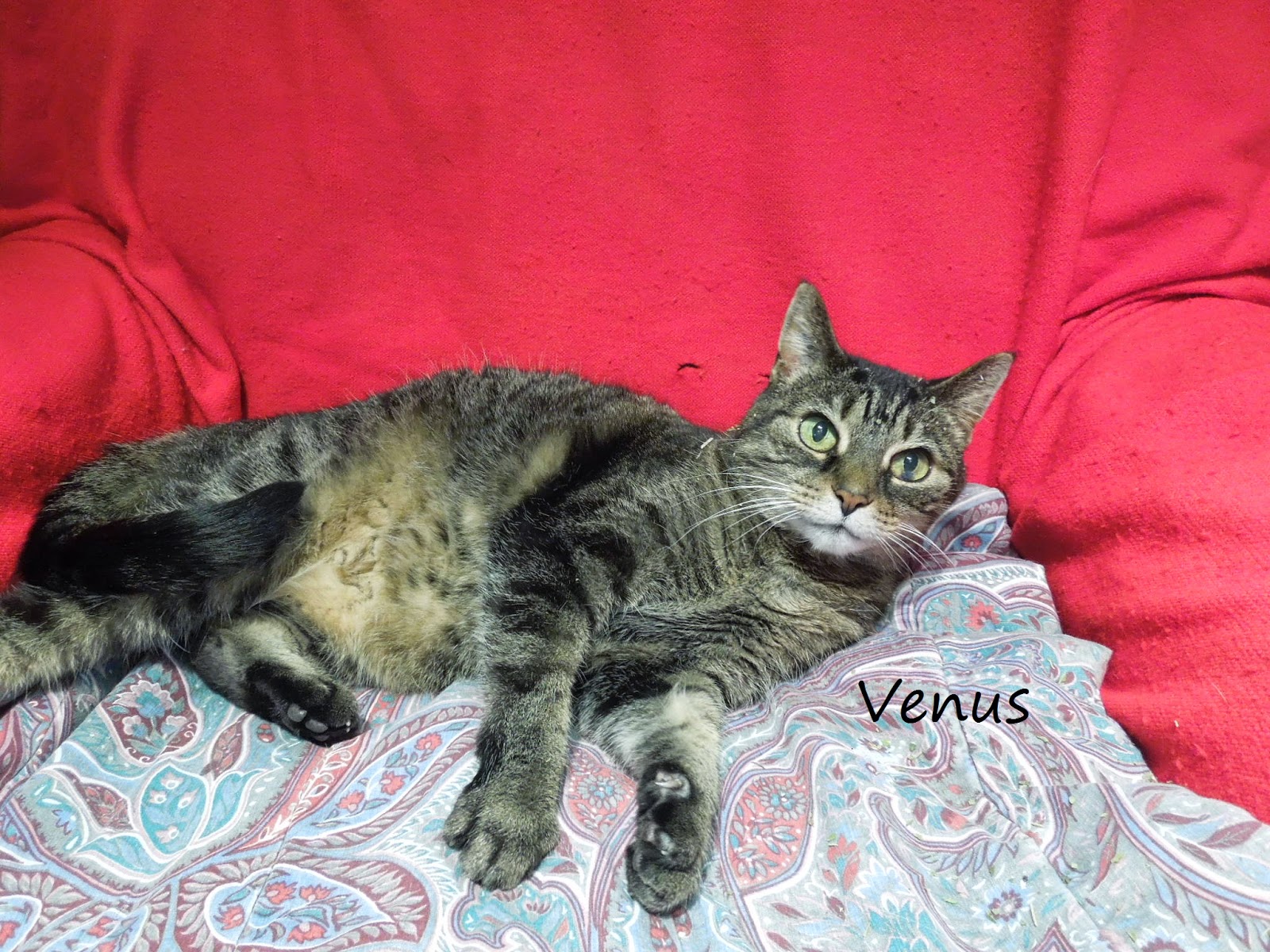
Five from Five Road: 4 & 5 - the senior ladies - Bluebell and Venus

 
This is the final installment in a series of stories about five cats who were recently transferred to the Cat Sanctuary from the Richmond City Shelter because they were considered unadoptable. 


Bluebell is a pretty blue-eyed blond girl who was surrendered because it seems that, for all of her twelve years, she never did learn to use a litter box.  Since her arrival at the sanctuary, there have been a variety of innovative attempts (paper in the litter box, various types of litter in the litter box, a bit of her “droppings” in the litter box, etc.) to get her to see the error of her ways, but with very limited success, if any.  And now she’s out and about, her litter box is fair game for all the other cats.  So, despite being  gorgeous, friendly and playful, Bluebell’s status unfortunately remains as “unadoptable”.


She seems quite content to hang out with the other cats in the Moore trailer and be admired by everyone who sees her.


Phaedra says “Bluebell seems to be getting cuddles from lots of people so I've been focusing on the play aspect. There is not a single toy in her trailer that she hasn't enjoyed playing with. She is quite mischievous and tries to get out the front door even though I suspect she doesn't really want out. I swear she was laughing at me on Thursday when she ducked past me and I carried her back inside.”


Venus has been moved around quite a bit in her thirteen years, which may account for her occasionally demonstrating some  “cattitude”.  She was surrendered to RAPS in 2012 because her owner was moving and couldn’t take Venus along.  She was adopted soon after but surrendered again about six months later.  Maybe it’s because, although she’s friendly and loves people, she can get a bit over-excited and give a playful nip or two.    After spending about six months at RAPS’ City Shelter, that habit resulted in her being labelled as unadoptable and she was transferred to the Moore trailer at the cat sanctuary, where she’s still working things out with rest of the “divas” in the building. 


She’s quick to jump on a lap for cuddles but not willing to share that lap with any of the other cats.  Phaedra reports that “Venus is one of those cats you have to take things slow with to get to know her. She doesn't take kindly to you taking liberties with her and lets you know when you've gone too far. She lets you know she's there when food is around but I haven't found the way she likes to be petted just yet.”

 
Divas in the Moore House is too right! And these two sure add to the collection!

Blog by Marianne Moore
Pictures by Phaedra Hardman, Marianne Moore and Michele Wright

Monday, January 5, 2015

Adoptable? – or not? – part 1: the ferals


When visitors first come to the Cat Sanctuary, they are told that most of our cats are unadoptables, and that if they’re looking for a new cat, the No 5 Road City Shelter is the place to go.  Typically, visitors will look around and say “but they’re so tame!” – but what they’re seeing is cats who are comfortable with their surroundings.

The usual four categories of non-adoptable cats are ferals, semi-ferals, behaviour problems and health problems, and on this basis, many of our cats would be killed by the typical animal control system.

The definition of feral is usually a cat that is born wild, or a stray that has had minimal socialization with humans, and has reverted to wild state. It does not include the typical “lost” cat, who may have many of the feral behaviours, but can sometimes be reminded that humans are friends.

There’s not much question about the true ferals – the majority of them want nothing to do with humans, and they are much happier living in a pen at the back of the sanctuary where people will let them be.
Ginti
Our med staff know all these cats, and keep a careful eye on them; medical treatment usually means netting, and a certain amount of human blood shed. Typically cages with big red signs saying "Med staff only" house ferals who are in for care, and are not happy with the situation.
Nelly
There are a fair number of ferals who prefer to live indoors. Nelly was one of our beloved Mario’s “harem”; when we lost Mario last year, Nelly was obviously searching for him. She lives entirely on the top of the double-wide cages and refuses to interact with humans other than the occasional disdainful finger-tip sniff. Her horrified stare is a typical feral look.
Rusty
Cats like Rusty are very selective about the humans they will allow around them. Sometimes, like elderly people with memory loss, they forget that they should be scared, and a feral who becomes approachable is very often a sign of an aging cat.


Coming up in the Adoptable – or not? series: 
Health problems / Behaviour problems / Semi-ferals and strays.


Blogger: Brigid Coult
Photos by Claire Fossey and Michele Wright