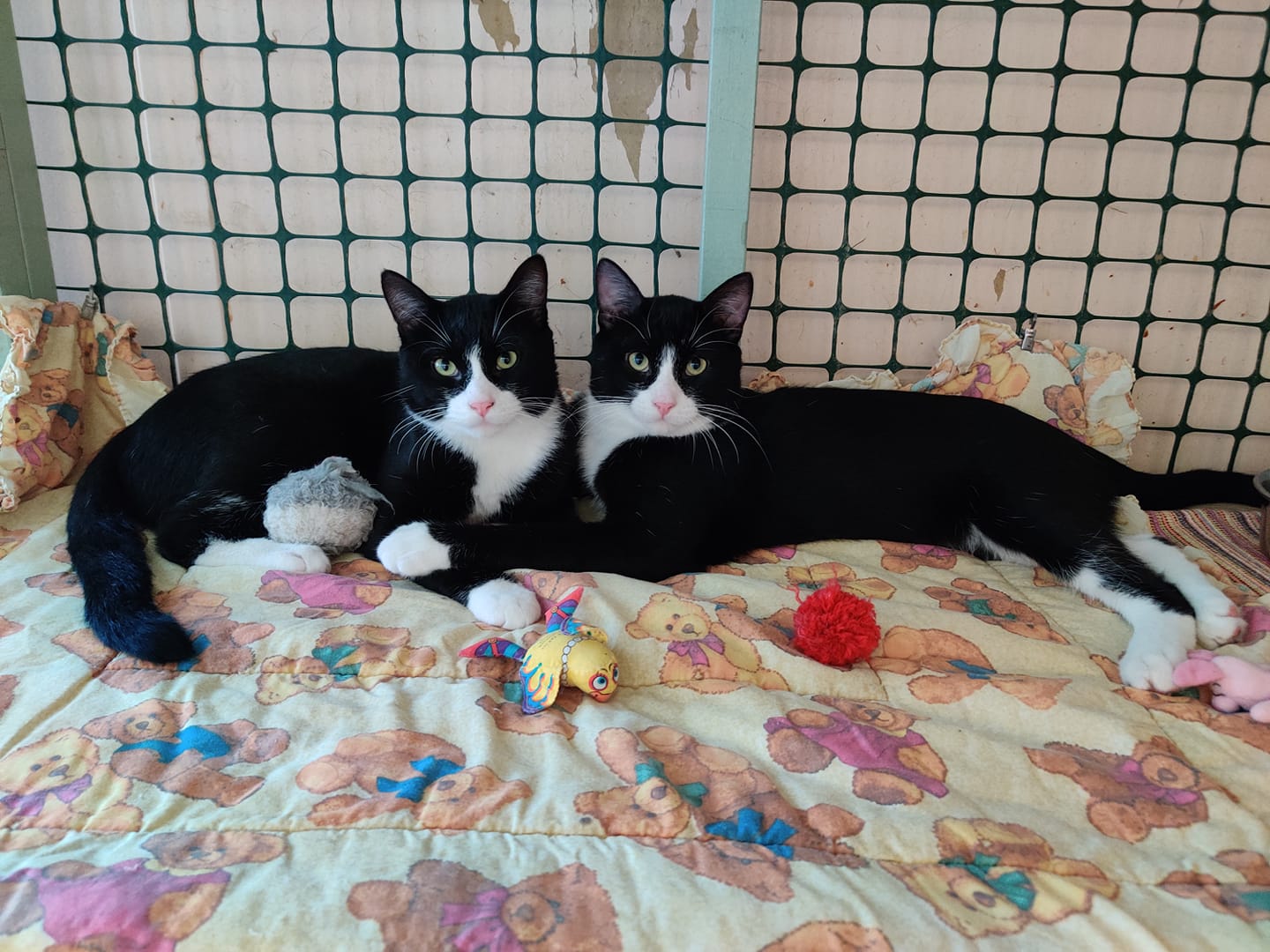
RAPS is short for Regional Animal Protection Society, a registered charity and operator of a sanctuary which houses and cares for nearly 500 homeless or abandoned cats in Richmond, BC, Canada. The Neko Files is a celebration of the sanctuary and all those who live and work there.

Wednesday, April 26, 2023

Rollins

Rollins  (KN)
We’ve had black and white “cow cats” at the Sanctuary for some time – most of them coming from a trapping operation at an east Richmond composting plant. The trio of Mya, Teagan and Kirsty came first, then Hillie – initially so fearful and then everyone’s friend – and last was shy Yma, who still hides from contact. All we have now from that group are Kirsty and Yma; Mya was adopted, and the other two passed. And now we have another “cow cat” – but this one is in the front courtyard. Meet Rollins!

Rollins (GA)
Rollins belongs to the Sanctuary tradition of “detective cats” – cats who are smart enough to find us, rather than the other way around. Typically these are cats who are spotted in the parking lot, or in the area around the perimeter; we now have trail cams running and are more able to identify if the cat we are seeing is a local one or someone new.  

Exploring in the courtyard  (KN)
Sanctuary detective cats are named for fictional detectives – mostly TV-fictional characters. We have rejoined in the company of Magnum, Colombo and Kojak, Watson, Horatio and Steele. Our most recent incomers have all been black-and white; Rico, in 2020; Munch and Cassidy (tuxedos) in 2021, and most recently, Rollins.  Rollins was actually spotted on trail cams while we were looking for Munch, who had done a jailbreak and was not in a hurry to return, though he hovered in the vicinity. It took Rollins very little time to decide that the food in the trap was a fair tradeoff for a comfy place, and he settled with us very easily.

Munch & Cassidy (EC)
Our med staff are Law and Order fans, and the names of Munch, Cassidy and Rollins all come from the Special Victims Unit series. The other detective/cow-cat in the front courtyard is Cagney and both he and Rollins actually get their names from female characters.

Relaxed with welcoming visitors  (BC)
Like all new cats, he had a cage-stay for awhile, but unlike many of them, he loved having visitors, and would roll and preen and encourage attention. It was quite obvious that this boy was used to being handled, and we suspect that he was dumped off. Once released, he made himself at home in the front courtyard; he likes to explore and is one of those active cats constantly on the move. He tolerates the others – he doesn’t appear to have bonded in any way – but he likes to have human attention, and especially enjoys wrapping himself around a nearby foot.

Playing hug-the-foot   (BC)
That’s OK, but the foot owner needs to be careful that Rollins doesn’t get so excited that he bites.  We have one ankle-biter already (Little John, in the back courtyard); at least Rollins sends clear signals that he’s getting close to the edge. Many “aggressive” cats are labelled that way because we humans don’t read their body language well enough.  I think Rollins is still young, and will calm down further as he matures; sadly, he appears to be a pee-er, so the Sanctuary is likely to be his lifelong residence. Nice to have your company, Rollins!


Blog by Brigid Coult
Photos by Graham Akira, Elianna Chin, Brigid Coult, Karen Nicholson

Wednesday, April 19, 2023

Caging Cats

Plum caged for one of her Manx-syndrome bladder infections (MW)
One of the things that visitors love about the Sanctuary – well, we do, too! - is the way that cats roam freely. They can choose whether to be in or out, hidden or in sight, alone or cuddled with a buddy.  There are limitations, of course, the Leukemia (FeLV) cats need to be kept isolated from the general population for everyone’s good, and we keep the AIDS (FIV) cats separate for similar reasons, though, strictly speaking, it’s not essential.

For BB, being in a cage is sanctuary; she's not a fan of other cats  (KN)
But the concern that so many people have before they experience the place is the thought of dealing with cats in cages – and that’s simply not the norm with us.  In fact, some of our cats have come to us from the Adoption Centre because they don’t handle the inevitable cages in that smaller space, and show shelter aggression – as happens to many animals in confined spaces. Elvis, Hunter, Mango, Lunette and many others have settled well now that they are no longer shut in, and can take their time to find the person who is right to adopt them from the Sanctuary, rather than returning to the Adoption Centre.

LittleCat & Menjosie have claimed their cage in the SW,
and do NOT want to be moved   (BC)
Cages are necessary, though. Most of our cats are caged when they first arrive. The caged period gives them a chance to settle, to hide behind a drape if they need to do so, to encounter first the highly cat-savvy med staff, then the calm, encouraging Kitty Comforters, and then the other volunteers, and to learn that no harm will come to them and they’re getting food and care.  This is the period when they get their vaccinations and health checks, and when we get to work out whether we have a scared stray on our hands or a fearful feral. Many scared or angry cats choose to stay in their cage once it's opened; it becomes a place of security for them.

Ariel took a long time to move out of her cage after it was opened (GA)
Cages are also necessary when cats need specific medical attention. For many receiving care, it’s a matter of getting a little plate of something tasty with meds in it, and you will often see the med staff around with a tray of little dishes, watching that a cat eats all its dose (or turns its nose up, because the food is chicken and it wanted fish!). But there are many cats who will not take their meds that way, or who need it syringed into the mouth, or who need eye-drops or cage rest for an injury – and each of the main buildings has cage space, so that cats who need caging can at least have it in a familiar area.

Luke and Bodhi were photographed for Valentines,
while Luke was being caged for insulin adjustments  (LBF)
Sometimes there’s even an advantage to caging. When big tuxedo Luke was diagnosed diabetic, he was one of the semiferals on the DoubleWide Deck. Because he needed twice-daily insulin, he was initially caged so that the med staff could monitor his intake, work out what his favourite foods were and give him his “treat” plate along with his insulin shot. From being a wary boy, Luke decided that he was definitely on to something, and when the cage was opened he decided to stay – after all, that was where the good food was!  And with all those humans who came and fussed over him, Luke became a lap-cat, and persuaded his pal Bodhi that he should join in too. Luke now loves lap-time and fuss – he doesn’t need food-bribery, just love.

Amelia in Pen 4 - anxious eyes, ready to swat  (LBF)
I just spent time this evening with Amelia, similarly caged. Amelia is interesting, because she’s a feral farmcat from Pen 4;  she came in many years ago with her sister Willow and was named Amelia Earheart for her flattened aeroplane-ears. Most of the Pen 4 ferals want nothing to do with us – it takes the patience of Lisa or Catherine to make any headway at all, and it’s measured in inches.  But both Amelia and her friend Annie had to come in for medical care, and while Annie preferred to hide behind the drape, Amelia would emerge at mealtimes and let us know what she thought of this restaurant and the service.  Annie is now back in Pen 4 and still hiding, but Amelia is bunting and preening and talking in a way that makes us wonder how she’ll be when she’s returned to her home pen – will she forget all about her enjoyment of human company and go and hide with her cat-pals, or will she be more like Ranger, and come looking for attention? 
Amelia loving cage-pets  (BC)
The general rule is that if you don’t tame a feral cat within a specific window of time, you probably won’t – but general rules are made to bend, and sometimes a feral will decide that humans are OK, after all.  We do often see it with the old cats – when an old feral becomes friendly, it’s often a side-effect of senility.  But though Amelia’s no spring chicken, she’s got plenty of life in her still, and we would be delighted if the rest of that life was spent enjoying more contact with humans at the Cat Sanctuary.


Blog by Brigid Coult
Photos by Graham Akira, Lisa Brill-Friesen, 
Brigid Coult, Karen Nicholson, Michele Wright

Wednesday, April 12, 2023

Sweet Siblings

Honeydew, Melon & Kiwi  (KN/LL)
At the beginning of this week, whatever Powers-That-Be that decree the names of specific days informed the world that Monday was National Siblings Day in the US and Canada.  We’d just been posting a bunch of other stuff to social media, so we decided that this week’s blog would give us a Belated Siblings Day at the Cat Sanctuary.

We don't KNOW that Cornelius & Scarlett are sibs
- but it's quite possible  (KN)
Family groups have always been a thing at the Sanctuary, and over thirteen years of volunteering here, I have known and loved many – now passed. Long-time volunteers will fondly remember one-eyed Val and her family: Savannah, Paulo, Silverfox and Latte. Pretty Hope, in the Connor, is the last of her family – brothers Domino and GusGus are gone now. We lost our beloved Miller – preceded some time before by sisters Fiona and Schatze.

Juno, Atlas & Mercury  (LBF)
But there is no lack of siblings around, because we are frequently a resource for other shelters who cannot accommodate large groups – usually family groups – of semi-feral cats. Our own most recent population explosion brought in what we call the McLeod cats, and though some were adopted, Juno, Nyx, Atlas and Mercury are regular occupants of Pen 1, and are in no haste to gain tame-cat status. Also in Pen 1, but from a different source, are orange brothers Chumley and Siskel – both fast to slap out at someone who comes too close.

Siskel & Chumley  (KN)
There have to be siblings in Pen 3, though there’s no knowing precisely who’s related to who.  My guess is that Reinhardt and Holly may be sibs – similar in build, though not in colouring, and with the same light green eyes, and Baker and Jenkins are look-alike tuxes (though Baker is now a chonk!).

Len & Lloyd  (LBF)
In Pen 4 we have two long-haired tabby boys who came from Kamloops. Lloyd and Len are practically always found together; they’re very shy (as most of the pen 4 ferals are), but they love each other’s company.

Orange floofs hang together (JS)
There can be no denying the family resemblance in Pen 6 – from the same rescue in Kamloops, though from a different colony, many of us struggle to tell the difference between Persimmon, Buffy, Kumquat, Creamsicle, Cheeto, Ginger and Rapunzel. At least Kelvin and Billy are short-haired, and though Chamomile and Chaga are floofs like the first group, their colouring makes them easy to identify among the sea of orange fur!

Owen, Zoey, Betsy   (KN)
Our newcomers in Pen 8 (now on the loose) are equally identifiable AND non-identifiable. SweetPea and Curious have different coloured eyes, and very different behaviour; Zoe, Cleo and Betsy all have the same dark faces and dark stockings. Whether they’re from one litter or more, they are undoubtedly related to each other.  They have settled to Sanctuary life really well – a measure of the care they got before they came to us.

Mozart, Caleb & Benny (LBF)
A very noticeable set of siblings are the “fruit girls” – calicos Honeydew, Melon and Kiwi in the front courtyard, and tabbies Dominique and Kahlua came in together with pretty Chai.  Floofy boy Mozart is probably the brother of shyer Caleb.  

Titan & Dixie  (MS)
Other siblings are around, but not so immediately noticeable. Solar and Mabel in the front courtyard no longer have contact with their brother Midnight who now lives at the back; Titan and Dixie are rarely found together – Titan prefers the comforts of the Connor, while Dixie would rather be with the ferals. Carly, Christina and Celine all came in together, and are probably related – but you couldn’t tell by the way they don’t interact. But then, that’s families for you – sometimes you love ‘em, sometimes you can do without them – though it’s usually good to know they’re there!

Blog by Brigid Coult
Photos by Lisa Brill-Friesen, Leslie Landa, Karen Nicholson, Justin Saint, Molly Sjerdal

Wednesday, April 5, 2023

Foster to Adopt

Mango will be wearing an "I am adoptable" bandana  (KN)
As its name implies, the RAPS Adoption Centre is the place to go when you’re looking for a cat. Kittens come from fosterage when they’re old enough to get all their immunizations, and both foster-parents and Kitty Comforters have made sure that they’re well socialized.  Other older cats come in – sometimes from trapping strays who then make it clear that they’re tame and home-able; sometimes when someone surrenders a cat because of their own illness or age. There is never a lack of cats looking for a home.

Elvis has his favourite people for cuddles  (LBF)
...which is where the Sanctuary comes in. There have been occasions when the Adoption Centre is just too full, and cats have been transferred into our care.  Some of our older cats – the Pen 2 cats in particular – came to us that way, and just never went back.

Sam loves attention - as long as there are no other cats around  (LBF)
Other cats don’t do very well in the Adoption Centre surroundings – I suspect it’s just too intense for them. They have to be caged at night, and for those that are out during the day, it’s not easy to avoid personality clashes. Sam, Elvis, Mango and many others, all moved to the Sanctuary to give them some relief from a situation in which they demonstrated cage aggression. Many of them are cats that would do really well in a home with space to explore – especially if they were The One and Only Cat.

Cornelius & Holly  (LBF)
A third category of cats is those who have come to us as ferals or semi-ferals, and who have proved to be very friendly and adaptable. The thing with most of these cats is that they’re used to having the run of the Sanctuary, and we can’t always track their bathroom habits. Many cats prefer to use the litter boxes we scoop twice daily – but others prefer the garden, and are not necessarily indoor-adaptable, even when they’re friendly. With some of the shyer cats, we would prefer that they are adopted in pairs, so that they continue to live with another cat they already know.

Dango needs diet-specific living....  (KN)
The last category of adoptables is the cats with a manageable health issue. Our sweet Dango, for instance, throws up bladder crystals and really needs to be on a carefully restricted urinary diet – but that’s difficult to achieve in community living without making him live in a cage. Right now, Dango’s been moved into the Val Jones pen, with a smaller number of cats – and they’re ALL on a urinary diet, whether they need it or not.

FeLV cat Adria is young, playful and sociable (BC)
Cats with FIV or FeLV - feline AIDS or feline leukemia virus - may also be adoptable, though there are more stringent restrictions around care. Cats with FIV can do very well in a home, even with non-FIV cats, as long as there is no fighting among them.  Cats with FeLV can live with other FeLV cats, or alone. Both conditions need more awareness of health-checks and of the cat's immune system, though in both cases, the virus can go into remission.

Sweet old Akiva is really unhappy around other cats (KN)
We’ve always been wary about adopting out Sanctuary cats – there have been bad experiences with former ferals who have reverted when put into new surroundings. But increasingly we’re looking at the more sociable cats and how they react to or bond with a visitor, and asking ourselves whether this might be a possible adoption.  With the Adoption Centre cats, we know that they can go into a new home and settle easily; with the Sanctuary cats we are more cautious. So the focus moves to “Foster-To-Adopt” – an adoption is not confirmed until we know that both cat and adopter are happy, and that the situation is working all round.  In some cases – perhaps with an older cat like Akiva, or one who needs more medical care – it might remain a fostering situation indefinitely.

Tabby Hunter is picky about his human company  (KN)
So, if you come to visit us this summer – Sunday afternoons, starting April 16, and then Saturdays as well from mid-May – do ask the staff about the possible foster-to-adopt cats, and take some time to sit with them and make their acquaintance.  There are many who love life in the Sanctuary – but who would love even more to have a home of their own.


Blog by Brigid Coult
Photos by Lisa Brill-Friesen, Brigid Coult, Karen Nicholson

Wednesday, March 29, 2023

Alvin

Alvin (KN)
As a volunteer, it's all too easy at the Sanctuary to spend most of your time in specific areas, covering shifts, and then discover that there are a bunch of new cats you don’t know in another area. That is particularly so when it comes to black cats – and I especially struggle with identifying the front courtyard black ones.

Alvin (BC)
So I found it interesting that in the last couple of months, I’ve had three black boys coming and “making nice” with me – though all three of them are not in fact pure black, but what I call flecked cats – black with little flecks of grey or white among the black fur.

L: Puddin' (BC);  R: Odin (KN)
The first of the three is Puddin’, introduced a few weeks ago; Puddin’ mostly hangs out in Pen 3, but likes to follow me round the back pens on a shift. He remains very affectionate, but is cautious, because his place on my lap is being invaded by Odin.  Odin bases in Pen 1. He was very shy when he first arrived with us, but time with the staff (especially Alice) and Kitty Comforters has worked wonders, and now he comes running when he hears my voice, and demands lap-sitting and lots of petting.

Alvin (KN)
The third is a front courtyard cat called Alvin. We think he’s around 9 years old, and was brought in to us by a local Samaritan who found him as a stray. It would be interesting to guess his background; he’s a friendly boy, so has obviously known human care and attention, but he was unneutered when he came to us, so hasn’t had good care. He’s been living stray for some time; he had bad teeth and a pellet lodged in his belly, so life has been tough.

Water is GOOD, Alvin!   (BC)
Alvin is one of many cats in our care with CKD – Chronic Kidney Disease. It’s very common in cats, especially the older ones, and our med staff are careful to monitor those in early stages, and give fluids where necessary. Ideally, a cat with CKD should be on a special diet, but given our setup it’s not possible without caging him – what Alvin needs is a home where he can get the special food he requires.  He would actually be a good candidate for fosterage; his CKD is in the early stages, and the right food is all he needs. Assistant Sanctuary Manager Valerie says that he would be a good candidate for foster-to-adopt.

Busy about cat "stuff"  (KN)
Street life as a lone male has taught him to be a little wary around other cats, though he’s not aggressive; he is one of the cats who will often come running to greet me, and will jump up to sit beside me on the bench and then edge over onto my lap. He’s not a big boy, though like many other formerly unneutered males, he has chubby cheeks.  He loves to be petted, and to be scritched around his ears; if someone else approaches – even someone as gentle as Little Orange – he gives way and scoots off.

Alvin (BC)
You’ll generally find Alvin around the Connor House – snuggled into a bed at the back or on the porch – if he’s not on greeting duty. Now he knows and is comfortable with us, it will be interesting to see how he behaves when our Sunday visitors start coming – I hope he will make some new friends!


Blog by Brigid Coult
Photos by Brigid Coult & Karen Nicholson

Wednesday, March 22, 2023

Choosing a Laptop

Bill, in New Aids, loves his laptime with Mel  (MD)
So you’re thinking about getting a new laptop? What’s important to you? Weight? Flexibility? User-friendly? There are so many models from which you can choose – and they’re all at the Cat Sanctuary!

The Single-Wide lapful  (JS)
As the song says (and we all know the pain) – “I can’t right now; I’ve a cat on my lap!” - lap-sitting with a cat is the perfect way of doing nothing and getting all the feels for it! But there are many different styles of lap-sitting.

Magnus says, "Come and sit with me NOW!"  (MW)  
There are cats like Magnus who climb into your lap and just settle there – no twitching or wriggling – just letting you know that you are now their comfy place, and you are NOT TO MOVE.

Adria LOOOVES lap-time - though it may not be restful   (BC)
There are the cats who want to be on your lap, but who wriggle and squirm to make sure they have all your attention; they want petting, but they don’t necessarily want to be held.

Oh, that smile....    (JS)
There are the cats like Roe who are advanced lap-sitters, blissed out by caresses, even allowing belly-rubs – and who will happily hog all your time. Roe is jealous if anyone else gets Justin’s attention before her.

"Can I come up now?" Bossanova is needy  (KN)
There are the lap-standers – they want to be up, but they don’t want to relax. Our sweet late Sara Lee was another lap-stander – and even when old and creaky, made determined efforts to struggle into volunteers laps at coffee time, though without ever settling. Bossanova can be coaxed into lying down with a bit of a belly-rub.

Cuddles with Jasmine need planning   (KN)
There are the cats with whom it’s wise to have a towel as padding – our leaky manx cats are loving and seek attention, but plan ahead to protect your clothing!

Sitting VERY still with JJ   (BC)
There are the cats who leap for your lap, but who do NOT want much in the way of touch! At coffee time, the human frozen postures tell who has JJ or Sophie sitting on them – both girls are reactive around hands, and stillness is appreciated.

KitKat is less interested in laps  (JS)
For some, laps are less an attraction than shoulders - KitKat is a determined shoulder-sitter!

Huey doesn't want Daphne to move  (DJ)
For others, the idea of the lap is nice, but they don’t actually want to be on it. Huey likes it best when he can sit on the couch beside you, and keep a possessive paw on you lap so that nobody else will claim it.

Elvis leads the lap-loading - 
Selena and Bear want in on it as well  (BC)
And for cats like Elvis, the lap is only the foundation to get as high on the chest as possible, so that he can gaze into your eyes, put his paws around your neck, and tell you how much he loves you.

Blog by Brigid Coult
Photos by Brigid Coult, Melanie Draper, 
Daphne Jorgenson, Karen Nicholson, Justin Saint, Michele Wright

Wednesday, March 15, 2023

William Shakespurr

William Shakespurr  (MW)
This little cutie is one of the cats from a hoarding situation in Alberta, who came to live in our Pen 3 back in 2021. The cats in this group were all young, and some were slightly socialized, but others were (and are) much warier.

Curious - but not enough for petting   (LBF)
William Shakespurr is one of the cats right on the cusp.  He’s social – but with cats rather than with humans. He hangs around with Cornelius and Jason – the latter likes attention and petting, but Cornelius is still very wary about being touched by anyone other than Lisa.  William’s very much in that space as well – he likes to be around the activity, especially if there is food being offered, but he’s not ready to be petted, and prefers to stay a foot or two out of reach.

Peeking through the cabin window  (KN)
Like Cornelius, he is something of a ham, and is ready to take part in photo-shoots as long as they don’t involve physical contact. He’s an active boy, ready to climb the structure behind Cabin 3, or even to the roof of the cabin itself. He can often be found visiting in the adjacent pens, but is not as ready as Cornelius to get as far as the Tea-Room.

Posing for Tongue-Out Tuesday with Jenkins & Cornelius   (LBF)
We don’t know who’s related to who, in this clowder, but my guess is that he and calico Baby are siblings – very similar in body shape and size, and often found together.  William’s colouring always makes me think of a bad haircut; he has beautiful tabby and white colouring, but it looks like he wears his hair in bangs.

Baby and William share a summer snooze   (LBF)
We would love to see some of these cats getting adopted, though this is such a social group that we would prefer that they go in pairs, so they have company. Sadly, though, I think it’s still too soon for William – hands are only acceptable to him if they hold chicken tidbits, and being petted is still pretty scary. Perhaps a little more time with the Kitty Comforters working on him...   

And if not – he’s always got a home at the Sanctuary.

Blog by Brigid Coult
Photos by Lisa Brill-Friesen, Karen Nicholson, Michele Wright