RAPS is short for Regional Animal Protection Society, a registered charity and operator of a sanctuary which houses and cares for nearly 500 homeless or abandoned cats in Richmond, BC, Canada. The Neko Files is a celebration of the sanctuary and all those who live and work there.
Showing posts with label Cricket*. Show all posts

Wednesday, December 31, 2025

Loved and Lost in 2025

(March) Sweet leggy Akiva had been declawed before he came to us;
he was always wary around other cats (KN)
The between-gates entry to the back pens of the Cat Sanctuary is also a storage area – cleaning supplies, transfer cages and carriers, the sign-in book, the board showing volunteer vacancies and temporary assignments – and a RAPS calendar. The latter is not there so much to keep track of dates as to keep an open record of cats who have passed, and you will often see an incoming volunteer checking to see that all is well in the area in which they are working. Kitty Comforter coordinator Anne Marchetti emails the KCs to let them know when we have a loss, and includes a little tribute and a photo that helps us to mourn privately – thank you, Anne! It’s hard to do a shift, and realise that you’ve not seen a specific cat – only to check the calendar or with one of the med staff, to find that cat has passed.

(March) Cole came to us with aggression issues, but quickly 
discovered that laundry-room life offered lots of good attention, 
first tastes of food, and warm towels for sleeping on.  (TV)

Some months we go long periods with no losses – and then we may have a dozen cats pass in a few weeks. This year we got through to May with 2-3 each month – and then we lost 25 in the next three months – especially hard on the med-staff, for whom compassion fatigue has to be an issue. Sometimes we know it’s coming – the cat has been on medication and under a watchful eye; sometimes it comes out of the blue – perhaps a cancer that the cat has been hiding, or a sudden stroke. This year I am all too aware that practically all the cats I encountered when I came to the Sanctuary in 2010 have gone – I think all that are left are May and Walker in Pen 5, and sweet Orlean in the DW.

(May) Named for his beautiful golden eyes, Pumpkin 
was very much the social leader of the Boys Club  (MW)

55 cats have passed in 2025; some that visitors may never have encountered because of where they lived; others who were beloved favourites, sought out for special lap-time or petting. I wrote about our Sweet Gericatrics in April, all of whom have now passed - and I memorialized some the July passings in a later blog called July Rainbows.  

Here are a few of the others.

(June) Beloved by all, Willow was known as Spider-Cat
in her early days. After a bout with vestibular disease and a cage-stay,
she became very friendly with humans.  We lost her sister Amelia in March (BC)

(June) Sylar was my sponsor cat, and my challenge; 
 when caged, he would  reluctantly enjoy petting;
 out in the back courtyard he was usually very shy  (BC)

(June) Handsome Adam was a core member of the Pen 5 crowd,
and is greatly missed by his sister May (MW)

(Sept)  From arriving as a plain tuxedo, pretty Holly's colouring looked like she'd
had an expensive balayage treatment. She loved lap time with visitors (MW)


(Oct) Bricklyn was a fearful feral through much of her life with us, but this
sweet old lady  experienced feline dementia in her last year, and forgot to be
so scared. She made many human friends and loved petting and treats  (KN)

(Oct) Rookie was a former feral boy brought to us by volunteers
Barb and Waldi, more than ten years ago; he loved their visits  (KN)

(Oct) Hannah (also known as Hannah-Banana) was the small queen of the
back courtyard, and, for the last year, the oldest cat in the Sanctuary.
Hannah enjoyed Sanctuary life; she just didn't care much for other cats! (MW)

(Dec) Dazzle was another girl who held to her wary-feral status for years;
she would come and leg-rub, or accept arms-length petting - and then
she suddenly made breakthrough and adored lap-time with Justin  (JS)

(Dec) Cricket was always known as one of the kittens, though she'd been with us
more than 10 years. She came to us as a feral and resisted taming, but she became
one of the best greeters, standing on her back legs to get petting  (KN)

ALSO: Jan: Mojo, Venus / Feb: Tang  / Mar: Amelia, Kip  / Apr: Skye, Lil / May: Taylor, SweetPea / June: Charlotte, Kirby, Flash, Marble / July: Jerry, Neko, Denzel, Autumn, Juliette, Chumley,  Lloyd,  Paula, Kimpton, Higgins, Nova, Fletcher / August: Mystery, Licorice, Peaches, Luna, Sierra, Crinkle  / Sept:  Kilkenny, Buddy / Oct: Della, Salem, Tux, Ringo, Neptune, Dave / Nov: Laszlo / Dec: Billy, Karisa, Skittles, Runti

We have many sweet memories of furry friends whose lives would probably have been shorter and harder without the Cat Sanctuary. We grieve losing them - and are grateful that we can continue to offer shelter to others who come to us in need, and who find a place of safety, care and love with us.


Blog by Brigid Coult
Photos by Brigid Coult, Karen Nicholson,
Justin Saint, Tanisha Vincent, Michele Wright


Thursday, February 24, 2022

Front Courtyard Tabbies

Speckle   (MW)
Last November, I introduced shy lynx-point Chai on the blog, and mentioned that she came in to us with other cats from a local trapping operation. All of them went to the Adoption Centre, but were not ready for taming, and were transferred to us at the Sanctuary. Tabby & white Speckle is the most easily identified by her markings, but I’ve struggled to sort out the other two from all our other front-courtyard "plain" tabbies. Some of them have already had their blog moments in the sun; here they are again, with our newcomers.

Freya (BC) & Cricket (KN)
Freya and Cricket are well-known to us all – affectionate and confident girls. Freya, who was initially surrendered for aggression, is likely to be the greeter and leg-rubber at the gate (and occasionally a gate-buster); she likes to sleep on top of the 6’ broom closet.  Cricket endears herself by jumping up to meet the petting hand; we keep a careful eye on her because she occasionally shows a limp, though it never seems to last long. Floofy Autumn with her highlighted ruff usually hangs out on the top level of the climbing frame. Cookie Hill has mostly moved her location from the Hill House to the Yellow Shed, but is anxious for pets when someone comes to visit. In the Connor we have the more torby girls: Carly Simon, Celine Dion and Christina Aguilera and of course, pretty dilute Chirpy

Lorelei & Libby (BC)
Libby was introduced as part of a feral group that came to us from VOKRA. Her brother, grey Solar, has settled well, and particularly loves Carol Porteus, who comes to feed twice a week – he knows she’s always good for particularly tasty offerings. Libby, though, is not comfortable with humans and hovers between the feral Old Rabbit Area and the Hill House. The draw in the Hill House is tubby little torby Lorelei, who Libby loves, but even loving Lorelei is not enough to tempt Libby into human contact. She looks on disapprovingly as other cats accept attention.

Kahlua (LBF) when she first came to us
Libby has the same identifying chest dot as Kahlua, who arrived last April with Chai and Speckle – but Libby’s fur has more of the classic-tabby whorls, whereas Kahlua shows the tabby stripes. Kahlua began in the Old Rabbit Area with the ferals, but has graduated to the Hill House, where she knows she can flirt with visiting humans. 

Kahlua today (KN) - confident and happy
From her beginnings with us as a feral, she has gained immensely in confidence, both on the table or shelves, and at floor level – some cats are ready to be petted in one place but not the other; at waist-height they can be fussed, but on the floor they are daunted by our size unless we get down to their level.  Kahlua just enjoys the attention, wherever it happens. She and Libby look alike, but their behaviour is very different!

Goose (KN)
Another tabby who is easily confused with Kahlua is Goose. She came to us more than a year ago from a local rescue; I believe she was originally from Manitoba. At about 8-10 months old, she was in the teenager space where she was past her best-by date for taming. Cage time was longer than usual, because she was so timid; many hours of Kitty Comforter attention  were spent just sitting and talking with her to accustom her to our presence. And, typically, once released, she still believed we were big scary monsters, and avoided being noticed.  And because she’s a very ordinary little tabby in appearance, it was easy to miss her.

Goose (LBF) in her favourite place
She loves to play, even if she still isn't sure of humans. Laser pointer, ping-pong balls, feather toys.. you name it, she'll probably play with it – in fact, she’ll wake out of a deep sleep to come play. She also LOVES cardboard boxes. She can mostly be found in the Gazebo in the centre of the front courtyard, where she hangs out with the boys – Mozart, Benny, Caleb (she is particularly attached to Caleb!) and enjoys the comfort of the heat lamp.

Dominique (MW)
The last little tabby came to us a little later than her buddies Speckle, Chai and Kahlua, because it turned out that she was pregnant, and she went into fosterage to have her kittens. They tamed and were adopted, but she remained wary, and was brought to join the others. She had originally been named Domino, but since we’ve had two Dominos (one adopted) and currently have another Domino (male) in New Aids, she was renamed as Dominique.  Rather than joining the other ferals, she stayed near Chai in the Connor area, and can often be found near the gate.

Dominique (KN)
Though clearly tabby-marked, her fur is more agouti-patterned, with torbie hints of orange in it. Dominique is very food-motivated, and the offer of treats is a major incentive to hang around certain humans!

Most of us struggle to identify all our black cats correctly. The tabbies, too, tended to get lumped into “the tabbies” group – but there are enough differences in appearance that a little detective work has helped ID them, and allow their personalities to shine through!

Blog by Brigid Coult
Photos by Lisa Brill-Friesen, Brigid Coult, Karen Nicholson, Michele Wright


Thursday, July 25, 2019

Room for Teens

One regular visiting-day question is “where are the kittens?”
Kittens always look SO cute!  - JS
Visitors are always disappointed to learn that any kittens in RAPS care are usually to be found at the City Shelter, waiting for adoption – and some of them go rushing off to visit there.
In fact, to get kittens to that point, there’s a great deal more RAPS care by the invisible (to the public) team of fosterers.  Any time a pregnant cat, or a mom and kittens arrives in our care, someone from the fostering team leaps into action.  Many of them reserve a room in their home just as a kitten-nursery; if that space is taken, stand-alone cages are erected on the dining-room table, and all formal entertaining is postponed.
Mama Carly Simon is now settled with us;
her kittens were all adopted from the City Shelter - MW/KD
Fosterers are used to the anxiety of waiting for a litter to be born, of tube- and syringe-feeding when necessary, of dodging a protective mom in order to clean a cage. They handle young kittens as soon as possible, to familiarize them with people – the weaning stage between four and eight weeks is usually seen as the best time – and when the kittens are old enough, they are taken to the City Shelter for adoption - while mama is spayed, to prevent another litter, and moved to Shelter or Sanctuary, depending on her temperament.
Four wary teenagers: Perry, Peony, Perkins & Della - MM
The problem comes when we receive older kittens, who are past that optimal window for easy handling. Socializing them when they are four months old or more can take a great deal of patience to overcome the feral instincts instilled by a feral mama. We will sometimes receive these ones at the Sanctuary. At the age of 4 months to a year, they are not yet fully adult – we would probably say that a 1-year old kitten is developmentally equivalent to a 15-year old human.  And though 15-year old humans can be delightful creatures, they are not as adult as they think they are! We don’t need any feline teen pregnancies, so all of them will be “speutered” (spayed/neutered) before they come to us.
Baby Beetle is all grown up now - but still shy  - MW
You may hear the Sanctuary’s Hill House sometimes referred to as “The Teens”, from its early function. These days we have fewer teens, and they usually go to a room off the quiet senior-focused Moore House.  At one stage it housed Sage and Silky, Cricket, Beetle and Frisky, it was a home for the young cow-cats, Mya and Kirstie, when they first came to us, for Perry, Perkins and Peony (all adopted) and now it’s the base for six youngsters.
Blond Leo relies on his braver friend Benny - BC
Leo and Benny came to us from a hoarding situation. They are less than a year old, and were initially very nervous about being handled. Benny rapidly settled; Leo was less ready to be touched. They were sited in the DoubleWide, and got a lot of attention, but large as our cages are, they really didn’t give this pair space to be as active as they would like. Kitty Comforters spent a lot of time and love on them, and it was obvious that it would just take a bit of time. The two of them are a younger echo of Lindor and Parker who came to us earlier this year – and with similar colouring and initial characteristics. Both Lindor and Benny are fuzzy and black, fairly outgoing and not afraid to engage; both Parker and Leo are slighter and blond, much more shy and in need of coaxing.
Mason loves having space to play - AM
In the cage facing them was a little black panther: young Mason; very hissy and swatty in his first weeks with us, but with the Kitty Comforters working with him, he became very keen on human company – going in to feed or clean his cage meant entertainment time!
It's a hard life, being a kitten, says Mozart - MW
In the meantime, there was another group of teens in one of the Single-Wide’s big cages, tended only by the med staff until we were sure that they were all healthy. This trio had come to us from the Interior, offspring of a feral mama, and about 8 months old. They were named Pistachio, Caleb and Mozart – Pistachio with a little moustache marking; Caleb with more black markings, and Mozart more grey.
Mozart & Caleb - KN
Now there’s been a general reshuffle and the two groups have been put together in the Moore House kitten room, where there’s more room for them to run and play, and for the Kitty Comforters to do the work of socializing them as much as possible.  We hope that they will eventually go to the City Shelter for adoption, but it may be that their feral beginnings are too ingrained to overcome, and they will end up staying with us like the other youngsters. Sadly for visitors, the Moore House is off-limits – they may be seen out on the deck if they choose; they can be admired but not handled.
Pistachio - MW
The Kitty Comforters, of course, are having a wonderful time – but they all know that how they play with these delightful fuzzballs will be vital in establishing patterns that will help Benny and Leo, Mason, Pistachio, Caleb & Mozart eventually to find new homes and grow to be confident cats.

Blog by Brigid Coult
Photos by Brigid Coult, Kati DeGraff, Anne Marchetti, the late Marianne Moore, 
Karen Nicholson, Jocelyn Schonekess, Michele Wright
Monday, July 15, 2019

Adopting a Feral

More than half of our Sanctuary cats have come in as ferals.
Smithy's first reaction always used to be a hiss;
 recently he's become more curious than aggressive - BC
Feral cats are those born wild, or living wild from a very early age. They run the range from the cats that take one look at you and turn to hide (or to hiss angrily at a human interloper) to the cats who have decided that there is no better life than sitting in a human’s lap. Ferals and strays are not the same thing; a stray knows what human contact is, and though scared, may more easily revert to tame behaviour.
Our beloved Dell came in as a terrifyingly aggressive cat;
we are sure he was a stray because of how quickly he settled with us.  - MD
For many years the Sanctuary has been a refuge for ferals, as well as for owner-surrenders and health-problem cats. When we’ve had a particularly friendly cat, we have sometimes transferred it to the Shelter at 5 Road, so that it can have its chance at finding a new home.  And because for many of those years, the Sanctuary was Richmond’s best-kept secret, that was very often the only way those cats might make a new start, if they weren’t adopted by one of our volunteers.
Sandy (L) and Pebble (R) are feral sisters;  Sandy still has the horrified
feral stare and is wary of humans; Pebble loves to be petted.  - KN
What we call the semi-ferals are those cats who have adapted well to life with humans at the Sanctuary; they are often among the welcoming committee at the gate, and come looking for petting and attention. But just because they seek attention doesn’t always mean that they are adoptable – experiences with cats like Esme and Jenny led to a general no-feral-adoptions rule. A cat that appears happy to be handled at the Sanctuary may freak out when taken out of its familiar turf and put into a new home.
Sweet Jenny is entirely at home in the Single-Wide - MW
Many of us, of course, have ferals or former ferals at home. My own little Kissa, who passed last year, would hide when anyone except me or her favourite cat-sitter entered the house.  It took her more than two years of living with me before she allowed herself to lap-sit.  I have friends who care for neighbourhood ferals, who have adopted them as their humans, and who come and go from their home with great comfort.
Watson was very scared when he came in to our care;
he now lives happily with one of our volunteers.  MW
But at RAPS we feel a strong responsibility to the cats who we allow to leave in someone’s care. A cat that escapes from a new home may never return if it’s on unfamiliar territory. When you adopt a cat from the RAPS City Shelter, you will complete a questionnaire intended to ensure that you will provide a safe home for your new friend. If you adopt from the Sanctuary, you can expect, in addition, to be grilled by our Manager and/or med staff. Will this be an only cat? What is the potential access to outdoors? Do you have a room that can be a sanctuary for its first days or weeks? What’s your experience with ferals?
Peony - now called Twinkles - was a half-grown feral kitten from a composting
centre when she came to us; she's another cat who has found a home with a volunteer.  MW
Some of our former ferals we will never adopt out – cats like Simone and Latte have lived with us for years, and we would not want to have a relocation make them unhappy. For them, the compromise is sponsorship – the knowledge that you are contributing to their welfare and to a continued happy life with us. But others have become contented outgoing members of the welcoming committee, and when the right person comes along an adoption may be possible. The impetus has to come from the cat; when a visitor appears weekly and the cat makes a bee-line for them every time, discussions can take place. Sadly, many of those bonds happen with people whose situation may not allow for an adoption, and they become among our most faithful visitors in order to have time with “their” cat.
Pretty Cher is mostly a one-man cat,
and her guy comes to visit with her every Sunday - MW
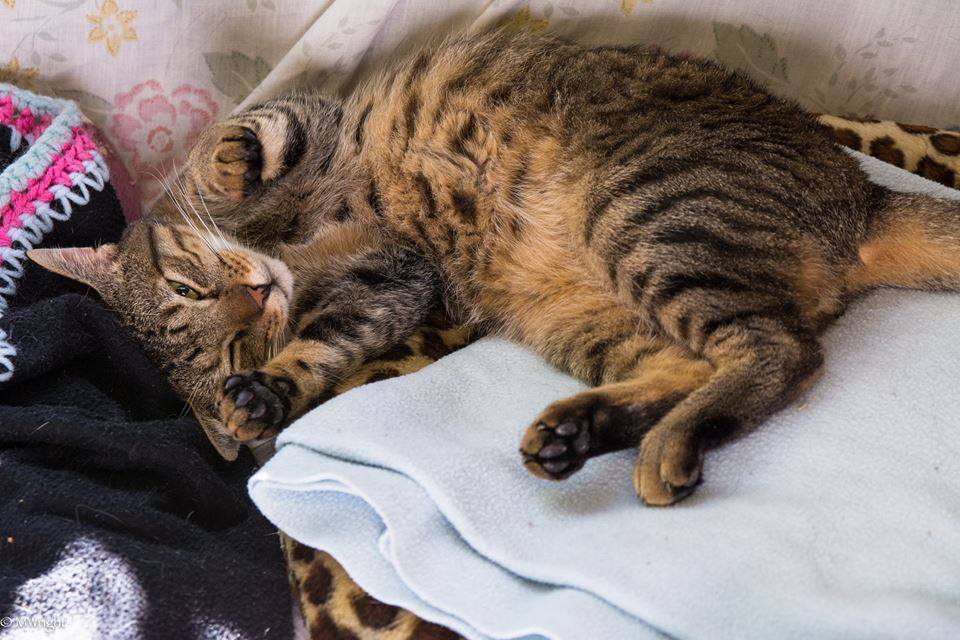
The majority of adoptions from the Sanctuary are actually owner-surrender cats who may have been too stressed at the Shelter to show well, but who blossom in our hands.  Tiger, Terra, Suki (now Cassie - first blogged here by her new owner), Mookie and several others are doing very well in new homes – but the Sanctuary was never really home for them. Cats like Cricket or Silky in the front courtyard, and Willow or Hillie in the back are all a very different affair – they are all cats who have known the wild life as youngsters, and they are all used to a life without boundaries (other than the Sanctuary walls). We would need to be very sure that they had bonded with a human they had chosen, and that the potential owner understood that giving a home to a feral may be a much longer process than with a tame cat. Cricket, in particular, is outgoing and sociable with visitors (as both Jenny and Esme were), but that is no guarantee that she would be a good candidate for adoption.
Cricket loves attention - but she loves her relative freedom still more - MW
We do have feral adoption success stories – especially from among our volunteers, who establish a relationship of trust with one cat or another. But even with a feral-savvy adopter, it can take much patience, waiting for the cat to decide that it can trust again after relocation - Watson's human tells me that it took more than three months for him to come out of hiding.
Many of our ferals, friendly and shy alike, will need to live out their lives in our care, confident that with us they are in a place of safety.


Blog by Brigid Coult
Photos by Brigid Coult, Melanie Draper, Karen Nicholson, Michele Wright

Thursday, January 24, 2019

Feral to flirty

Hillie enjoys watching the activity around - MW
One of the important differences between RAPS and many other shelters across the country is that we have the Sanctuary, and are able to walk the talk about being a no-kill organization.  Most shelters are set up to take in stray animals and to try to adopt them out – and many do an excellent job of it. But when it comes to cats, and especially cats born in the wild, it’s very difficult for the average shelter to find homes for them.  In a rural setting, it may be possible to create cat colonies on a farm, to help with rodent control, and there are an increasing number of municipal experiments on the same principle, where feral cats are being used in warehouse facilities to restrict a rat problem. But it’s a sad fact that there are still many shelters where they look at a feral cat, name it untameable, and euthanize it.
These feral cats prefer to live at the back of the pen.  MD
When feral cats come to RAPS, we are able to find them a home at the Sanctuary. They may end up being incorporated into one of the feral pens, or they may be allowed to find their way into the general population, and hide or not, as they please. Their initial period spent in a cage gives our Kitty Comforters a chance to see if any progress can be made, but we know that you can’t force-tame a cat, and some will never become comfortable around humans.
Autumn likes to flirt for attention - MW
That being said, we have had our share of successes. Pretty Autumn, in the front courtyard, has made the transition all by herself – even if it has taken her six years to do so.
Cricket is now totally at ease with us - MW
Cricket’s transition was faster – she came in as a half-grown kitten, just past the usual tameable window. We worked very hard with her, and her brother Beetle, and she resisted all our efforts. But when released into the front courtyard, she made a quick about-turn, and has become one of the friendliest cats in the place (though Beetle is still very shy).
Horatio is waiting for someone's lap - JC
Orange Horatio spent a year being untouchable, and then decided that he was in love with the med staff.  Bossanova, Gilbert and many others are now irrepressible cuddle-bugs.
Hillie is a nature girl - PH
Two arrivals within the last couple of years came from the same source; one of the places our trappers have kept an eye on for some time was a composting facility. A clowder of cats made their home there – some obviously feral, some possibly dumped. The group we call the “cow cats” came from there, and the black and white markings were common to many of them. Hillie  and Yma look very similar, but actually came to us some two years apart. The most recent arrival was a little tabby who looked nothing like the other cow-cats; his name is Merran, and he was put into the SingleWide.
Merran within reach of a hiding place - MW
For some time he was a ghost cat – mostly spending time out on the deck. Working there, you would become aware, at the edge of your vision, of a little cat watching every move but reluctant to come much closer. Gradually and with much patience, with grooming and toys (and not with treats!), Merran discovered that humans weren’t so scary.
Merran has now become an established member of the SingleWide family. He still loves his original tamer best, but he will accept play and petting quite happily from other volunteers.
Hillie allowing us closer and closer - MD
Hillie has been a familiar figure in the back courtyard for the last couple of years, but wary of contact. She is frequently found lurking in the flower-beds, or in one of the open pens; she’s not quite such an enthusiastic tree-climber as is Yma.
Yma would rather be out of reach - MW
One of our volunteers has been watching her for some time and encouraging her with play. Quite suddenly something in Hillie’s brain clicked, and she became very enthusiastic about touch, rolling and flirting and generally making it clear that she thought this was a Good Idea!
Other staff and volunteers are now reporting that Hillie is coming to them looking for attention.
Now who’s the next cat to decide to forsake the feral way?

Blog by Brigid Coult
Photos by Jackie Chappell, Melanie Draper, Phaedra Hardman, Karen Nicholson (videos), Michele Wright